Brooch-ing the subject of tales from the Underground
Elephant and Castle, Angel, Mudchute, Oval - there's no shortage of weird and wonderful names on London's famous underground. Now, the stations are being used to inspire a quirky collection of short stories which are also reflected in jewellery.
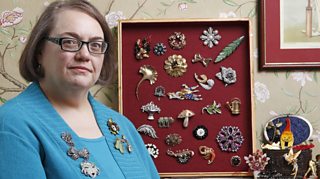
Writer and jewellery collector Joanna Sterling is using her unique hoard of 650 brooches to represent stations from Paddington to Peckham. She is then encouraging aspiring writers to pen a 300 word story, inspired by the ornament and the station name. Almost 80 of the stations have already had the brooch and story treatment on Joanna's website TubeFlash, with 12 more added from Tuesday 1 September. And to test how well you know your tube, we've put the dozen into a quiz - can you guess which brooch represents which station?
She came up with the idea after her friend went to a fancy dress party as Elephant & Castle, and Joanna immediately thought – “I could illustrate that with a brooch….I wonder how many others I could do?”.
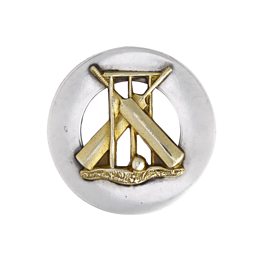
A cricket brooch obviously belongs at Oval, and a crown at Tower Bridge
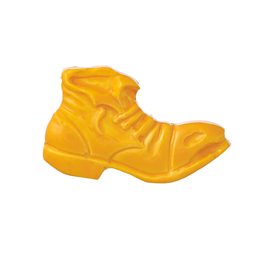
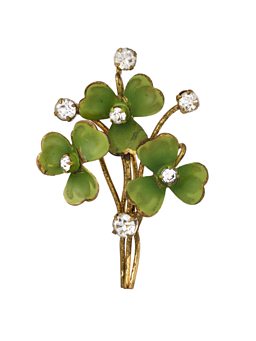
Joanna has worked hard to find connections between the Underground stations and her brooches. A cricket brooch obviously belongs at Oval, and a crown at Tower Bridge – but there’s also the shamrock connected with Kilburn, traditionally home of a large Irish community; or the boot for Lambeth North – from doing the Lambeth Walk, a song from the musical Me and My Girl.
Some stations are harder to represent than others: Joanna would still love to find a brooch with a judges’ gavel for Chancery Lane, and had to search high and low when a friend suggested they wanted to write a story about Temple, finally settling on a sword to represent the Knights Templar. And that’s not even to mention North, South, East, West and Central Acton.
Joanna’s brooches range from Victorian to modern, flea market to Christian Dior, and her collection is ever-growing, with one unifying requirement: that she would wear them. "I wear all my brooches and I’ll buy one because I like the design, the colour, or it just speaks to me," she said. "Some are favourites and I wear regularly: an Art Deco style silver cat, a black and white flower by the modern designer Sue Gregor, a silver Möbius knot by Vinianna Torun Bülow for Georg Jensen and an unusual large green Art Deco Bakelite brooch. Some I buy just to go with something special, I have a Danecraft knitting brooch, as a knitter I just couldn’t resist that one."
So far, TubeFlash has curated 78 flash fiction stories – by professional and amateur writers, others by people who’d never written fiction before. When it first started, Joanna and her team published one story per week. They would be read by an actor or voiceover artist and the recordings made available on the TubeFlash site.
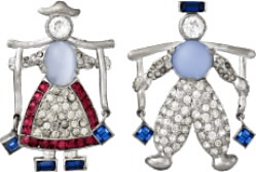
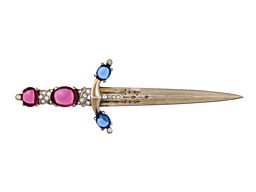
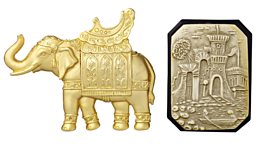
A dozen new stations are being added to the project from Tuesday 1 September with the challenge to anyone to write a 300-word story based on one of the 12 new brooches and stations and upload it onto the TubeFlash website.
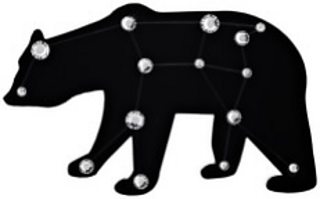
It’s about quite an intense moment and you focus on that – to make someone really understand the character or sceneJoanna Sterling
"You don’t have to live in London or even to have visited the station you want to write about – all you need is the inspiration and your imagination," Joanna said. The top stories will be published online and recorded as audio podcasts for iTunes, after submissions have closed on 31st October.
What is flash fiction?
Flash fiction is a type of writing featuring all of the classic storytelling elements: a plot, characters, a beginning, middle and end – but condensed into as few as 100 words. Joanna always writes her flash fictions out by hand first, before typing them up, and enjoys the challenge of capturing a single moment.
"It’s the need to hone it right down, get to the real essence of what you say. It’s about quite an intense moment and you focus on that – to make someone really understand the character or scene," she said.
The TubeFlash project is supported by TfL and TubeFlash is partnered with CityLit, another BBC Get Creative Champion.
Joanna's TubeFlash tips
Flash Fiction goes by a number of names – short fiction, concise fiction, micro fiction, micro narrative, postcard fiction, short short, sudden fiction, cut-off fiction and in China it is known as ‘smoke long’. Here are Joanna's helpful tips to writing the perfect flash fiction.
Time is short – with a restricted word limit do not waste them on unnecessary scene setting or complicated explanations. You really don’t have that luxury. You will be surprised what your reader can deduce from small descriptive details.
Work the title – in flash fiction you have a limited word count, so use your title wisely.
Cast of thousands – It is not advisable to clutter up your story with too many characters; you don’t have the word count to flesh them out and it will confuse your reader.
Break the rules – in flash fiction the story conventions of a beginning, middle and end can be broken. You have greater flexibility than you would perhaps have in a traditional short story in terms of language, structure and style.
Leave them wanting – leaving your reader with a sense of suspense, not knowing what might happen next or how the story ends is not a bad thing. Tying everything up tidily in a neat pretty bow is not always a good idea.