Will train travel save the planet?
Making a journey by rail can be up to 80% greener in terms of carbon emissions than travelling by car. There are exciting new innovations – like battery-run trains – hoping to make rail travel even more environmentally friendly.
But some argue that global warming can be partially pinned on the invention of the railway, for its role in the burning and transportation of fossil fuels.
200 years since the first passengers took to the rails, Rare Earth is putting trains on trial. Is train travel going to save the planet, or did it help to break it in the first place?

How climate friendly are trains today?
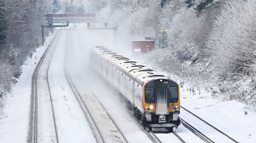
Trains are the most environmental surface transport mode.
“They only produce 1% of transport climate emissions,” states Silviya Barrett from Campaign for Better Transport. “The research that we have done shows that if one person is traveling in the average car, that produces five times as much carbon than if they were traveling on a train.” If the train is electrified, it's 10 times more carbon.
“We tend to underestimate just how important it is to get more people moving by train rather than car,” states journalist, author, and rail enthusiast Christian Wolmar. You might have 700 people on one train, replacing around 200 cars.
“Rail is a much easier way to reduce your carbon footprint than other common green behaviours,” argues Silviya. “If every driver in Great Britain switched just one journey a year from driving to train, you would save the same electricity as it takes to power streetlights in the UK for half a year.”
Did trains contribute to the climate crisis?
Environmentalists love trains now, but are they partly to blame for climate change?
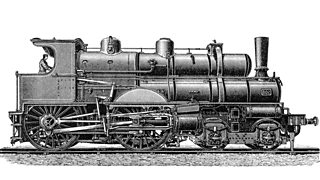
In the 19th century, the Stockton and Darlington Railway’s main function was to transport coal to a waterway, where it would then be transported to London via the North Sea. This helped England’s capital to become one of the biggest economies in the world, explains Rob Scargill, Curator of the Railway Futures Gallery at the National Railway Museum. We think of the early locomotives as “coal-guzzling steam machines,” he says, but they were also transporting the coal for industry.
“I think they are one of the root causes of the climate crisis,” he argues.
We need to see rail use grow if the UK is to meet its green targets
One recent report from the Rail Delivery Group says that we need a 40% growth in rail use by 2035 to achieve the UK's net zero targets.
“I think we've had a disaster in this country in terms of that,” says Christian. “We've got the HS2 project which was supposed to be the emblematic thing that would then have gone from London to Birmingham and to Manchester and also to Leeds.” Instead, we've spent vast sums of money on it, and don't know when it will be completed. “That would have been the engine of growth of the railway network. It would have attracted a lot more people.”
But there could be some good news.
“Great British Railways will be a new body created by the government to deliver and strategise the railways in the future,” explains Silviya. “It will unite train and track, so it will look after the infrastructure and the services as a whole, which in the past has been fragmented. Arguably, it will deliver much better clarity and consistency for services.”
“This is a big opportunity over the next few years to really transform the passenger offer… If we are to meet those net zero targets, we need to really grow passenger demand – and the potential is there.”
Train travel needs to be more affordable
Train travel also needs to offer better value for money. Often a flight is just a fraction of the price of a train ticket.
We need to see much more focus on affordability of travel, as well as the simplicity of the fare system.Journalist, author, and rail enthusiast Christian Wolmar
“Aviation is private and it's very much market-led,” Christian explains. “They're not subsidised overtly with money, but they are subsidised inherently by not paying a tax on fuel.”
“Some people are unable to afford train travel,” says Silviya. “We need to see much more focus on affordability of travel, as well as the simplicity of the fare system.”
Electrification is crucial
The first electric train came along in 1879, but as a nation we have been slow to adopt electrification. “The UK has only 38% of its lines electrified and that's very low in comparison with other places,” says Christian. Around 60% is currently running on diesel, still creating emissions.
“There's basically three things that the railways can do in response to the climate crisis,” explains Rob. One is get more people and goods onto the railways. The second is decarbonise and the third is build a climate resilient railway.
Railway traction (how trains are powered) accounts for the greatest proportion of emissions within rail. “What we need to do is electrify,” states Rob. When you can’t electrify, because it costs a lot and the passenger numbers may not justify it, then you've got to look at other solutions, like battery, solar or hydrogen power.
The railways are a host for biodiversity
The narrow spaces around our railways are home to vegetation and habitat for many protected species.
“We have an estate that's about one and a half times the size of the Isle of Wight,” explains Network Rail's Biodiversity Strategy Manager, Neil Strong. “We are green-corridor through the whole of Britain so we’ve got lots of biodiversity.”
“There's not a lot of space, but we join everything up. We go through every national park. We go through every local authority and every country.”
The undisturbed, linked green areas provide amazing opportunities for species that are struggling with the land use outside the fence. “We've got rare plant species,” says Neil. There are two of the 20-odd populations of a little flower called the Deptford pink.
In terms of animals, every protected species in Britain will use the railway, says Neil, including dormice and bats. It’s also home to foxes, badgers, otters, and deer.
“We have six million trees on our side of the fence and we've hardly planted any of those… We have been rewilding for the last 60, 70 years.”
Could battery-powered trains be the future?
In August, a Great Western Railway battery-powered train broke a world record by travelling 200 miles on a single charge.
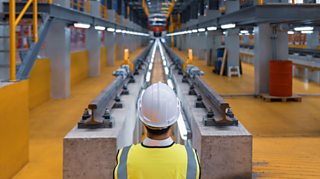
The company are currently trialling a battery-operated train on the branch line between Greenford and West Ealing. It is designed to charge in the station in just three to four minutes – the time it takes for the driver to get from one end to the other, and for passengers to alight.
“Little branches like this are perfect for battery with a short charging system,” explains Julian Fletcher, the Technology Development Manager for GWR. “For other lines elsewhere through the network you certainly could have a longer, faster route where you have bits of electrification and that’s the way the battery’s charged.”
Christian believes their role will be marginal: “You're not going to get a battery train that's to take you from London to Edinburgh in any sort of efficiency,” he argues.
Rob is more optimistic. “I think there's huge potential for it. I think where you can't electrify, you have to look at other solutions. So, if you've got a branch line that there's no way you'd electrify because the cost is too significant for the amount of passengers that are on there, why not use battery trains?”
What other rail innovations are we seeing?
“There’s loads of different developments that are going on in and across the railways and they're not just on the track,” says Rob. “There's a disused tube station that's now being used,” he says. “They're using waste heat from the London underground, caused by the breaking of the trains, to power nearly 1,500 homes in Islington.”
In South Wales they have built a depot with new trains that they call “tram trains”, explains Silviya. These are vehicles that can use both conventional heavy rail tracks and also continue on to light rail tram networks.
What will rail travel look like in 20 years’ time?
There's a big schedule of reform happening, says Silviya. “There's a new integration strategy coming between modes and that will make things really exciting because if we can integrate better between the trains and buses and active travel then people will be able to use cars much less.”
She wants to see better connectivity. “There needs to be more services, more frequency, to more communities.”
Rob agrees. “I would absolutely love it if we had something very similar to a hundred years ago, with the amount of lines that we had there. I would want them electrified and I would also want way cheaper fares. I want everyone to be able to access the railways.”
Christian would like to see an improvement in the passenger experience. There could be play areas for children, and it should be easy to travel with your bicycle. “Let's just think of the passenger, make it a kind of a railway that is friendlier, more accessible and hopefully cheaper.”
“I think that's the future.”
![]()
Rare Earth
Journalist Tom Heap and physicist Helen Czerski unpack a burning environmental issue each week.
![]()
Should we be afraid of the wolf?
The wolf has mounted an extraordinary comeback. But should we fear it or welcome it back?
![]()
Do you know the true cost of AI?
Nine eye-opening facts about how our tech affects the planet.
![]()
Can we protect cities from rising seas?
570 cities and 800 million people globally are at risk from sea level rise.