Heysel: The night that changed my life by Eamonn McCabe
7 October 2022
Photojournalist and broadcaster Eamonn McCabe has died aged 74. In 2017, the four-time sports photographer of the year returned to Heysel Stadium for Britain in Focus, a BBC Four series he was presenting. He wrote this BBC Arts feature, about the night in 1985 that changed his life. On a clear, sunny evening, fans of Liverpool and Juventus had gathered in Brussels for the European Cup Final. These are McCabe's personal recollections of Heysel, captured on film.
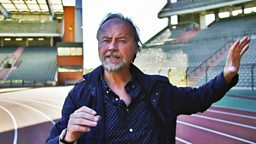
It was a beautiful, sunny evening and I was both nervous and excited. Although I'd had some success by that point, you never know how your next picture is going to turn out.
I want people to know that when I took these pictures I didn’t realise what was happening.
You’ve got to remember that in those days football wasn’t on television five nights a week, and Belgium seemed a lot further away than it does now. Football, and especially European football, was exotic. There was a glamour about it and I couldn’t wait to shoot Juventus in their famous black and white strips.
It was half an hour or so before kick-off. I gravitated towards the Juventus end and it was a photographer’s dream – banners, flags and fireworks. I was as happy as a sand-boy.
Then I noticed a wave of red travelling across the terracing from right to left. It was a group of Liverpool fans and they were charging at the Juventus fans. There was often trouble at games but it was usually overtaken by the football after kick-off. Unfortunately on this occasion it would lead to a catastrophe none of us saw coming.
Just as I arrived at the scene, the wall above me collapsed from the weight of the fans who were pushed up against it in their hundreds. All hell was breaking loose.
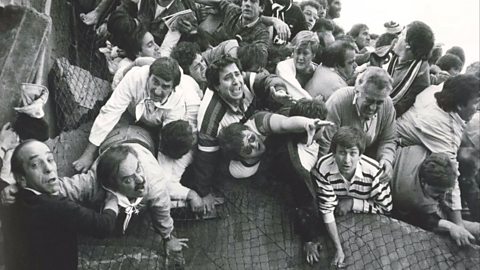
Witnesses to twentieth century history – The Heysel Stadium – May 1985
Presenter Eamonn McCabe and the horror he saw through the lens of his camera.
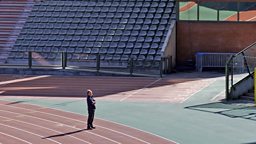
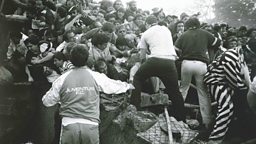
With me that day I had my usual camera and long lenses for shooting the game. I also carried a Nikon SureShot round my neck - a point-and-click camera - as it can be bedlam at the end of the match as all the photographers try to get a shot of the trophy being handed over. I instinctively picked up this camera and took a couple of pictures.
I ran over to see what was happening. The Juventus fans were trying to flee, scrambling up to the back of the stand in the hope of finding a way out. They were met with a sheer drop and had to turn around and come back down the terraces.
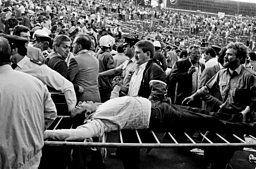
I want people to know that when I took these pictures I didn’t realise what was happening.
You know some photographers get labelled as ghouls for taking pictures of these sort of tragic events. You go into a different mode. You’re there for your paper, in a foreign country and there's this unfolding story. I thought, 'I better do this, this is important'. In that situation it’s point and click and stay out of the way.
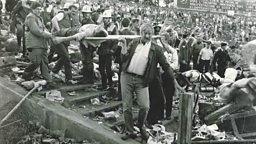
I continued to take pictures, some too harrowing for publication. Pictures of dead bodies on the pitch, ambulances. I’m not proud of it but at the time I thought, 'I’ll document this and someone else can make the decision of what to show'.
Luckily all of the fans in that picture made it, but 39 other people died that night and hundreds more were injured.
I stayed there until one in the morning, then I drove back to my hotel and slept. The next day I caught the ferry back and delivered the images to my picture editor.
That first picture I took, of the fans reaching out over the wall, was on the front of The Observer the following Sunday.
Luckily all of the fans in that picture made it, but 39 other people died that night and hundreds more were injured.
I won News Photographer of the Year for those pictures, an award I wish I’d never won. I walked into that stadium a sports photographer and I left a news photographer.
After that night I just thought, if this is sport you can have it.
It was tough returning to Heysel Stadium for the filming of Britain In Focus. They had rebuilt it but kept everything the same so I could immediately picture the ambulances, the bodies.
The last time I was standing there, 39 people were dying and now there were people acting like it never happened. It was hard to go back there but I am glad I did.
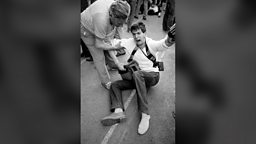

This article was originally published in March 2017 for Britain in Focus: A Photographic History, a three-part BBC Four series presented by McCabe.
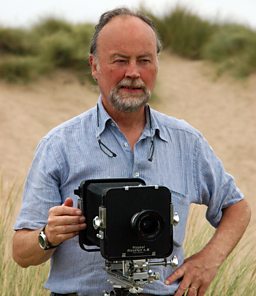
Eamonn McCabe was picture editor and former head of photography at The Guardian.
From 2001, McCabe moved into editorial portraiture for The Observer and The Guardian.
- View the photographs held inthe collection of the National Portrait Gallery, London, including portraits of Philip Pullman, Bridget Riley and Tony Blair.
More photography from BBC Arts
![]()
War and peace
The compassionate photography of Don McCullin.
![]()
Childhood in the 1970s
Tish Murtha’s tender photos of deprivation in Britain.
![]()
Neon dreamland
Liam Wong's sci-fi-style images of Tokyo at night.
![]()
Pup art
William Wegman's Polaroids of his loyal Weimaraners.
![]()
Stanley Kubrick
1940s New York through the lens of teenage Stanley Kubrick.
![]()
Jailhouse Rock
Behind-the-scenes photos of Johnny Cash's prison shows.
![]()
The real Sin City
Hard-boiled photographs tell the history of crime in LA.
![]()
10 years with Kate Bush
Rare photographs of the singer at the height of her career.
More from BBC Arts
![]()
Picasso’s ex-factor
Who are the six women who shaped his life and work?
![]()
Quiz: Picasso or pixel?
Can you separate the AI fakes from genuine paintings by Pablo Picasso?
![]()
Frida: Fiery, fierce and passionate
The extraordinary life of Mexican artist Frida Kahlo, in her own words
![]()
Proms 2023: The best bits
From Yuja Wang to Northern Soul, handpicked stand-out moments from this year's Proms