Smell of meat triggers my 'life-threatening' panics
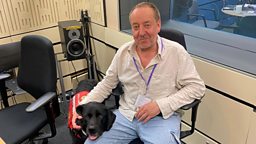
After army veteran Geoff Stear witnessed a traumatic incident in the Falklands, he developed extreme trauma reactions triggered by the smell of meat.
It led to numerous life-threatening situations - one time running across the M1, another time waking up in hospital with a broken neck and no idea who he was.
His life fell apart and he spiralled into homelessness, until a transformative bond with a medical alert dog named Charlie changed everything.
He told his story to Dr Sian Williams on Life Changing.

A life-changing smell
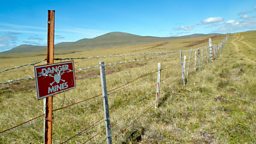
More than 40 years ago, British soldier Geoff Steer landed in the Falkland islands after the 1982 war.
Time stood still… it was very loud, and then this wall of air and other stuff hit meGeoff Stear
The fighting had ended, with the British recapturing the territory from Argentina - but the carnage was not over.
Geoff was just five metres away when his colleague stepped on a landmine, which exploded.
It was a horrifying experience, and although his friend remarkably survived, the moment stayed with Geoff long after.
“Time stood still… it was very loud, and then this wall of air and other stuff hit me” he says.
But worse than the visual impact was the smell.
A short while afterwards, when the army chef was cooking roasted lamb joints, the memories came flooding back.
They were indistinguishable for me... I was very shocked at the strength of the reactionGeoff Stear
“Instantly, my brain associated a joint of lamb with this unfortunate man's upper thigh," he recalls.
"They were indistinguishable for me and that was repulsive in that moment… I was very shocked at the strength of the reaction.
“I knew, instantly, instinctively, that I would now be vegetarian. There’s no way I could even think of eating an animal again. It was just so, so similar.”
“I remember looking around at the other guys and not seeing any reaction from them and thinking, ‘It’s just me that has this weakness’… and I saw it as a weakness very quickly.
"It hadn’t bothered anyone else, they were just getting on, they were laughing and joking.”
This event, compounded with the impact of witnessing two distressing road traffic accidents, left Geoff with complex post-traumatic stress syndrome (c-PTSD).
“A motorcycle overtook me in this torrential rain” Geoff recalls.
“And I watched as the motorcycle hit the white line in the middle of the road and slipped and went under a milk tanker… It became a memory that was embedded.”
Uncontrollable reactions

The smell of cooking meat would come to dominate Geoff’s life in the most terrifying way.
A guy got on [the bus] with a hot dog. Bang. I remember nothing else until I woke in hospitalGeoff Stear
He would relive the explosion “absolutely exactly” in a flashback, triggering a life-threatening panic reaction.
“I was on a bus, and a guy got on with a hot dog. Bang. I remember nothing else until I woke in hospital”, he says.
Geoff enters what psychologists call a “fugue state”, where he has no recollection of his actions.
He pieces together the timeline of events with statements from emergency service workers.
“I've run across the M1… I've swam across swollen rivers. I've broken my neck. I've dislocated my shoulder, been severely hypothermic...”
“I'll wake up usually in hospital not knowing who I am… there'll be a doctor asking me who's the current prime minister and I don't know and that's quite a scary place to be.”

It left him, understandably, afraid of going out.
I've run across the M1… I've swam across swollen rivers. I've broken my neckGeoff Stear
“My house was a safe place, my car was a safe place. Anything else was potentially a danger point.”
It is an extreme reaction, but an experience Dr Sian Williams, presenter of Life Changing and practising NHS psychologist, knows only too well.
“I work with emergency responders, and some of them have similar reactions to smells, because it’s the only sense which goes straight to the limbic system in our brain, which is all about emotion and memory,” she explains.
“It’s why smell can trigger such powerful feelings and reactions. And it does it so before our conscious brain has caught up with it.
"Smell can take us back to a traumatic memory instantly and our body reacts immediately to what it thinks is a new threat.”
“Determined to hide” his condition, Geoff felt a deep sense of shame, and became more and more reclusive.
“Slowly but surely, I found it more and more difficult to leave the house and I found myself making excuses to not go into the office.”
Life ‘fell apart’
But at home, things were not any better - as the married father-of-three’s relationship began to disintegrate.
My marriage fell apart… this thing was taking over my worldGeoff Stear
“My marriage fell apart because I was difficult to live with,” he says.
“I wasn't violent or nasty. I was just difficult. You know, this thing was taking over my world.”
“I was married at the time to a German lady, lovely lady… We had three children. She wouldn't entertain not serving meat at every meal.”
“I developed the ability to fib to get any excuse to get away from eating at the table.”
Geoff had to move out of the family home, and things began to spiral.
He “sofa-surfed” for a while before living in his company car – but when his employer asked for it back, he became “properly homeless”.
Rock-bottom

Things had hit rock-bottom for Geoff, so he decided to seek help from his GP.
I found myself still isolating in my room… I was not eating, I wasn't sleepingGeoff Stear
He was given some basic mental health tools such as mindfulness and grounding techniques and was signposted to organisation supporting veterans.
“I was allocated a room in a hostel, a hostel for military veterans with mental health problems,” Geoff says.
“But I still had the meat problem, and it was a shared kitchen. So I found myself still isolating in my room… I was not eating. I wasn't sleeping.”
Facing “an eternity of this”, Geoff decided one day that he could not cope any more.
His youngest daughter, who was living in China at the time, discovered that her father was in “a bad way” and flew immediately to the hostel to help.
A pivotal moment
On a trip into Milton Keynes together, to buy him some new clothes and some food, Geoff was anxious, but his daughter held his hand tight.
I remember thinking, this will go nowhere. My life, I'm not this lucky...Geoff Stear
It was at that moment that Geoff’s life changed forever.
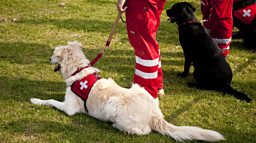
He spotted a woman walking a dog in a red coat, emblazoned with the writing, “Medical Alert Dog in Training’.
As a dog-lover, he was intrigued and decided to find out more.
The woman told him she worked for Medical Detection Dogs, training dogs to detect diseases such as cancer and Parkinson’s through scent.
But the charity’s other purpose piqued Geoff’s interest in particular – training assistance dogs to help people living with health issues.
“The dogs are trained to detect an odour, and the dogs will then alert their partner that there's an episode coming up, and it can give them enough time to take precautions,” he says.
It was then he had a brainwave – perhaps a detection dog could help him with his predicament.
“It was only when I was back in the hostel that I thought, ‘hang on, I have a potentially life-threatening condition’. There are only so many M1s you can run across and so many shoulders and necks you can break.
“So I applied online to medical detection dogs. And I remember thinking, this will go nowhere. My life, I'm not this lucky.”
But he was one of the lucky ones.
“On the 3rd of December, 2018, two trainers… walked up to my door and introduced me to the most beautiful black Labrador called Charlie.”
The paw-fect partner
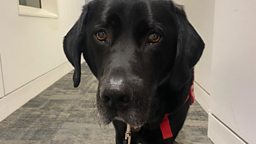
They had trained Charlie to respond to the scent created when Geoff was in fear, but the trainers would only know if it worked by trying it out for real.
Charlie's average response is three secondsGeoff Stear
“Charlie was trained to have three alert levels. The first one, he'll just back off and absolutely fixate, and he might vocalise a little bit.
“The second level, he'll make contact. And the third level, he'll jump and head-butt me, basically.”
Travelling to the nearby town of Aylesbury, within five minutes, Geoff was triggered.
“It went straight to the head-butt,” he says, “before I even knew I was triggered.”
It was the perfect match – with Charlie’s extraordinary skills working exactly as planned.
“It's extraordinary. We've worked out that I have about a 15 second window between the trigger and it being kind of the point of no return.
“Charlie's average response is three seconds… So plenty of time to sort myself out.”
It gives him time to take action and interrupt the panic escalation.
“I carry with me aromatherapy oils wherever I go… I put a dab of that on my top lip. All I can smell is that now and that takes away the problem."
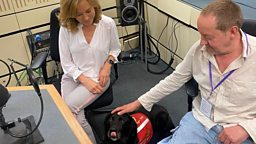
Claire Guest, CEO of the charity Medical Detection Dogs, explains how they trained Charlie to pick up Geoff’s scent.
“Charlie was initially trained to recognise physical changes in Geoff, which have been paired with odour changes,” she says.
“These odour changes are due to the rise in cortisol and adrenaline that occur when an attack is imminent.”
She says Charlie can even detect if Geoff is in need of help from another room, or if he and Geoff “are some distance apart”.
No longer 'ashamed'
There has also been a surprising additional benefit to Charlie’s work, too.
I don't hide the condition any more, I don't need to... Charlie breaks down barriersGeoff Stear
“Before Charlie, I was probably admitted into hospital, into A&E at least twice a month, costing the NHS bucket loads of money.
“Seven years down the line… Not a single admission, not one. And we've calculated that he's probably saved the NHS £100,000.”
Sadly, Charlie’s health is failing and the future looks uncertain. But for now, he is “happy” and “bouncy”, and Geoff is determined to give him a life full of love.
The special bond with his faithful four-legged friend has given him back his “sense of self”, and he is forever grateful.
“I don’t hide the condition any more, I don’t need to… and actually Charlie breaks down barriers. People see him for what he is with his red coat on, and they know he is doing an important job.”
“I don’t have to be ashamed anymore.”

![]()
'I was reunited with my long-lost love, after 50 years apart' '
Carol Cairns shares her journey, rediscovering a lost love in her 70s.
![]()
My brain injury nearly killed me, but it won’t stop me sailing
When yachtsman Robin was violently attacked, a life-or-death decision had to be made.
![]()
Life Changing: I saved 30 people from a sinking ship – but I can’t swim
Lorry driver Larry O’Brien explains how he saved over 30 people from a sinking ferry.
![]()
Life Changing: I was shot in the face and blinded - but stayed positive
Ed Stewart went blind after being shot, but a new - albeit risky operation - offered hope.