Object of the Week
Each week we'll introduce you to one of the many intriguing objects found in the museums we visit...
Week 7: Dr. Janina Ramirez
"When is naked nude?"

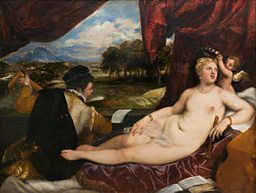
Titian’s ‘Venus Crowned by Cupid with a Lyre Player’ is a celebrated artwork and a jewel in the crown of the Fitzwilliam’s holdings. Titian paintings go for silly money. Just two years ago his ‘Diana and Castillo’ was saved for the nation with a payment of £45 million to its owner, the Duke of Sutherland. The artist is supremely talented, and in this example his treatment of both the landscape in the distance, and figures in the foreground, display his skills as an oil painter. The tonal variety of the pallid skin of the reclining female figure captures the reality of naked flesh. So why does this painting leave me cold?
Had I been born at the time this painting was produced it is highly unlikely I would have seen it, let alone been allowed to make any value judgement on it. This painting was for male eyes only, and wealthy male eyes at that. All manner of allegorical interpretations have been proposed to make sense of this painting and the four companion pieces Titian created, each of which showed Venus with a musician. The series shows the senses of sight, hearing and touch. It’s an allegory of love. But Titian himself refers to this painting simply as ‘a female nude’.
The popular motto of Renaissance Italy, derived from Virgil was “love conquers all”. This truism acted as an excuse for the proliferation of naked female images that were hidden away in the corners of stately homes throughout Italy. They represented noble love, not lust. Yet the men who gazed on them weren’t necessarily concerned with the ideals of courtly love, or the classical symbolism of Venus engaged in her strangely perverse relationship with her infant son. They wanted to look upon a woman’s body for their own titillation and arousal.
It seems the men who owned these paintings were also aware they weren’t the most noble and upright images. Nude women were painted on bedroom furniture, and even concealed behind a painted cover, like that known quaintly as ‘love conquers all’, showing Cupid and a lion from the Ashmolean’s collection. They hid these paintings away for the delight of their owners and their close male friends. They were intended to be gazed on behind closed doors. This was pornography for the wealthiest of Italy’s elite.
Then we come to the question of whether the women in these paintings are naked or nude. To become naked means to take off ones clothes. It is to lay bear flesh that is usually covered and concealed. The word nude presumes something different. A female nude is usually disguised as a goddess – Venus or Aphrodite or Diana. This is despite the fact that many of the women depicted were well known ladies of the court, and instantly recognisable. But their nudity is shown as something eternal. To be without clothes was their proper condition, their eternal state. Their flesh is a thing of divine beauty and no clothing is necessary.
Feminists have reacted against such statements. Most famously ‘The Rokeby Venus’ by Velasquez was attacked by the suffragette Mary Richardson in 1914, because she didn’t like the way ‘men visitors gaped at it all day’. She was treated as a murderer, renamed ‘Slasher Mary’ and sentenced to six months in prison. I can see why Mary reacted as she did. I’m an art historian and would never contemplate damaging an artwork. This Titian is a masterpiece and a beautiful image, which represents the ideals and culture of the time in which it was created. But there is something derogatory and undermining about the thousands of female nudes displayed in galleries throughout the nation. When you next gaze on one of these celebrated paintings ask yourself, ‘Is she naked or nude’, and then ‘what am I doing by gazing on her’?