Find the Apollo landing sites
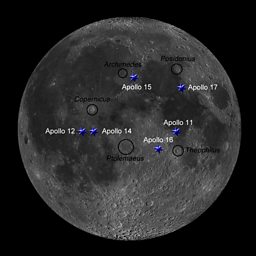
Between July 1969 and December 1972, six Apollo missions successfully touched down on the lunar surface. Although the mission remnants cannot be seen from Earth, this short guide – scroll down – tells you how you can locate the landing site areas.
- Don’t have a telescope? Have a go online with this zoomable Moon map!
- See even closer images of the landing sites by NASA's Lunar Reconnaissance Orbiter
Apollo 11 – Landed 20 July 1969
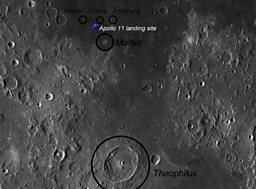
The first mission to land mankind on the Moon was Apollo 11, touching down in the Sea of Tranquility.
- Look for the largest nearby crater, Theophilus.
- Following almost directly north will lead you to the smaller but distinct crater, Moltke.
- The landing site is situated just north-west of the crater.
- For bonus points see if you can locate the three small craters, Armstrong, Collins, and Aldrin, named after the Apollo 11 astronauts.
- The two moonwalkers were Neil Armstrong and Buzz Aldrin, with Michael Collins in lunar orbit.
Apollo 12 – Landed 19 November 1969
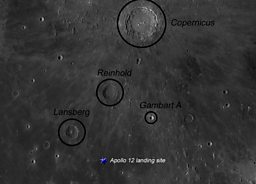
The second mission landed in the Ocean of Storms, within walking distance of the Surveyor 3 probe.
- Locate the large crater Copernicus.
- Look south-west to the deep ringed craters Reinhold and Lansberg.
- The Apollo 12 landing site forms a rectangle with these two craters and Gambart A.
- The two moonwalkers were Pete Conrad and Alan Bean, with Dick Gordon in lunar orbit.
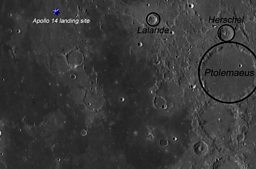
Apollo 14 – Landed 5 February 1971
After the failure of Apollo 13, all eyes were on the Apollo 14 mission, which touched down in the Fra Mauro formation.
- Look for the large crater Ptolemaeus and locate the Herschel crater just above it.
- Travelling west by north-west should lead you to the crater, Lalande.
- Drawing a straight line from the centre of Herschel crater through the south edge of Lalande crater and travel 1.5 times the distance again to reach the Apollo 14 landing site.
- The two moonwalkers were Al Shepard and Ed Mitchell, with Stu Roosa in lunar orbit.
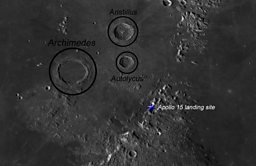
Apollo 15 – Landed 30 July 1971
Apollo 15 landed alongside Hadley Rille and was the first mission to utilise the lunar rover.
- Find the crater Archimedes.
- Draw a line from the middle of Archimedes south-east perpendicular to the bright Apennine Mountains.
- Jump north-east to the next alcove in the mountain range to find the Apollo 15 landing site.
- If you are able to resolve Hadley Rille (the sinuous feature) you can follow it north to where it sharply bends west to find the spot more precisely.
- The two moonwalkers were Dave Scott and Jim Irwin, with Al Worden in lunar orbit.
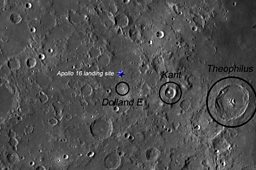
Apollo 16 – Landed 21 April 1972
Apollo 16 was the first mission to land in the lunar highlands, in the Cayley Formation.
- Begin by locating the crater, Theophilus (the same crater to find Apollo 11).
- Look west to the next large crater, Kant, and travel across the same distance again to find the small crater Dolland E.
- Looking directly north a small distance from Dolland E will lead you to the Apollo 16 landing site.
- The two moonwalkers were John Young and Charlie Duke, with Ken Mattingly in lunar orbit.
Apollo 17 – Landed 11 December 1972
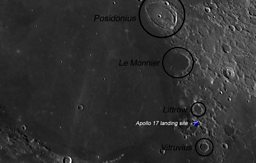
The final Apollo mission, number 17, landed in the Taurus-Littrow Valley.
- Find the oblong crater, Posidonius.
- Travel south by south-east to find Le Monnier, Littrow and then Vitruvius crater.
- Apollo 17 landed in the dark valley between Littrow and Vitruvius.
- The two moonwalkers were Gene Cernan and Harrison Schmitt, with Ron Evans in lunar orbit.