Object of the Week
Each week we'll introduce you to one of the many intriguing objects found in the museums we visit...
Week 6: Dr. Janina Ramirez
"It's a thumbs-up from Chcôca!"
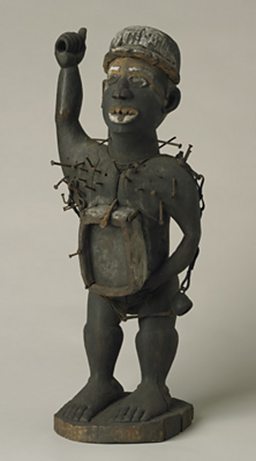
This seemingly friendly looking figure, hand raised with a thumbs-up, is known as Chcôca. He sits alongside a number of Minkisi sculptures in Liverpool World Museum. Some of his companions are not so appealing, with glass in-set eyes and alarming expressions. And when you look closely at Chcôca he is also bedecked with a series of pins that pierce his wooden torso. The raised hand is missing something – he would have been holding a weapon, probably a spear, and he is one of the violent Nkondi or hunter type of Nkisi.
These sculptures were at the heart of spiritual life in the Kongo, where they performed an important role communicating with the dead. But not just anyone could contact the dead. The role of intercessor was often taken by a chief, or by a group known in the Kongo as the baganga. Baganga were, and still are, healers and diviners who defend their community against evil in its various forms. This includes witchcraft and disease.
The powerful minkisi sculptures are containers for the spiritual force of the dead. Often ‘relics’ from graves would be sealed into a central boss within the wooden carving, and would be accompanied with varieties of medicines and herbs to enhance the potency of the object. This could include mpemba, a white porcelain clay found in riverbeds, which was associated with the land of the dead, kala zima (charcoal) to extinguish witchcraft, and mpezomo (copal resin) to flash like lightning and blind witches.
Chcôca has a mirrored boss containing the bilongo, or magical preparations, and another on a chain around his neck. His pack has been examined because it came loose, and inside was found a mix of traditional herbs and compounds, but also a small snake, a kestrel’s egg, and pieces of animal fur. Every time a nail was hammered into the bilongo pack by one of the baganga it would activate the power of the sculpture and make a direct line of communication with the dead, allowing the healer to request support during times of trouble.
Kavuna Simon, an early twentieth-century evangelist in the Lower Congo, describes the power of minkisi:
“These are the properties of minkisi, to cause sickness in a man and also to remove it. To destroy, to kill, to benefit… The way of every nkisi is this: when you have composed it, observe its rules lest it be annoyed and punish you. It knows no mercy."
So when you look on the sculptures in the Liverpool World Museum collection, you’d better beware. Trapped behind that glass, and probably quite annoyed by now, lies otherworldly power.