Find out more
Mrs Florence Hunt
When Florence’s husband Rowland died in 1878, she was just 42, with 10 children, aged between of 20 and 4 years old. The Boreatton estate was inherited by the oldest son, so Florence no longer enjoyed access to the Hunt wealth. Six years on, Florence decided to up sticks and leave Shropshire. Believing a fortune could be made in Queensland by breeding Angora goats, Florence set sail for Australia with seven of her children. She arrived in Brisbane, intent on the purchase of a desert island. But on arrival, no desert island was for sale. And there were no angora goats in Brisbane. Florence revised her plans and purchased a 50-acre paddock to rear chickens. The stock was not good; many of the chickens were born with deformities. But Florence was undaunted and decided to amputate and replace the limbs with peg legs made of matches. It became the duty of Florence’s youngest daughter, 16-year old Agnes, to administer the anesthetic. This would be the start of a lifelong mission to heal the sick.
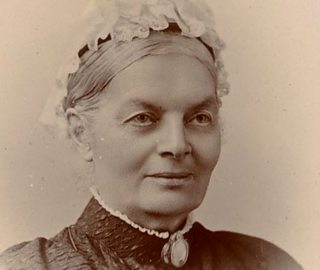
After two years, Florence decided that the Australian continent had failed to live up to expectations, so she decided to return to England in 1886. Instead of returning to the family estate she headed for London and took up rooms in a boarding house in Kensington. Her children described it as ‘a somewhat slummy district’ and nicknamed it ‘Burglar’s Alley’. This is when Florence became involved with the Charity Organisation Society – or the C.O.S.
By 1900 Florence had decided she was too old and too deaf to continue her work in London. Instead she instructed her daughter, Agnes, to rent premises in Baschurch where together they could establish a convalescent home for the Salop Infirmary. In Baschurch, at the foot of the Boreatton estate, they set up what is now generally known as the world’s first open-air orthopaedic hospital. Here, Agnes, a trained nurse, led the way in orthopaedic medicine, stressing the importance of good food, fresh air, and early forms of physiotherapy (medical massage). This is where Florence ended her days – in October 1917 she passed away at the Hospital in Baschurch, aged 81.
Lavinia Manley
In 1887, deserted by husband John, Lavinia was in a terrible situation. The Charity Organisation Society closed the Manley case – though subsequently they did go on to try to help the children. Lavinia and Florence also went to the Society for the Protection of Women and Children to see if they might help, to no avail.
By March 1888, Lavinia decided that her only option was to enter the Fulham Union workhouse with her 4 younger children – they stayed there for around six weeks before the law obliged John to take responsibility for them.
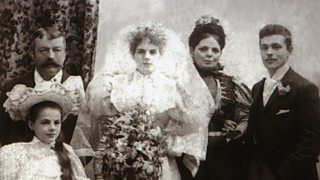
Lavinia lived out the rest of her life being supported by her children. One family photo shows her at her daughter Edith’s wedding to Jonah Starkey, in 1896. Lavinia’s son John Manley Jnr is also there for Edith’s big day. We know that in 1911 Lavinia was still living in Conningham Road, West London, with her youngest son Arthur. Lavinia died on Boxing Day, 1917, aged 71. We know that her children Edith and John were with her during her last days.
John Manley
John Manley, born into an educated family, had slipped down the social ladder when he married Lavinia. The relationship did not run smoothly. During the proceedings that led to their judicial separation, John alleged that Lavinia behaved badly and was not a responsible mother but the court found in favour of Lavinia and her allegations that John had used violence against her. After they were reconciled, illness meant John’s work in insurance dried up, and soon the family were in dire financial trouble.
John deserted Lavinia in 1887, not long after the Charity Organisation Society became involved in the family’s predicament. Destitute Lavinia went in to the workhouse and because she was relying on the parish for assistance, this meant that the police issued a warrant for John Manley’s arrest – as a husband was supposed to support his wife and children. The police apprehended John in Tunbridge Wells and he was brought before the magistrate. Lavinia and their four youngest children came out of the workhouse, John was reprimanded and allowed to go away his wife and children.
Things did not go well afterwards, and by 1890 John appears to have relocated to Leeds to have a second family there with a much younger woman, called Jessie. Eventually, by 1908, John had returned to London. He died in Camden from a heart condition, attended by his brother.

