Missing masterpieces: Great paintings we may never see again
15 March 2017
Paintings by the likes of Van Gogh, Klimt, and Raphael were just some of the artworks stolen or destroyed in World War Two. One such painting is The Tower of Blue Horses by Franz Marc. WILLIAM COOK visits a new show dedicated to this missing work and recalls other great paintings whose loss is still mourned.
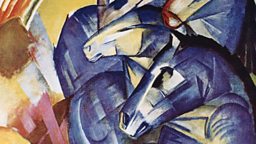
Eighty years ago, here in Munich, one of Germany’s most famous paintings disappeared, and now Munich’s leading modern art museum is mounting an exhibition in its honour.
Franz Marc’s The Tower of Blue Horses was the iconic artwork of German Expressionism. Its disappearance, in 1937, is still mourned throughout the art world. Through old photos, preliminary sketches and new interpretations by contemporary artists, the Pinakothek der Moderne has brought this lost masterpiece back to life.
Franz Marc’s The Tower of Blue Horses was the iconic artwork of German Expressionism
Franz Marc was the leading player in Der Blaue Reiter (The Blue Rider), a dynamic group of painters, including Paul Klee and Wassily Kandinsky, who pioneered Expressionism and Abstraction in Munich during the decade before the First World War.
When Germany went to war in 1914, Marc joined up. He was killed at the Battle of Verdun in 1916. During the 1920s, his progressive paintings were championed by liberals and intellectuals, and when Hitler came to power, he was one of the modern artists whom the Nazis denounced as ‘degenerate.’ Marc’s pictures were removed from German galleries, and his Tower of Blue Horses was included in the notorious ‘Degenerate Art’ show in Munich, a Nazi exhibition designed to denigrate avant-garde art.
The inclusion of Marc’s masterpiece in this derogatory showcase prompted protests from veterans of the First World War. Marc had given his life for the Fatherland, they said. To mock him in this way was disrespectful. The Nazis didn't mind upsetting artists, but they didn't like offending old soldiers. The picture was removed.
Ironically if these veterans hadn't protested, The Tower of Blue Horses would probably still be on show today. Most of the artworks in the Degenerate Art exhibition were eventually sold to foreign collectors, and many of them ended up in public museums abroad.
Countless artworks were destroyed during the war, but it seems Marc’s masterpiece survived
Though the Nazis removed The Tower of Blue Horses from the Degenerate Art Show, they didn't return it to the National Gallery in Berlin, from whom they’d taken it, and during the chaos of the Second World War it vanished. So where is it today?
The curators I spoke to believe The Tower of Blue Horses is still out there – somewhere. Countless artworks were destroyed during the war, but it seems Marc’s masterpiece survived. There were several sightings after the war, first in the ruins of Hermann Goering’s Aviation Ministry, and then in the Haus am Waldsee on the outskirts of Berlin (this mansion, now an art gallery, is staging a parallel exhibition about Marc’s painting).
After that, who knows? But it’s unlikely it was destroyed. And hopes that it might reappear one day have been boosted by the extraordinary case of Cornelius Gurlitt. Gurlitt’s father, Hildebrand Gurlitt, was an art dealer who worked closely with the Nazis. In 2012, German police broke into Cornelius’s home in Munich, and found a secret stash of over a thousand artworks, many of which has father had acquired during the Third Reich, including paintings by ‘degenerate’ artists like Franz Marc.
If Marc’s Horses In A Landscape can remain hidden in a Munich apartment for half a century, then couldn't his Tower of Blue Horses be just as close at hand?
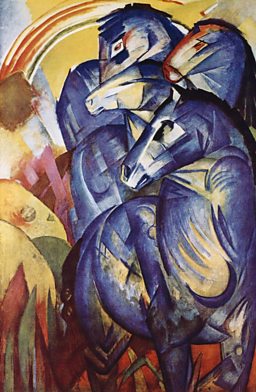
Missing – The Tower of the Blue Horses is at the Pinakothek der Moderne in Munich and at the Haus am Waldsee in Berlin until 5 June 2017.
Lost: Van Gogh's self-portrait
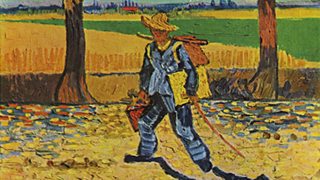
Van Gogh’s atmospheric self-portrait, also known as Painter on His Way To Work, was stored in the Kaiser Friedrich Museum (now called the Kulturhistorisches Museum) in the German town of Magdeburg where it is believed to have been incinerated in an Allied air raid. Francis Bacon painted a version of the picture, which is now owned by the Tate.
Lost: Raphael's Young Man
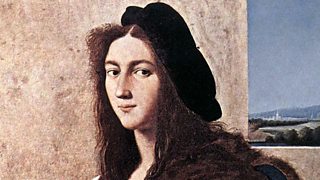
Seized by the Gestapo during the German occupation of Poland, Raphael’s masterpiece was last seen in Wawel Castle in Krakow. The Nazi governor of Poland, Hans Frank, took this painting with him when he fled to Silesia, ahead of the Red Army, but when he was arrested by the Americans in 1945, it was nowhere to be found. Frank was executed in 1946, and it seems the secret of its whereabouts died with him.
Lost: Klimt's Vienna murals
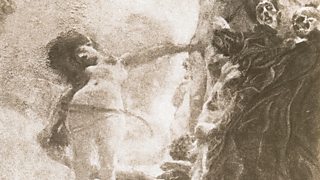
Commissioned by the University of Vienna, these dreamlike murals called Philosophy, Medicine, and Jurisprudence were condemned as pornographic and perverted, and rejected by the university. They ended up in Schloss Immendorf in Austria, where they were destroyed in 1945, when retreating SS soldiers set fire to the Schloss, to prevent it falling into the hands of the advancing Red Army.
Lost: Kandinsky's composition
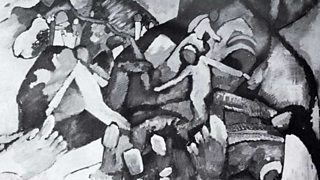
Kandinsky’s groundbreaking abstract painting, completed in 1910, was owned by the German modernist art collector Otto Ralf, who lived in the German town of Braunschweig. In October 1944 an Allied bombing raid created a ferocious firestorm which destroyed 90% of the medieval Altstadt, including Ralf’s home and his art collection.
More from BBC Arts
![]()
Picasso’s ex-factor
Who are the six women who shaped his life and work?
![]()
Quiz: Picasso or pixel?
Can you separate the AI fakes from genuine paintings by Pablo Picasso?
![]()
Frida: Fiery, fierce and passionate
The extraordinary life of Mexican artist Frida Kahlo, in her own words
![]()
Proms 2023: The best bits
From Yuja Wang to Northern Soul, handpicked stand-out moments from this year's Proms