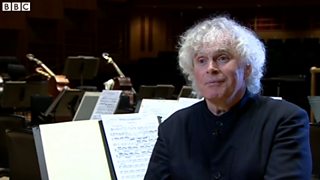
'A conductor at the very peak of his powers': Nicholas Kenyon on Simon Rattle
9 February 2015
The BBC is marking the 60th birthday of Sir Simon Rattle with a host of special programming. BBC Two will present the first television biography of the conductor for 15 years, while BBC Radio 3 and BBC Four are broadcasting Rattle and the Berlin Philharmonic performing all seven Sibelius symphonies at London's Barbican. BBC Arts has curated a selection of archive performances and interviews, andwe also have 12 exclusive short films featuring Rattle's thoughts on his favourite composers. Here, Barbican chief and Rattle biographer SIR NICHOLAS KENYON tells the story of Britain's leading conductor.
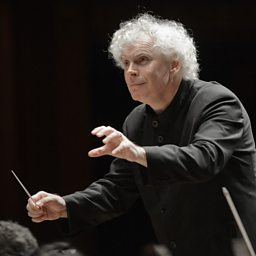
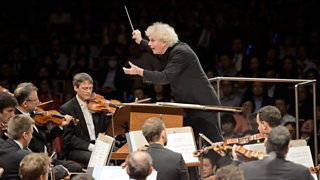
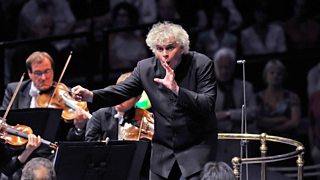
What does a conductor actually do? It’s a fair question when you see a hundred musicians on stage bowing their violins and cellos, breathing into their clarinets and oboes, and hitting their drums with total commitment, while the only person not making a sound is the conductor.
Usually, though fortunately less so than it used to be, it is a man, and certainly he is getting paid more than the players.
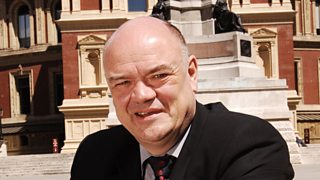
When the conductor steps on the podium at a concert, you are seeing only the tip of a vast iceberg of activity
Yet however much we might want to do without the conductor, this is who is the motivating force of the occasion, giving the character, the shape and the momentum to the performance.
They are the mediating force between the orchestra and the audience. In the end, they make all the difference to whether a performance flies or sinks.
Yet a lot of this is invisible. When the conductor steps on the podium at a concert, you are seeing only the tip of a vast iceberg of activity which involves planning, preparing, rehearsing, managing diaries and schedules, and above all endless background work to understand the music.
Those are just a few of the things that make Simon Rattle one of the world’s great conductors.
He is a meticulous planner, has a fantastic instinct for the right combination of pieces in a programme, and is a brilliant pacer and galvanizer of rehearsals, knowing exactly what he has to achieve and motivating his players accordingly.
And he is clear-sighted and unruffled, even when things go less than perfectly: he just makes sure they improve.
Simon Rattle has wanted to conduct since he was small, and started at home in Liverpool under the influence of his elder sister Susan who brought scores home from the local library.
Quite early he was studying Berlioz’s Treatise on Orchestration. He would write out the percussion parts of big orchestral pieces and distribute them to family and friends, put on the record, and conduct.
At school he was a good pianist and not so good a violinist. From 11 (even though the entry age was 15) he played percussion in the Merseyside Youth Orchestra.
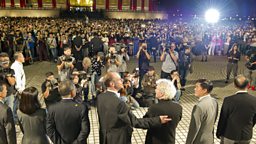
When Rattle left the City of Birmingham Symphony Orchestra after 18 years that had established it in the rank of top orchestras, the manager recorded that Rattle had conducted 934 concerts with them, and estimated that they had rehearsed for 10,000 hours.
A conductor cannot hone his skills in isolation: he needs orchestras to practice with
That is a remarkable figure, because it exactly matches the time it is supposed to take for a solo virtuoso to hone their skills: according to the writer Malcolm Gladwell it can equally apply to sportsmen and women or computer boffins.
A conductor, however, cannot hone his skills in isolation: he needs orchestras to practice with. Hence Simon Rattle’s huge motivation for assembling his own orchestras from the age of 15 onwards, cajoling his friends and professional colleagues in his native Liverpool to play for him. He needed to learn.
I well remember standing in a queue for a Covent Garden Prom way back in 1973 with a friend who was a cellist at the Royal Academy: suddenly a small whirlwind bore down on us and she was being persuaded, cajoled and bullied in the nicest possible way to play in his next Mahler symphony at the Academy.
That was Rattle, and it was his performing Mahler’s Second Symphony there, as he will at Southbank Centre this February, that attracted attention. Add to that the success of winning a conducting competition in Bournemouth, and everyone in the musical world would soon know of Simon Rattle.
He was immediately offered engagements that he was wise enough to decline: he knew when asked to step in for an absent conductor with a London orchestra that he wouldn’t be ready (and imagined he would have ended up as a bitter old percussionist somewhere).
He moved carefully, learning in Bournemouth, which was quite hard, and with the BBC Scottish, which was better, before landing the job with Birmingham at the age of only 25 in 1980.
His commitment to Birmingham, which involved the building of a new concert hall, remained constant, even when Berlin and Vienna and so many other glamorous orchestras beckoned. He knew that he was still learning.
It was not until 1998 that he was ready to make a move, and in 1999 Berlin sensationally elected him as their conductor in succession to Claudio Abbado from 2002, the first British conductor ever to be chosen.
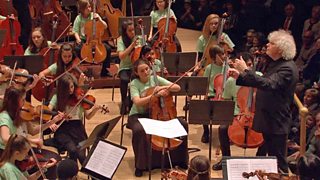
So when Rattle returns to London for The London Residency with the Berliner Philharmoniker – in which he will also conduct an especially assembled orchestra of 100 young people from all 33 London boroughs - he is a conductor at the very peak of his powers who has worked with one of the world’s greatest orchestras for the last decade.
When we see him on TV on 15 February, conducting Sibelius symphonies from the Barbican, it may look easy, but it isn't: it is the fruit of passionate commitment and intense labour over many years; it is art concealing art.
Nicholas Kenyon is the Managing Director of the Barbican Centre and the author of two books about Simon Rattle. Sir Simon Rattle and Berliner Philharmoniker's The London Residency 2015 is from 10–15 February at the Barbican and Southbank Centre.
From the archive
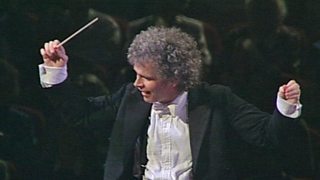
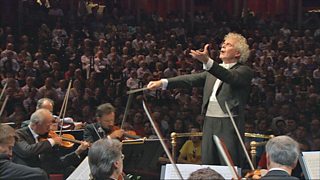
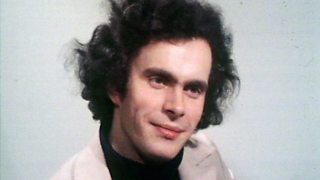
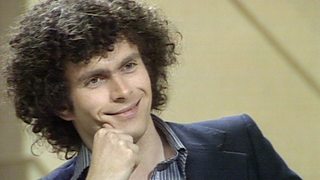
More from BBC Arts
![]()
Simon Rattle and the Young Orchestra for London
A special rehearsal and performance at the Barbican
![]()
Simon Rattle: My 12 favourite composers
The conductor discusses his favourite music in a series of exclusive short films
Listen on BBC Playlister
![]()
The Making of a Maestro
A selection of pieces by 12 composers who inspired Simon Rattle

Simon Rattle across the BBC
![]()
BBC Radio 3: Celebrating Simon Rattle
Simon Rattle's Live in Concert series plus clips, links and more
![]()
BBC Two: The Making of a Maestro
Watch the major new documentary on BBC iPlayer until 17 March 2015
![]()
BBC Four: London 2015
Watch the complete Sibelius cycle from the Barbican on BBC iPlayer until 17 March 2015
On BBC News
![]()
Rattle considers UK move
But conductor says Britain's concert halls are not up to international standards