Kula Ring Blog
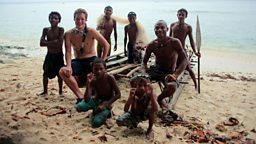
Fiendishly complex and wonderfully remote, the Kula Ring takes in a loose circle of islands spread across Milne Bay, a large patch of the Solomon Sea located right off the southeastern tip of Papua New Guinea. In its simplest sense Kula is an ocean-based trading network involving ancient shell valuables: ‘mwali,’ bands of shells to fit around the arms, which travel anti-clockwise around the island ring, and ‘soulava,’ a shell necklace, which travel in the opposite direction, clockwise around the ring. Each individual shell trader has a respective kula trading partner on their nearest neighbouring island in either direction, acting ultimately as one link in a chain of trade that encompasses the five main Milne Bay districts and dozens of islands stretching across this corner of the Solomon Sea.
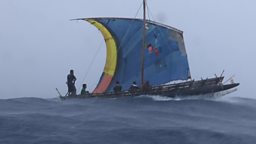
For the people of the Ring, the Kula exchange binds their culture through debts of obligation that to-and-fro between historic Kula partners: a highly ritualised two-way riposte of gifts and counter-gifts that can last for hundreds of years. There are nine grades of mwali and soulava ranging from the most ordinary: the ‘kitom’, which is basically a freebie to signal the beginning of a new partnership; to the legendary: the ‘bagi’, which is the most sought after grade with a long history of exchange between the most powerful men in Kula. You don’t just choose which piece you want and get given it though; you have to prove you are worthy. The expeditions themselves involve long and dangerous wind-powered journeys between neighbouring islands: half the challenge of an exchange being in just getting there and back alive, but if you do make it then legendary feasts and dance performances await.
We had heard the great Kula expeditions of yore were in a state of terminal decline. Some islands in the Ring were sat on a goldmine, with the residents having their heads turned by a system of wealth acquisition of far greater short-term value than an antiquated shell, while other islands were simply falling victim to their isolation: over-population, a lack of access to fresh water, the pull of jobs and a greater quality of life on the mainland, all provided a strong incentive for residents to move away from an outmoded and increasingly undervalued past.
I wondered whether the Kula Ring was still relevant today? Whether you could still climb the ladder of power through shell acquisition? Whether those key ‘bagi’ pieces were tucked away in the back of someone’s hut or just gathering dust under some label in a far-flung museum somewhere? We resolved to find out, but two weeks into our project and we had drawn a complete blank. It became clear on the Trobriands that the islands had moved on without Kula. Our local guide, Edric, had spent the previous decade in the capital working for Coca-Cola and my host, Uncle Nagya, an earnest man with blackened teeth and blacker hands (he was a superb gardener and dedicated chewer of the mild hallucinogen ‘betel’ nut) had not taken part in a Kula exchange for some twenty-five years.
Little did we realise that our ultimate salvation would come with the arrival of a shiny ferry, and the two thousand cash-rich tourists holidaying within its bowels.

16th September
A sharp blast of a conch at mid-day tears everyone’s eyes momentarily to the horizon. Dwarfed by the bulk of the brilliant white cruise liner half a dozen fully manned Kula canoes appear around the headland. The word ‘canoe’ is totally inappropriate, these Kula canoes are absolute giants, each capable of carrying up to twenty men, skirted by hundreds of white cowrie shells and ornately carved with marine scenes and symbols that reflect the high status of the men onboard. They had been paid by the tourist company to make an appearance, and had travelled from Kitava Island, the Trobriand Islands Kula partner neighbour and the closest place with any functional Kula canoes. It was a fact that these Kitavan men were only too willing to exploit: they were about to make a reasonable bit of income from the tourists and massively get one over on their supposedly feckless neighbours, who were more interested in painting wood carvings than making a major cultural statement of intent.
As they pulled into the shoreline the tourists hosed them down with their cameras. One of the lead men already had his shirt off. With his pectoral muscles glistening like a pair of over-baked Danish pastries, he stuck his nose in the air in mock defiance and leapt into the waves, giant conch still in hand. Part of me wondered where the flamboyance of an authentic Kula arrival began and the show for the tourists ended, mostly though, I didn’t care: This was theatre at its very finest and the Trobriand islanders were clearly green with envy.
Unbeknown to me our own Kula expedition was just dipping its toes in the water. In a quieter corner of the beach Edric was busy making introductions. These Kitavans were distant relatives of his and he had seen an angle: If we couldn’t take our own Kula canoes on an expedition we could just hi-jack someone elses. The Kitavan boys brought yet more good news: Mwali armbands had arrived en masse on the island neighbouring Kitava, a small rock outcrop named Iwa. It seemed that Kula artifacts were on the move, and now, finally, so were we.
God Bless Tourism.

