Facts of faith: 9 things you didn’t know about human beliefs
Throughout human history, people living in groups have tended to agree on a shared story to explain their place in the world. In Living With The Gods, Neil MacGregor examines many of these shared beliefs and the rituals that are associated with them.
1. A sacred fire has burned for 1296 years
In a temple in Udwada, Gujarat, in the west of India, a sacred fire burns as it has done, day in, day out, since the year 721. Outside, a sign announces that the fire within is the "Iranshah" – the King of Iran – because ashes from a great sacred fire were brought to Gujarat by refugees from Persia.
Zoroastrians, who tend the fire, do not worship it. For them it represents God’s light or wisdom. No non-Zoroastrian is ever permitted to see the flames. Listen: Fire and State
2. A Maharajah brought thousands of litres of Ganges water to London
Water from the River Ganges is revered by Hindus as a liquid form of the goddess Ganga. So when, in 1902, the Maharajah of Jaipur was invited to London for the coronation of Edward VII, he wanted to bring Ganges water with him. He used the largest silver objects ever made – jars standing over 1.5m tall – to carry the water he needed for drinking and washing during his trip.
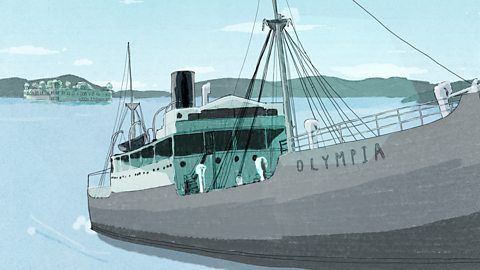
How the river Ganges came to London
The story of an extraordinary journey with the largest silver objects ever produced.
A modern Maharajah would not need this heavyweight luggage. You can now order Ganges water online. Listen: Water of Life and Death
3. The Inca called upon their mummified ancestors to help them make decisions
For more than 6,000 years in Peru and northern Chile, people mummified the dead, wrapping their remains in textiles to create “mummy bundles”. For the Inca, the mummy bundles were ancestors with great wisdom and knowledge of the world, so they would be called on to help with key decisions – they were physically present in the room.
The mummies reveal the Inca view of time in which the past, present and future run in parallel. Listen: Living with the Dead
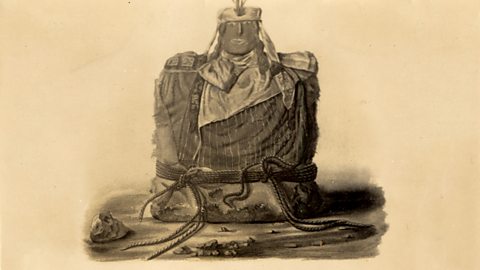
The dead “mummy bundles” who influenced the living
Neil MacGregor hears how ancestors played a role in the lives of Inca people.
4. Early temples were built as homes for the gods with rooms for their guests
A sacred space created for the god Ningirsu in Mesopotamia around 4000 years ago was very much a home as well as a place of worship – and it’s among the earliest temple buildings for which we have written records. Temples from this time included private spaces crafted to meet the god’s every need such as kitchens and dining rooms, family rooms and even spaces for guests. Listen: The House of God
5. Aztec human sacrifice saved lives on the battlefield
To understand human sacrifice in the Aztec world, you have to understand their view of warfare, says Jago Cooper of the British Museum. Unlike 15th-century battles in Europe, which aimed to annihilate the enemy, Aztecs aimed to capture a small number of people and bring them back to the capital to be killed in a ritual sacrifice. This sent a strong message to opponents. Also, the Aztecs did not want to slaughter the male population of opposing regions, because they relied on the tribute from these areas. Listen: Holy Killing
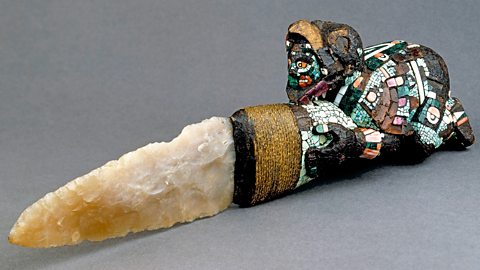
A beautiful knife made for a brutal act
Jago Cooper from the British Museum explains how a sacrificial knife helped save lives.
6. The Romans incorporated the gods of conquered peoples
In the mid-1840s, a Roman earthenware cooking pot was dug from the earth near Felmingham Hall in Norfolk. In the pot was a jumble of gods – small figures of Roman deities along with figurines and religious objects from pre-Roman times. Roman gods were exported to new provinces, while gods of defeated regions might join the pantheon.
“Rome was in many ways a really typical polytheism,” says Mary Beard, “and I think one of the big advantages of having lots of gods is that you can have more or fewer as you decide.” Listen: Living with Many Gods
7. Half the gold items made by the Muisca people were designed to disappear
The Muisca, an indigenous Andes community in eastern Colombia, were renowned as some of the finest gold workers in the world. Archaeologists estimate that about 50% of the gold work they created was made as offerings for the gods, to be buried or placed in water, notably into Lake Guatavita – the source of the El Dorado myth. It’s possible that the visible lifetime of these often complex works might have been just a matter of hours. Listen: Gifts to the Gods
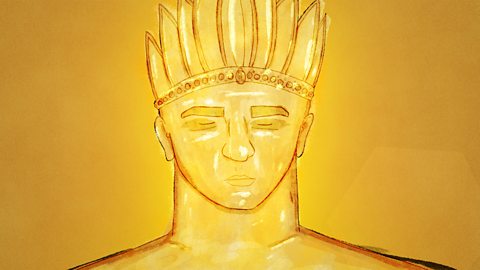
The legend of El Dorado
Neil MacGregor tells the story of the “golden man” who commits treasures to the deep.
8. A 40,000-year-old carving is the first evidence we have of shared beliefs
The Lion Man, made from mammoth ivory, is the oldest evidence we have of a human mind capable of giving physical form to something that could never have been seen in surrounding world. It was clearly of great importance to the society in which it was made, because it probably took 400 hours to carve.
“You’ve allowed someone to spend time out from things that enable your physical survival – hunting, protecting the children, tending the fire – to make something which is perhaps more about your psychological survival,” says British Museum curator Jill Cook. Listen: The Beginnings of Belief
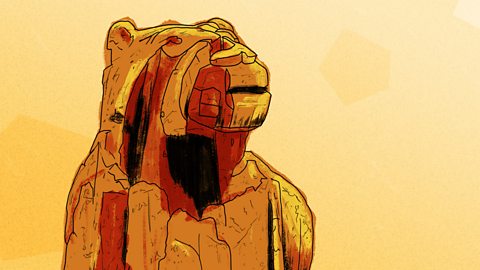
The Lion Man
Neil MacGregor tells the story of a small ivory sculpture, carved 40,000 years ago.
9. The French Revolutionary calendar renamed the months to remove religious influences
The French Revolutionaries guillotined the monarch and abolished not just the Catholic Church but God. They also re-ordered time – 1792 became Year One – and the months of the year were all re-named after nature and the weather (including mist, frost, snow, rain), rather than ancient deities.
In 1800, one commentator on the other side of the Channel mocked the new names, with suggested translations including Wheezy, Sneezy, Freezy, Slippy, Drippy and Nippy. Listen: Living with No Gods
More from Radio 4
![]()
Living With The Gods podcast
Neil MacGregor explores the role and expression of shared beliefs in communities around the world.
![]()
How do you find direction in life?
Why an astronaut’s predicament is one which we all experience as human beings.
![]()
Beyond Belief
Radio 4's series exploring the place and nature of faith in today's world.