Seven train movies to set the pulse racing
31 October 2017
As Kenneth Branagh’s all-star Murder on the Orient Express hits UK cinemas, we look at some of the train movies which have stationed themselves firmly in our hearts and steamed their way into cinema’s history books. How many have you seen?
Murder on the Orient Express (2017)
About the film
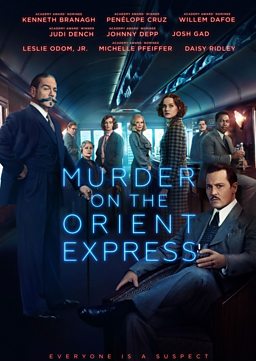
The film is based on Agatha Christie’s 1934 novel of the same name. It is set aboard the luxurious Orient Express from Istanbul to Paris, on which 13 disparate passengers are gathered. A murder on board and the last minute arrival of famed Belgian detective Hercule Poirot (Kenneth Branagh) means the exercising of his little grey cells over whodunnit.
Like its 1974 predecessor, director Branagh employs an array of starry names: Johnny Depp, Michelle Pfeiffer and Judy Dench are all on board. Branagh opens the film differently from the novel and the 1974 Sidney Lumet-directed interpretation, but will it end in a champagne curtain call as in Lumet’s film, or with moral outrage as expressed by David Suchet’s Poirot in the 2010 television version?
Partly inspired by the Lindbergh kidnapping case, still unresolved at the time of the novel’s publication, Christie explored themes of grief and retribution. The author made her first trip on the Orient Express in 1928, making copious notes about her surroundings for use in the novel.

Snowpiercer (2014)
About the film
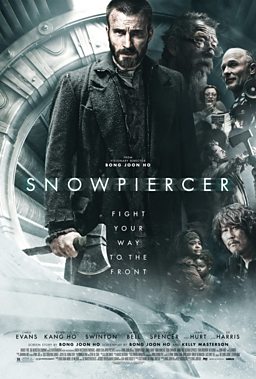
After an apocalyptic event leads to another Ice Age, what is left of humanity must travel the earth in perpetual motion on the Snowpiercer, a socially stratified train. The poor, led by Curtis (Chris Evans), are crammed in the tail of the train in squalid conditions, and towards the front is a literal first class where the comfortable and elite have access to sushi bars and salons, their life managed by Mason (Tilda Swinton). All are manipulated by Wilford (Ed Harris) as he maintains the ‘balance’ on his moving microcosm of society. Curtis and his mentor Gilliam (John Hurt) have other ideas and look to take control of this world, one carriage at a time.
As Hurt’s character's name attests, there’s a knowing nod to Terry Gilliam’s Brazil and its dystopian take on the future, but Korean director Bong Joon-Ho offers striking visuals and a fresh take on the action within the confined space of the train. As the characters journey through the train, and each carriage in turn evolves from bleak austerity through to surreal ostentation, Bong’s depiction of a subversive class struggle underscores the idea that taking control of the social machinery doesn’t necessarily mean your revolution has succeeded. This train’s political symbolism seems ripe for interpretation, or as Bong himself has said, maybe it’s just a science fiction film set on a train.
Listen: Front Row
Runaway Train (1985)
About the film
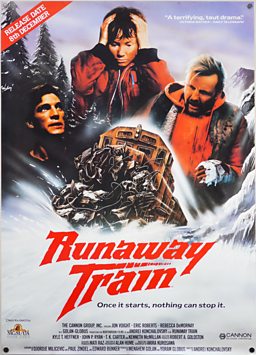
Jon Voight and Eric Roberts star as Manny and Buck, two escaped prisoners who are desperately seeking freedom in the wastes of Alaska and who think a passing freight train will offer them safe passage. Unfortunately, along with Rebecca De Mornay’s railway worker, they become trapped on the runaway train tearing over the tundra when the engineer dies after a heart attack and the brakes burn out. All this plus a prison warden who won’t let his man go free.
The original screenplay for the film was written by Akira Kurasawa and it was his intention to direct, but it was not to be. Ultimately directed by Andrei Konchalovsky and subsequently rewritten, the film retains Kurasawa’s trademark character-under-pressure exploration.
Much of the plot is implausible and ticks off a number of prison movie cliches, but it doesn’t stop the film being a rollicking rollercoaster ride with superior action. What elevates the film is the dynamic between the three characters: the intelligent old-timer, aware of the choices he’s made, the situation he finds himself in and the limitations it brings; the earthy youngster, blind to cause and effect, primal in his response; and the woman who mediates between the other two. There’s even space for a little Shakespeare at the end.
The Train (1964)
About the film
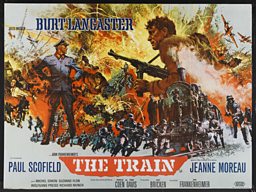
It’s August 1944 and the Germans are intent on removing art from France before the fast-approaching Allies can stop them. The French Resistance needs to hold the train up, or redirect and protect the cargo, long enough for the Allies to intervene, but the German officer in charge is focussed on the artworks' transfer no matter the cost.
Burt Lancaster stars as Paul Labiche, a SNCF railway worker and initially reluctant resistance operative who battles German officer Colonel Franz von Waldheim, played by Paul Schofield, for control of the train. Elements of the story were explored recently in The Monuments Men, but The Train is grittier and bleaker in its contemplation of the value of art to humanity, weighed against the loss of life required to protect it.
Though it strays a little more from the truth of the actual events, this black and white action film, dynamically shot on location with real ground-rippling explosions, is definitely worth a look. Boldly directed by John Frankenheimer with a shrewd eye for an action sequence, there’s also a percussively-driven soundtrack from Maurice Jarre.
The Narrow Margin (1952)
About the film
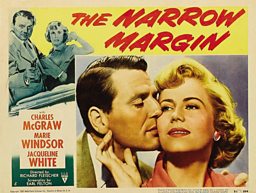
Two LA cops on protection duty arrive in Chicago to pick up a widowed mob wife and bring her back safely to Los Angeles to testify. One of the cops dies en route to the station, and the other is left to play cat-and-mouse with mobsters on the cross-continent train journey, while more goons keep pace alongside the train in a car. Undercover cops, mistaken identities and ingenious fight scenes keep this taught thriller on track.
It’s a lean, mean, noir machine, 71 minutes long and shot in 12 days by director Richard Fleischer for RKO. This above average B movie takes the sound of the train as its musical score, and its pace from the train rocketing over the tracks. In one sweaty fight scene in a toilet on the train, Fleischer shoots the encounter with a hand held camera; unusual for the time but extremely effective in conveying the brutal struggle. Remind you of Bond at all? This is classic noir ramped up by the claustrophobia of narrow carriages and a finite journey. It was remade in the 1990 with Gene Hackman as the lead.
The Night Mail (1936)
About the film
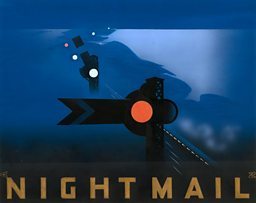
A 22 minute feature about the Royal Mail’s overnight train delivery operations between London and Glasgow doesn’t sound like an audience winner, but this critically acclaimed film is a masterpiece of the British documentary movement. It became the GPO Film Unit’s biggest box office success.
A collaborative affair featuring the work of Harry Watt, Alberto Cavalcanti, WH Auden and Benjamin Britten, the film epitomises the Unit's attempt to experiment in sound, visuals, storytelling and editing. It features a hypnotic soundtrack from Britten, who took his cue from the rhythms and sounds of the train itself. Auden did the same when asked to fill 3 minutes at the end of the film by writing the poem Night Mail, specifically timing it to fit cuts and shots. The film gives an insight into a world now largely lost to the digital age.
L’arrive d’un Train en Gare de La Ciotat (1895)
About the film
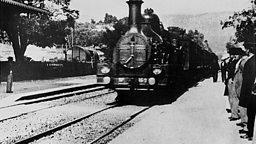
It was one of the first moving images seen by people in Europe: a train steaming towards them as they sat in the darkness. The Lumière brothers'Arrival of a Train at Ciotat Station seemingly induced audience responses now the stuff of legend - fainting, screaming and running from the cinema / tent in fear. What director wouldn’t want that kind of publicity these days, and perhaps that’s all it was?
What the audience saw in the film was a sunlit station, a train pulling in and the passengers alighting. But with the arrival of the train comes an indication of the changing times. What people sensed was the potential of a newly emerging society, with mechanical speed and power, both frightening and exciting at the same time. The view from a train window predates the cinema but prepared the audience for its coming. A train may move you from one point to another, but film's imaginative possibilities are endless.
More from Front Row
![]()
Shows within shows
The animated characters who watch other shows on TV.
![]()
Podcast transitions
Can your favourite audio survive a move to the screen?
![]()
Ready to rumble?
Seven times the art world grappled with wrestling.
![]()
Apocalypse now
Seven doomed futures from E3’s hottest games.


More from BBC Arts
![]()
Picasso’s ex-factor
Who are the six women who shaped his life and work?
![]()
Quiz: Picasso or pixel?
Can you separate the AI fakes from genuine paintings by Pablo Picasso?
![]()
Frida: Fiery, fierce and passionate
The extraordinary life of Mexican artist Frida Kahlo, in her own words
![]()
Proms 2023: The best bits
From Yuja Wang to Northern Soul, handpicked stand-out moments from this year's Proms