The good and bad in fungi... Nine fascinating fungal facts
In this episode of The Curious Cases of Rutherford & Fry, science sleuths Adam and Hannah find out about the organisms responsible for life on earth as we know it.
Here are nine fascinating facts about fungi...

![]()
Listen to The Good and Bad in Fungi
Why are some fungi helpful and others harmful? asks Paul Glaister from Reading. Rutherford and Fry try to outdo each other with fungal top trumps in their attempt to find the answer.

1. Fungi are responsible for all recognisable life on land
As Hannah explains, if we didn’t have fungi, we wouldn’t have plants, we wouldn’t have animals, and we wouldn’t have us. Fungi have filaments which allow them to get into places other organisms cannot. So, when plants made the evolutionary journey from water to land, fungi served as their root systems for tens of millions of years until plants could evolve their own. The fungi provide plants with nutrients and water; the plants provide fungi with sugars from photosynthesis.
![]()
In Our Time: Fungi
Melvyn Bragg and guests discuss fungi – organisms that play a crucial role in the earth's ecosystems.
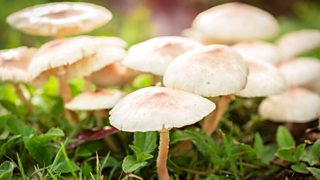
2. Fungi allow trees to talk to each other
Today, around 90 percent of plants depend on these fungal networks which, as Adam explains, is nicknamed the “Wood Wide Web”. In addition to allowing the exchange of nutrients and resources, the fungal networks enable plants to communicate with each other. If one tree is attacked, it can release chemical signals through the fungal networks which can warn their neighbours to raise their defences.
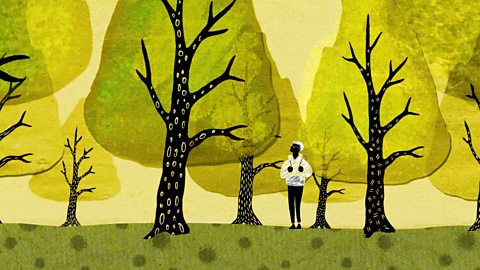
How trees secretly talk to each other
Plants talk and share resources using an underground network called the "Wood Wide Web"
3. We inhale between one and ten fungal spores with every breath
Fungi use spores like plants use seeds, to help them spread and reproduce. Mushrooms, for instance, are the spore-producing fruiting element of fungi. Some fungi actively expel their spores into the air while others rely on the wind, water or animals to spread their spores. Fungi are the largest source of living particles in the air. In the episode, Hannah and Adam find out that we inhale about ten fungal spores with every breath.
4. The Earth’s largest organism is a fungus
If fungi have adequate resources and conditions, they will keep growing. The Earth’s largest living organism is a honey fungus (Armillaria ostoyae) in Oregon, USA. As Adam and Hannah found out, the “Humongous Fungus” covers eight square kilometres and is over 8,000 years old. While the fungus itself is largely hidden underground, you can see its parasitic effects on the landscape where it has wiped out entire forests.
The “Humongous Fungus” covers eight square kilometres and is over 8,000 years old
5. Fungi prevent the earth from turning into a dead vegetable swamp
Although fungi’s powers of decomposition can be a nuisance for homeowners – think dry rot – they are essential to life on earth as we know it. By releasing nutrients from dead organisms, fungi allow ecosystems to keep going. By Hannah’s calculations, without fungi to decompose plant matter, we would be up to our armpits in a “beautiful blanket swamp of gross leaves and half-eaten fruit and vegetables” in just three years.
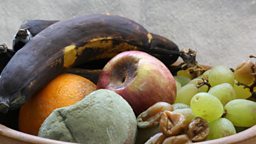
6. Fungi can break down explosives and radioactive material
Fungi are metabolic wizards. They can break down lignum (one of the world’s toughest woods), rock, crude oil, polyurethane plastics, explosives like TNT, and radioactive waste. In fact, Chernobyl is home to Cladosporium sphaerospermum, a radio-tolerant fungus which can harness the radiation as a source of energy.
Chernobyl is home to Cladosporium sphaerospermum, a radio-tolerant fungus which can harness the radiation as a source of energy
7. Some fungi turn ants into zombies
As Hannah explains, fungi don’t just sit around and wait for organisms to die – many attack living organisms. For the last 48 million years, Ophiocordyceps unilateralis has hijacked carpenter ants’ bodies to complete its life cycle. Ants infected by the “zombie-ant fungus” will climb up a leaf and clamp their jaws around the central vein in a “death grip”.
The fungus locks the ant in position, grows a stalk out of its head from which it spews spores on to the unsuspecting ants on the forest floor below.
8. Fungal infections are among the most deadly infectious diseases
Fungi take advantage of whatever resources they can. In the human body, this can cause infections like Athlete’s Foot and thrush. Some fungal infections can be life-threatening, especially for people with weakened immune systems. Hannah and Adam learn that invasive fungal infections are responsible for more than 1.5 million deaths per year.
9. Fungi can also work for our benefit
In the episode, Adam and Hannah find out that fungi have given us bread, cheese, alcohol and some of our most important medicines. These include: penicillin and cephalosporin antibiotics; cyclosporin for use in organ transplants and immune diseases; ergotamine for migraines and excessive blood loss; acarbose for diabetes; and statins to reduce cholesterol and prevent heart disease.
More from Radio 4...
![]()
The Curious Cases of Rutherford & Fry
Science sleuths Dr Adam Rutherford and Dr Hannah Fry investigate everyday mysteries sent by listeners.
![]()
Scientifically...
The home of the best science programmes from BBC Radio 4 introduced by Dr. Alex Lathbridge.
![]()
Entangled Life by Merlin Sheldrake
A remarkable account of how fungi make our worlds, change our minds and shape our futures.
![]()
Go Wild
Nature documentaries to inspire your next outdoors adventure, introduced by Harriet Noble.