How do blue whales get so big?
by Jeremy Goldbogen, Assistant Professor of Biology, Hopkins Marine Station of Stanford University
The ocean is home to the largest animals of all-time, the great whales, yet these oceanic giants remain some of the most poorly understood organisms on earth. What is life like at this extreme body size? How did whales get so big? How do they manage to support such huge bodies and the large energy demands that come with it? These questions about the biology of gigantism drive our research on rorqual whales, a family of whales that all use an extreme feeding strategy called lunge filter feeding.
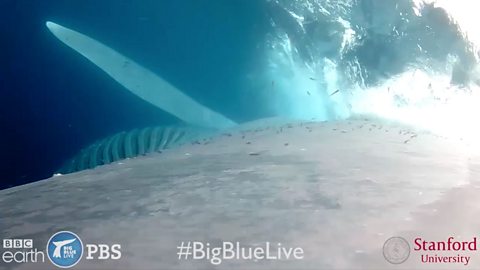
The view on-board a blue whale
To study lunge-feeding behaviour blue whales are tagged with cameras.
Rorquals are some of the largest whales on the planet including: blue, fin, and humpback whales. Lunge filter feeding involves a rapid acceleration and the engulfment of an enormous volume of prey-laden water, the size of which is roughly the size of a school bus. This feeding event is made possible by anatomical specializations that are not seen in any other animal on earth. These adaptations for lunge feeding include incredibly large jaws and a super-expandable throat pouch that accommodates these giant gulps of water and fish or krill. The mouth then closes around the engulfed water mass as the inflated throat pouch contracts to force water past the baleen to filter out the prey inside the mouth. It is thought that this extreme lunge feeding method is the key to fueling the extraordinary energy demands of rorqual whales, but we are only beginning to learn how it works.
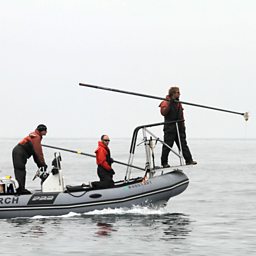
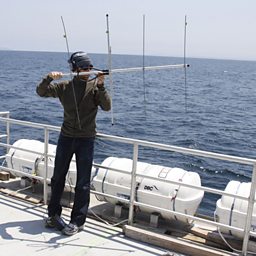
To study lunge feeding, my colleagues and I deploy suction-cup tags to foraging rorqual whales off the coast of California. These tags have multiple sensors that measure movement in 3D as well as simultaneously shooting video from two cameras within the tag. With this technology, we are able to get a whale's perspective on foraging in the open ocean. We can now see exactly what these whales are feeding on, measure how deep in the ocean they feed, and also quantify the acrobatic maneuvers they use to corral and capture prey. It is an amazing time to be a marine biologist studying the largest whales with this constantly evolving technology.
Related Links