A love story that broke the conventional boundaries of Empire
An introduction by Historian William Dalrymple
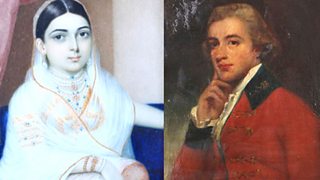
Kirkpatrick had gone out to India full of ambition, intent on making his name in the subjection of a nation; but instead it was he who was conquered, not by an army but by a Hyderabadi noblewoman called Khair un-Nissa.Historian William Dalrymple
Colonel James Achilles Kirkpatrick was the British Resident or Ambassador at the Indian court of Hyderabad between 1797 and 1805. Kirkpatrick had gone out to India full of ambition, intent on making his name in the subjection of a nation; but instead it was he who was conquered, not by an army but by a Hyderabadi noblewoman called Khair un-Nissa. In 1800, after falling in love with Khair, Kirkpatrick not only married her, according to Muslim law, and adopted Mughal clothes and ways of living, but had actually converted to Islam and had became a double agent working against the East India Company and for the Hyderabadis.
Beneath the familiar story of the British conquest and rule of the subcontinent, there lay a far more intriguing and still largely unwritten story - about the Indian conquest of the British imagination. During the eighteenth and early nineteenth century it was clear that it was almost as common for westerners to take on the customs, and even the religions, of India, as the reverse.
These White Mughals had responded to their travels in India by slowly shedding their Britishness like an unwanted skin, and adopting Indian dress, studying Indian philosophy, taking harems and adopting the ways of the Mughal governing class they slowly came to replace. Moreover, the White Mughals were far from an insignificant minority. The wills of the period show that in the 1780’s, over one third of the British men in India were leaving all their possessions to one or more Indian wives.
Kirkpatrick inhabited a world that was far more hybrid, and with far less clearly defined ethnic, national and religious borders, than we have all been conditioned to expect. Only seventy-five years after his death, it was possible for Kipling to write that ‘East is East and West is West and never the twain shall meet’. At a time when respectable academics talk of a 'Clash of Civilisations', and East and West, Islam and Christianity appear to be engaged in another major confrontation, the White Mughals provides a timely reminder that it is indeed very possible – and has always been possible – to reconcile the two worlds. It is only bigotry, prejudice, racism and fear drive them apart. But they have met and mingled in the past; and they will do so again.
Hyderabad Mughal meets Victorian London
William Dalrymple sheds light on some of the key actors involved in Mughal India, and the love story that brought together two very different worlds in an age of Empire. He explores the full story in 'Love and Betrayal in India: The White Mughal' on BBC Four, 3 September at 9pm. The programme will be available to watch soon afterwards on BBC iPlayer.
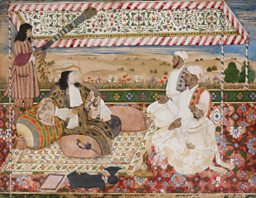
Darbar of Cornelis Van Den Bogaerde
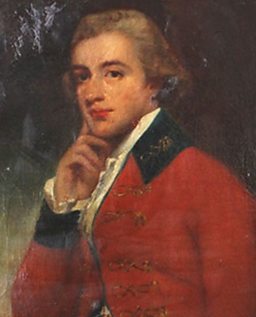
James Achilles Kirkpatrick
James Kirkpatrick in Mughal Dress
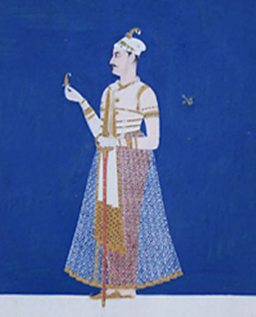
Khair-un-Nissa
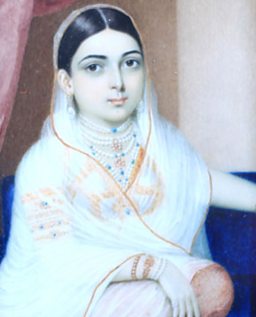
General William Palmer and family
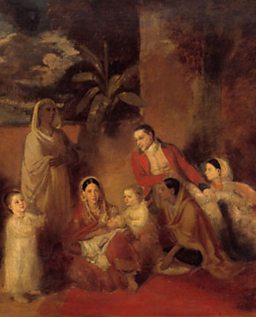
The Kirkpatrick Children: Sahib Begum and Sahib Allum
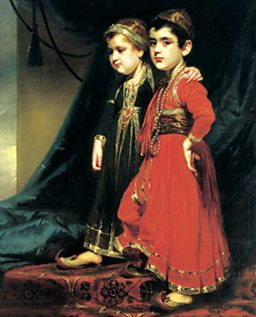
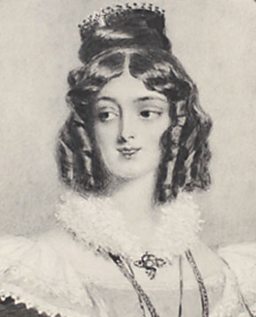
Kitty Kirkpatrick