Five of the best Schubert partsongs
Five of the best Schubert partsongs, by Chris Taylor
Schubert is probably the classical world’s most celebrated song writer.

Schubert's body of 600 plus solo songs (or "lieder") established this rather domestic art form as something worthy of serious attention. The choral equivalent of "lieder" is the "partsong", a catch-all title for the short-ish, mainly secular pieces Schubert and many others produced for multiple voices. They are often unaccompanied with a simple texture of tune in the top line, harmonies underneath. It’s a seemingly basic formula that puts Schubert’s subtle and sophisticated gift for melody and mood, front and centre.
Schubert produced over 100 of these choral songs but despite the popularity of his lieder for solo voice these part-songs have never gained wider recognition. There are good reasons why we should spend more time with them. First, it’s music we know Schubert himself enjoyed, often sharing evenings with friends singing through each other’s compositions. Second, some of them are wonderful – new masterpieces by Schubert waiting for you to discover them. Here are some that I love.
Nachthelle, D.892
Lots of Schubert’s songs are set at night and in his music we often find the hours of darkness an alluring, magical place to be.
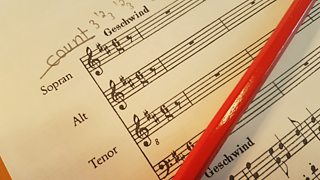
The words speak of a light that bursts within the poet’s heart, as he contemplates the shining universe and his place in it. Somehow, a few simple repeated chords in the piano introduction to Nachthelle manage to conjure a vast dark sky, peppered with a billion stars. Schubert places his male choir high up in their vocal register, the solo tenor stratospherically so. Their hushed, straining voices create a shimmering, unearthly mood before they build to a crescendo halfway through in a surge of emotion that can’t be contained. It’s a passing moment, and Schubert leads us gently onwards to a sensation of contented wonderment that eventually floats up and away into silence. By which time the solo tenor must be blue in the face! It’s one of Schubert’s most sublime and powerful visions – challenging the singers to be good enough and brave enough to pull it off.
Have a listen to an extract from Schubert's Nachthelle, D.892.
Nur wer die Sehnsucht kennt "Sehnsucht", D.656
This poem of loneliness and intense sadness was a favourite with 19th century composers.
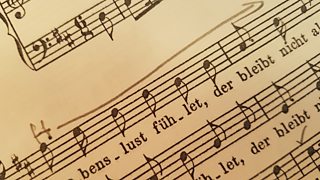
The words are spoken by Goethe’s character Mignon, who appeared in many of his plays, and inspired, among others, Beethoven, Schumann, Wolf, and Tchaikovsky (whose version is famously known in English as “None but the lonely heart”). Schubert set this text no fewer than six times and he clearly had a weakness for this heroine pining for her distant lover. But this setting for an ensemble of five men indicates he felt the isolation at the heart of these words has a more universal message. The close harmonies are unusually rich and can sometimes lead the music in surprising directions. Our 21st century ears might even catch a whiff of the barbershop quartet. At one point different vocal parts call ineffectually to each other. It’s no good, Schubert seems to imply, the gulf between us is just too great. Schubert’s setting isn’t mournful particularly. Rather there’s an undercurrent of bleak fatalism: life is hard, this is the way of things.
Have a listen to an extract from Schubert's Nur wer die Sehnsucht kennt "Sehnsucht", D.656.
Ständchen, D.920, Op.135
The majority of Schubert’s songs were composed for male voices.
Only a fifth of the total feature mixed voices, and barely a handful are for female voices alone. This is one of them.
On one occasion Anna Fröhlich asked her good friend Schubert to set a poem especially for her girls’ choir in Vienna. Schubert obliged but, when the manuscript came back, Anna was perturbed to discover he had absent-mindedly delivered a setting for alto solo and male chorus. He hurriedly and shamefacedly had to re-score it and good relations were restored when it was performed as a surprise birthday present for one of Anna’s students. Schubert forgot to turn up, which might have put him in the dog house again! This serenade includes not only a beautiful love song, but a delightful evocation of the love-struck songstress, hesitantly but excitedly approaching the object her desire (her fellow choristers presumably coming along for extra moral support), before sweetly chiming out her serenade, and creeping away. It’s feather-light, full of excitable good humour, and utterly charming.
Have a listen to an extract from Schubert's Ständchen, D.920, Op.135.
Gesang der Geister über den Wassern, D.714, Op.167
Although partsongs were born out of an essentially domestic tradition, Schubert was keen to find a public platform for them when he could. And, as you might expect from a composer of his invention, he looked for ways to expand and extend what the homely partsong could achieve.
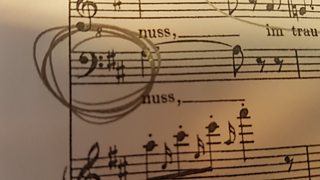
His lengthy (nearly 15 minutes) setting of Goethe’s poem “The Song of the Spirits” for male choir is truly ambitious, as befits the lofty aspirations of the text. It’s a meditation on the nature of the human soul, using water as the poet’s central metaphor. At one point Schubert pits high, aggressive barks from the tenor voices against the basses, resolutely digging into their lower registers, to illustrate the craggy heights over which the waterfall cascades. The dark and serious tone is enhanced by an accompanying band of violas, cellos and double basses. This is partsong at its most symphonic and Schubert proudly presented it in an important concert of his music in Vienna. Sadly, it was another partsong, the unashamedly simple and sentimental Das Dorfchen that won over the audience that day.
Have a listen to an extract from Schubert's Gesang der Geister über den Wassern, D.714, Op.167.
Der Tanz, D.826
We've seen how Schubert grabbed hold of the humble partsong and elevated it to previously unimagined heights, just as he had also done with solo songs.
This mixed choir favourite is not one of those works. Here is Schubert, the great lover (and composer) of popular dance music, playing to the gallery and giving the Viennese public a taste of what he knew they loved best. His carousing waltz tune sweeps us into the ballroom with its infectious energy and dares us not to have a good time. This is strictly merriment and, believe me, young Schubert knew just plenty about that side of life! It’s all over in a flash, like a dizzy, breathless night on the dancefloor should feel.
Just one more dance?
Have a listen to an extract from Schubert's Der Tanz, D.826.
Related Links
Contact Us
Please tell us about your favourite Schubert Partsong and why you like it. Do you enjoy the music or the mood? Does it remind you of a favourite time in your life?
To contact us email: [email protected]. We will publish some of the comments online. No personal information will be kept or divulged.