Ten pieces that will make your kids instant classical music fans
The excitement, beauty and vivid storytelling of the music featured in the BBC’s Ten Pieces project is a brilliant way of introducing young minds and families to classical music, with much of it being performed at the Proms in 2017. Here's a selection of our favourites.
1. The piece about breaking free: Shostakovich’s Symphony No 10
Dmitri Shostakovich was a Russian musician who spent most of his career working under the Soviet leader Joseph Stalin. It was a tough gig: for much of his life Shostakovich was forced to write only the sort of music that would please Stalin and the Soviet regime.

Lemn Sissay introduces Shostakovich's Symphony No. 10 (2nd movement)
Lemn Sissay investigates what it was like writing music under Stalin's oppressive regime.
When Stalin died in 1953, Shostakovich could finally express himself freely. His tenth symphony premiered in December that year. One musicologist claims that Shostakovich later told him the work was a musical portrait of Stalin and his regime. If that’s true – it’s not a very flattering portrait.
The second movement is a noisy, violent scherzo, packed with big brassy fanfares and the rat-a-tat of percussion. It’s full of panic, terror and anger, opening a door into a very different time and place.
Hear it: Radio 3
Learn more: Shostakovich’s Symphony No 10 on the Ten Pieces website
2. The piece that reminds you that classical music is still happening right now – Kerry Andrew’s No Place Like
Classical music isn’t something that just stopped when composers like Mozart and Beethoven died. Quite the opposite: it’s still being written by composers from lots of different backgrounds – many of them considerably more diverse than in Mozart’s day.
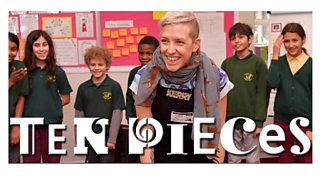
This year, 13 brand new pieces will receive their world premieres at the Proms – from Tom Coult’s St John’s Dance in Prom 1 to Lotta Wennäkoski’s Flounce on Last Night of the Proms. Among them is a new piece by Kerry Andrew, especially commissioned for Ten Pieces.
No Place Like uses words submitted by children across the UK to create an exciting a cappella song about home and place. There are no spoilers here – you’ll have to wait to hear it for yourself.
See it:Prom 11/12, 23 July
Hear it:Radio 3
3. The piece that draws on the classical music of another culture: Ravi Shankar’s Symphony
Ravi Shankar, who died in 2012, was one of India's most famous and well-loved musicians. Over his long career, he became known not only as an international ambassador for Indian classical music, but as a fearless musical collaborator who started working with Western classical musicians like Yehudi Menuhin as far back as the 1950s.
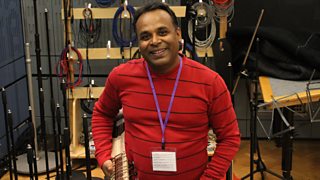
Still, Shankar didn't unveil his first symphony until 2010, when he was 90! Better late than never. His Symphony is an ambitious and addictive fusion of Indian and Western classical music, with each of its four movements built around a different raga scale.
The final movement, Banjara, is named for the nomads of the northwestern Indian subcontinent, whose descendents now live all over India. Expect pulsing rhythms, dazzling sitar solos, some quickfire singing and a whirling, dancing beat.
See it:Prom 11/12, 23 July
Hear it:Radio 3
4. The piece about space travel: Holst’s Mars, from The Planets
The composer and teacher Gustav Holst was so taken by the idea that the motions of the planets might affect our actions and feelings on Earth that he wrote horoscopes for his friends – even later in life, when he wasn’t quite sure whether he believed in it any more.
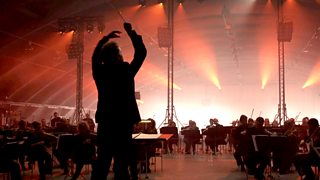
Mars is the first in a series of mini pieces that he wrote between 1914 and 1916. Each one illustrated one of the seven planets in our solar system that were known about at the time. Mars illustrates the Red Planet, itself named for the Roman god of war – something that comes across clearly in the music.
It’s a big, brassy, bombastic piece – quite unlike Holst himself, who was by contrast a rather shy and retiring character. It just goes to show that you can achieve all sorts of unexpected things (and visit all kinds of places) if you’re interested enough.
See it:Prom 14, 25 July
Hear it:Radio 3
Learn more:Holst and The Planets on the Ten Pieces website
5. The piece that turns real life into real music: Elgar’s Enigma Variations
New to BBC Ten Pieces in 2017-18 are four mini pieces from Elgar’s Enigma Variations – a work that gets right to the heart of music and personality.
Elgar created this series of musical variations in 1898-99, each one representing someone or something he knew. After creating a theme based on his own personality (Enigma), he wrote a further 14 pieces to capture things like the quirks of his friends, a memory of being caught in a thunderstorm, and even the sound of a bulldog falling into a lake.
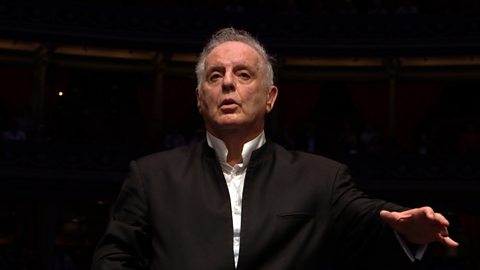
Elgar: Nimrod from Enigma Variations (Prom 4)
Daniel Barenboim conducts the Staatskapelle Berlin in this encore performance.
The variations show how music can convey personality, an event, a memory or a moment in time: the ideal springboard to challenge kids to start translating their own worlds into music.
See it:Prom 32, 9 August
Hear it:Radio 3
Learn more: Resources for Elgar’s Enigma Variations will be released in time for the start of the 2017-18 academic year
6. The piece that will soundtrack your next adventure: Grieg’s “In the Hall of the Mountain King”
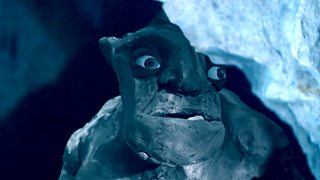
Edvard Grieg was a Norwegian composer whose music drew on the folk tunes of his homeland. His “Peer Gynt” Suite tells the story of a boy called Peer Gynt, who falls in love with a girl but is not allowed to marry her. Peer takes the unusual step of running away into the mountains, where he is immediately captured by trolls.
This piece, “In The Hall of the Mountain King”, illustrates the part of the story where Peer enters the underground cavern of the troll king. The music starts out in a slow, secretive, tense tip-toe before speeding up and breaking into a wild sprint as Peer is faced with a “great crowd of troll courtiers, gnomes and goblins”.
It’s the perfect accompaniment to all manner of games, plays and escapades – and more importantly, a real earworm.
See it:Prom 33, 10 August
Hear it:Radio 3
Learn more:Grieg’s In The Hall of the Mountain King on the Ten Pieces website
7. The piece that makes you feel really, truly alive: Beethoven’s Symphony No 5
The first eight notes of this piece of music are said to be among the most famous ever written. Even people who claim to know nothing at all about classical music will have heard the opening of this piece: try it and see.
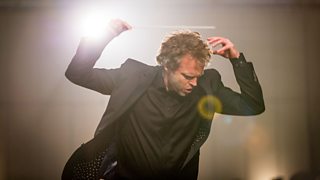
Ludwig van Beethoven’s Symphony No 5 was first performed in Vienna in 1808, at a concert to end all concerts – a four hour musical extravaganza that premiered no less than three of Beethoven’s greatest works. But it was a bumpy start. Not only was the concert very long, but the venue was freezing cold. Beethoven argued with all the musicians, who’d only had time for one rehearsal as some of the music had only been finished that morning.
But, as CBBC’s Barney Harwood says, Beethoven didn’t write music to make people feel nice. He was there to make them feel alive. This is music that does just that.
See it:Prom 50, 21 August
Hear it:Radio 3
Watch it:BBC Four
Learn more:Beethoven’s Symphony No 5 on the Ten Pieces website
8. The piece that reminds you of home: Largo from Dvořák’s Symphony No. 9, “From the New World”
New to Ten Pieces for 2017-18, this is a piece that has a lot to say about place – where a person comes from, where they’re going to, and all that’s in between. Antonin Dvořák was a Czech composer who was very influenced by the folk music of his homeland. But he wrote this piece whilst teaching in America in the 1890s.
Dvořák was also fascinated by the folk music of the New World, from Native American music to African-American spirituals. He was particularly moved by the music of black America, writing: “These beautiful and varied themes are the product of the soil. They are the folk songs of America and your composers must turn to them.”
Warning: Third party content may contain ads. See the BBC Privacy Policy for more info.
But as enthused as he was by American life and music, Dvořák was intensely homesick. His feelings of longing and nostalgia are very clear in the Ninth Symphony’s slow movement, which combines a spiritual-like melody with a very Bohemian sense of nostalgia. It’s a true melting pot of a piece that will remind you of home wherever you are.
See it:Prom 52, 23 August
Hear it:Radio 3
Learn more: Resources for Dvořák’s “New World” Symphony will be released in time for the start of the 2017-18 academic year
9. The piece that’s the ultimate musical air punch: the finale of Stravinsky’s The Firebird
The Firebird Suite started life in 1910 as a ballet. Based on a Russian fairy tale about a mythical, fiery bird who can grant wishes, it was an instant success that catapulted its composer – the then-unknown Igor Stravinsky – to international fame.
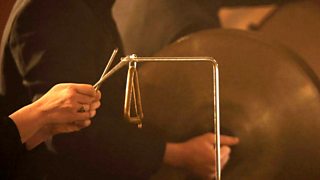
Later on Stravinsky rejigged the ballet so that it could be performed without dancers: a suite of orchestral music in its own right. Not only did this make the music more portable, it also made it signficantly cheaper to perform – the ballet version required a cast of dozens of dancers, including 30 extras who only ever came on during the last scene.
It’s this last scene – the Suite’s finale – that is so inspiring for adults and children alike. From the opening horn solo that could be a lone bird, skimming high above the ground, to the triumphant brassy swelling of the ending, it’s a proper lump-in-your-throat job that makes you feel as though you’ve saved the universe and they’re handing out the medals.
See it:Prom 60, 29 August
Hear it:Radio 3
Learn more:Stravinsky’s The Firebird on the Ten Pieces website
10. The piece that will make you want to sing along: Sibelius’s Finlandia
Finlandia is new for Ten Pieces in 2017-18: a wide-ranging symphonic poem written in 1900 as an under-the-radar protest against increasing censorship from Russia.
The original piece is packed full of stirring action that evokes the struggles of the Finnish people. Yet it’s the serene middle section that has become a sort of an unofficial national anthem for Finns, with words written especially for it by Veikko Antero Koskenniemi in 1941. It’s this choral version that will feature in 2017’s Last Night of the Proms, to mark the 100th anniversary of Finnish independence.
Warning: Third party content may contain ads. See the BBC Privacy Policy for more info.
This is music that has the idea of identity at its heart. It captures not only the vast, majestic landscape of Finland, but also its national pride at a crucial moment in the country's history. It’s a great opportunity for kids to question how music might reflect their own identities – and, of course, to sing along to this mighty tune.
See it:Prom 75 (Last Night of the Proms), 9 September
Hear it:Radio 3
Watch it:BBC Two (first half), BBC One (second half)
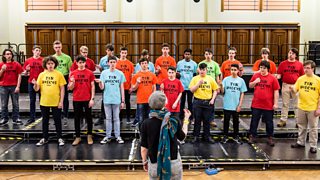
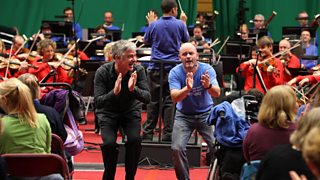
Join rollicking ringmaster Sir Henry Wood (founder-conductor of the Proms) on an exciting adventure for all the family. Together with young performers, the Ten Pieces Children's Choir and guests, he discovers how nature, history, dreams, love, magic and lots more have inspired composers to create musical masterpieces. Prom 12, 23 July 2017.
![]()
Sir Henry's magnificent musical inspirations
All the fun and frolics from the Ten Pieces Prom on 23 July.
![]()
Ten Pieces
Teachers, parents, kids: here's how to get creative with classical.
![]()
The Relaxed Prom
A fun and interactive musical experience in a welcoming environment, with plenty of opportunities for participation.
![]()
The Listening Service at the Proms 2017
This year the BBC Proms are getting the Tom Service treatment: discover how here.