Seven Reasons Why You Must Listen to Philip Glass
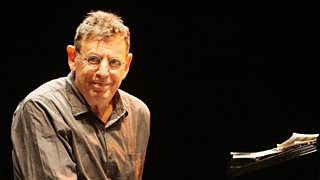
Philip Glass is rightly celebrated as one of the fathers of "minimal music" – his appealing, distinctive style and willingness to engage with contemporary art and issues through his music has won him legions of fans. In a special 80th birthday tribute, Radio 3 producer Philip Tagney introduces seven essential Glass works with tasters of all the music.
1. He creates stillness
FAÇADES (1981)

This lovely short piece has a sweetly melancholy melody for soprano saxophones, supported by rocking strings.
Glass plays with alternating major and minor thirds, which you also hear sometimes in jazz. It conveys a sense of stillness that is one of the special qualities of Glass.
This music was originally intended for a film soundtrack – the visual montage it accompanied consisted of scenes from New York’s Wall Street on a quiet Sunday morning.
Listen: Glass tells Donald Macleod what happened after Façades was rejected...
2. He creates velocity
EINSTEIN ON THE BEACH (1976): Act IV, Scene 3: Spaceship
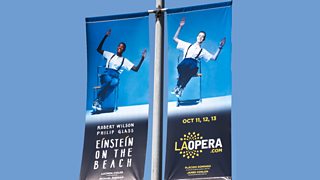
Contrasting with Façades, this piece is hair-raisingly exciting. It has an inexorable sense of rushing forwards. Watch out for the explosive entry of the vocalists!
Follow that snaking bass line, and hear how Glass keeps adding notes to it and changing the rhythmic patterns. Towards the end it becomes a high-speed chromatic scale passage, a musical roller-coaster.
This piece is also a test of the musicians’ stamina and agility. It’s a section from Glass’s first opera, and his first collaboration with renowned experimental theatre director Robert Wilson, whose Tower of Babel was recently broadcast on Radio 3.
3. He creates amplified excitement
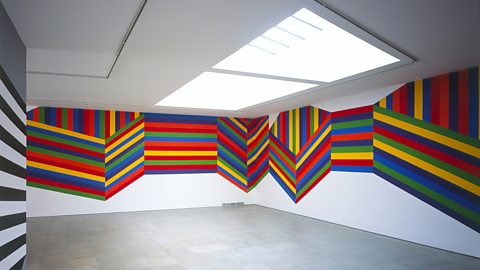
Philip Glass: From Music in 12 Parts (1974) – Part 12
'Music in 12 Parts is a compendium of his hypnotic repetitive and additive techniques.'
MUSIC IN 12 PARTS (1974) (PART 12)
In New York in the 1960s, Glass became friends with some of the leading abstract artists living in the city, including Robert Rauschenberg and Sol LeWitt (Lisson Gallery installation pictured). None of them, Glass says, listened to modern classical music.
So Glass asked himself, “what is the music that goes with that art?” This was his answer – he formed his own amplified ensemble including several electric keyboards, wind instruments (saxophones, flutes), and soprano voices. The group played loud and rhythmic music that had the attack and excitement of rock music, very different from the refined sounds of the classical concert hall, and they tended to perform in unorthodox venues such as loft spaces.
The four-hour-long Music in Twelve Parts (1971–1974) sums up Glass's musical achievement since 1967, a compendium of his hypnotic repetitive and additive techniques. You can hear it in an all-night Philip Glass celebration on Radio 3, Sunday 29 January.
4. He’s written a fitting soundtrack to contemporary life
KOYAANISQATSI (1982) – The Grid
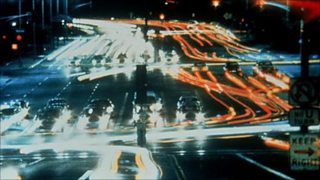
This is Glass’s first film sound track, and the first of several collaborations with non-narrative film-maker Godfrey Reggio.
In the Hopi language, the word Koyaanisqatsi means "unbalanced life", and the film is also known as "Koyaanisqatsi: Life Out of Balance".
Glass uses a sizeable orchestra with chorus: the section called The Grid is about the hyperactive life of big cities, and Glass’s music brilliantly complements the teeming insect-like speeded-up footage of cars and pedestrians.
Listen: Philip Glass defines his music and discusses the real origins of the term, 'minimalism'.
5. He wrote a contemporary symphony inspired by art rock
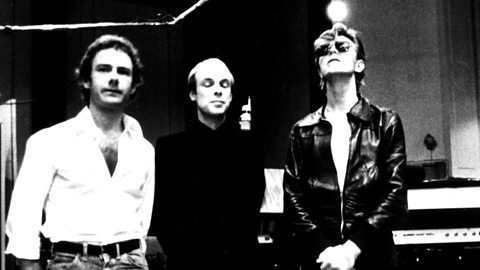
Philip Glass: From Low Symphony (1992)
'You can hear the influence of art-rockers David Bowie and Brian Eno here.'
LOW SYMPHONY (1992)
A two-way influence here – art-rockers David Bowie and Brian Eno (right and centre in the picture) were in the audience for early concerts of Glass’s music in the UK, and their 1977 album, "Low", was certainly touched by avant-garde and minimalist ideas – one side of the album is entirely instrumental, mainly played on synthesizers.
Glass later wrote another symphony on Bowie/Eno themes (Heroes). If you’re familiar with the Bowie albums, you’ll recognise some themes, but Glass develops them into large-scale structures that are entirely his own. Glass says that Bowie preferred the Heroes Symphony, but Glass prefers this one.
And it got him started writing what has become an impressive series of symphonies. (Incidentally, Bowie’s favourite soundtrack album ever is Glass’s score for the film "Mishima").
6. His symphonies are continuing to develop and deepen
SYMPHONY NO.6 (PLUTONIAN ODE) (2002): 2nd movement
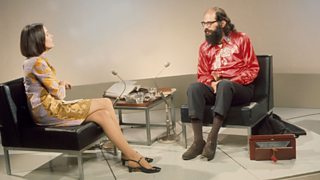
Sombre funereal brass chords usher in a dramatic setting for soprano of words by Beat poet Allan Ginsberg (pictured with the BBC's Joan Bakewell), an angry apocalyptic vision of the military industrial complex of the USA.
Glass and Ginsberg were good friends and collaborators (they also wrote a fine set of songs together called Hydrogen Jukebox).
Glass has written eleven symphonies, and several concertos – so if you like this, there’s plenty more orchestral music to explore. His 11th Symphony will be premiered on his 80th birthday, 31 January 2017.
Listen: Philip Glass talks about his days as a taxi driver alongside being a composer.
7. He is a great and original opera composer
AKHNATEN (1983) – Hymn (Act 2, Scene 4)
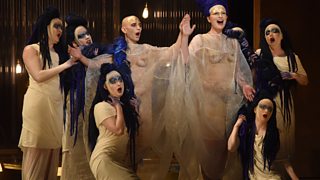
Glass is above all an opera composer, with more than a dozen operas to his name, and a similar number of chamber opera and music theatre pieces. "Akhnaten" is one of his most accessible operas, with beautiful melodic writing and a genuinely archaic atmosphere evoking the strange reign of this ancient Egyptian pharaoh.
The Hymn is the centrepiece of the opera, sung by Akhnaten himself (a countertenor voice adding to the strangeness of the character). The photo is from a recent production by English National Opera.
Listen: Reflecting in his Memoirs, Philip Glass analyses his compulsion to compose.
Philip Glass Birthday Celebrations on Radio 3
- Saturday 28 January: BBC Symphony Orchestra: Total Immersion – a day-long celebration of Philip Glass (booking details)
- Saturday 28 January at 1215pm: Music Matters: Philip Glass at 80
- Saturday 28 January at 10pm: Hear and Now – Philip Glass, Anthony Braxton and Friends
- Sunday 29 January at 1am: Glass Night – Tom McKinney presents an all-night celebration of the music of Philip Glass, built around Music in Twelve Parts (1971-1974)
- Tuesday 31 January at 7.30pm: An all-Glass concert with the Labèque Sisters and the BBC SO conducted by Marin Alsop
- Wednesday 1 February at 7.30pm: Glass's Quartet No.3, 'Mishima' with the Royal String Quartet
Are you a secret minimalist?
Glass's musical heritage
Glass has collaborated with some high-profile rock and pop artists including Paul Simon, Suzanne Vega, Mick Jagger, Leonard Cohen, and David Byrne.
But in terms of direct stylistic influence, you’ll hear clearer echoes of his music in the Progressive Rock instrumentals of Mike Oldfield and Tangerine Dream, and more recently in some Techno artists, especially the more dreamy pieces by Aphex Twin (Glass has orchestrated one of his electronic pieces.)
In the commercial realm, Glass’s sound can be often be heard in adverts; and in mainstream cinema, Hans Zimmer and Michael Nyman, among other sound track composers, are clearly indebted.
Glass undoubtedly influenced a whole generation of composers around the New York downtown scene of the 1960 and '70s. Many of these composers were influencing each other, so it’s hard to unpick, but you can clearly hear the ideas of Minimalism at work in the music of artists like Steve Reich, Meredith Monk, Terry Riley, Charlemagne Palestine; Laurie Anderson (who had a surprise hit single with O Superman in 1981) was also clearly influenced by Glass.
In Europe, important composers who picked up on the Minimalism of Glass include Louis Andriessen in Holland and Michael Nyman in the UK.

More on 'minimalist' composers at Radio 3
![]()
Composer of the Week: Philip Glass
The composer discusses his life and work with Donald Macleod
![]()
Composer of the Week: Steve Reich
In an extended interview, Donald Macleod finds Steve Reich wry, witty and disarmingly candid about the ideas and influences behind his work.
![]()
Great Composers with Tom Service: John Adams
Tom Service's four-minute video guide to John Adams and his 'addictive' music.
![]()
A Minimal Guide to Minimalism
BBC Music's quick guide to minimalism culled from the BBC's archives.