Why aren't there more women in trades?
Think of a person working in manual trades. Would that person be more likely to be a man, or a woman?
According to charity Women on the Tools, less than 2% of people in jobs such plumbing and construction are women - a figure that has barely changed in 40 years.
So why is this the case?
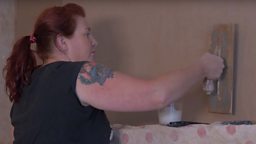
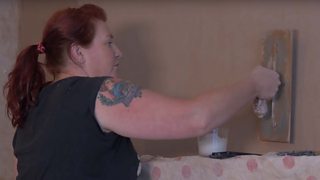
We decided to find out from women already working in the industry. Step forward Steph Leese - also known as the Pink Plasterer.
They look at me and think - 'Can she do it? She's a woman' - and the answer is yes!"Steph Leese, owner of The Pink Plasterer company
She's the only female plasterer working in Merseyside and is keen to get more women involved in trades.
"It's so nice to change people's perceptions," she says. "They look at me and think - 'Can she do it? She's a woman' - and the answer is yes. Yes we can!"
Steph didn’t set out to become a plasterer – but knew at school she loved “manual work” and wanted to do a job that used her hands. She learnt how to plaster from her boyfriend whilst studying software engineering at university.
After graduating and getting a job in HR – Steph was made redundant in 2006. It was then that she decided to put her plastering skills to work.
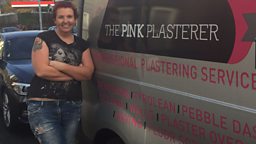
There has been opposition to Steph’s career choice, however: from men working on building sites, to family and friends.
When you’re a female going into a male-dominated environment, people expect you to fail"Steph
“When you’re a female going into a male-dominated environment, people expect you to fail,” she says.
“They expect you to not be as strong as a man, to not be as strong-willed as a man, and they expect you to not actually have the technical knowledge a man would have. That’s a stereotype I encounter a lot."
Steph admits there have been times where she has had to “remove” her team from building sites after the “intimidation” they have received, but in the vast majority of cases it’s about “earning [her] stripes by doing a good job”.
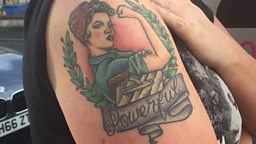
“If you're confident in what you do, trained to the right ability and do the job effectively, those stereotypes are broken down. You become part of the gang, rather than a gender."
There’s no reason you can’t keep your femininity and work in this industry”Steph
Steph believes it is important to "make the most of [her] femininity” at the weekend, by doing her nails and hair.
“I do go out and enjoy nice clothes and get the manicures and the pedicures and the fake tans once in a while. There’s no reason you can’t keep your femininity and work in this industry”.
The plastering career has clearly been a great success for Steph – but what about the next generation? Steph is keen to get girls interested in the industry, so she went to speak with pupils at Broadgreen International School in Liverpool.
Watch how she got on:
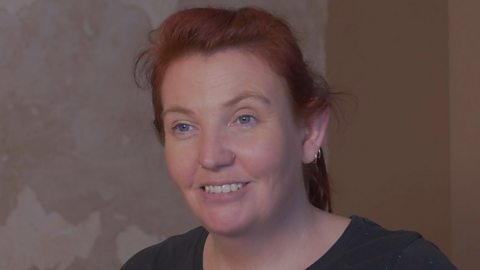
Meet Steph: Merseyside’s only female plasterer
Steph Leese is the only female plasterer working in Merseyside.
Another woman working in a trade is Katie Kelleher, a crane operator working on the Tottenham Court Road Cross Rail site.
She’s been doing the job for around two years – but was previously a recruitment consultant.
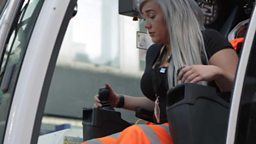
Katie applied for the job after seeing it advertised online and was a bit daunted by the fact that she could see “no women” on building sites, but she qualified for the job.
She says people are still surprised to see a woman in a crane - and often look at her like she's "grown a third head" - but it's the best job she's ever had.
People tend to look at you like you've grown a third head quite often"Katie Kelleher, crane operator
"I was never told that you could be a carpenter, that you could be a bricklayer, that you could do these things," she said. "You'd probably love it to be honest. I love it!"
Watch Katie in action on the Cross Rail site:
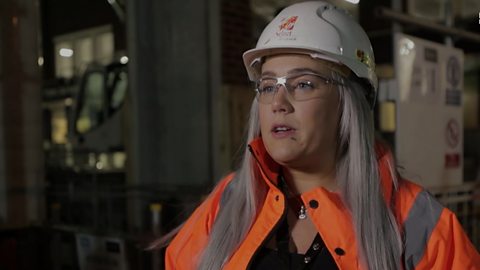
Meet Katie: ‘The woman who operates a crane’
Katie Kelleher is the only female crane operator at Tottenham Court Road Crossrail site.
So how can we get more women in trades?
Andrea Kelmanson, Chief Executive of Women on the Tools, says careers advisers need a more "consistent approach" with regard to manual trades.
Try to name one TV programme where we see a female builder, plumber or electrician"Phillippa Tuttiett, a builder in Cardiff
"People don't automatically say to girls 'that would be good for you, you're good with your hands, you want to solve a problem and create something,'" she said.
"What they tend to do with girls like that is recommend they go into beauty or hairdressing."
Phillippa Tuttiett, a builder in Cardiff, says more "exposure" is needed to encourage girls into the industry.
"Not many people will see women in the role. Try to name one TV programme where we see a female builder, plumber or electrician. It's so rare, so it's no wonder our young girls aren’t really thinking about it as an option."
But even if TV programmes showed female builders - would that necessarily inspire them to follow suit? Phillippa thinks it might.
"I absolutely love [my job]. It's mad, I've got friends who are accountants, lawyers, solicitors, and they're all jealous that I can renovate my own house."
Sarah McMonagle, Director of External Affairs for the Federation of Master Builders, believes the construction industry "still has a long way to go in terms of becoming more diverse".
The construction industry still has a long way to go in terms of becoming more diverse"Sarah McMonagle, Director of External Affairs for the Federation of Master Builders
"There are no roles that a woman categorically cannot do," she told 5 live. "Technology has improved which helps with things like heavy lifting."
She is, however, optimistic about the future: "If you look at other industries, nursing for example, years ago you wouldn't have imagined there would be many male nurses but now they are very common and the NHS is all the richer for it. That's the kind of cultural shift we need in construction too."
To listen back to 5 live's look at women in trades, please visit the "Find Out More" section at the bottom of the page.
Find out more:
![]()
Your Call: Why aren't there more women in trades?
Your calls with Rachel Burden.
![]()
Podcast: Afternoon Edition - guest edited by Steph Leese
This week's Afternoon Guest Takeover features Steph Leese, The Pink Plasterer.
![]()
100 Women
The BBC has chosen its list of inspirational and influential women for 2016.
![]()
What is working life like for women in the UK today?
Results of 5 live's survey, commissioned as part of the BBC's 100 Women season,