Troy: A brief history
Visiting academic at the British Museum and past curator of Mesopotamia, Nigel Tallis, takes us through the story of Troy.
The story behind the city
The fame of the beautiful Helen, the deeds of the Greek and Trojan heroes and the siege and sack of Troy have inspired and enthralled for generations. Alexander the Great, king of Macedon, paused his invading armies to sacrifice at Troy, and partly spun his world-shattering conquest of the immense Persian empire as vengeance for the abduction of Helen. Rome paraded its conquest of Greece as revenge for the burning of Troy, adopting the Trojan Aeneas as one of the founders of Rome. In the time of the empire, Roman emperors grandly embellished what was then the small town of Troy as the “mother-city” of Rome. Even in medieval Britain and in far distant Iceland, we find wandering Trojan princes claimed by writers as the founders of their nations, in attempts to understand the present through a remote, alien, yet impossibly glorious past.
In the time of the empire, Roman emperors grandly embellished what was then the small town of Troy as the “mother-city” of Rome.
The prime written source, the Iliad, actually focusses on only a single incident of the story we know from myth. It is said to be by Homer, of whom almost nothing is known, except he was possibly from Greek Ionia. It is a poem in Greek intended to be recited aloud to music; a story of divinities, war and heroes. Although we can’t be certain, it seems to have been composed, at least in part, by weaving together and reworking a number of older oral tales. As such it was a new work - a retelling - and of course it is poetry, meant for dramatic performance and not intended to be “history” as we understand it (though later Greeks and Romans took it all to be true).
Homer’s poem was probably formalised and written down in the Iron Age about 700-650 BC. Although there is much in it that is intentionally distant, fantastical and ancient - this is clearly set in a world of bronze not iron - and its subject is a heroic, part-imagined past, it also included much of the world contemporary to Homer. This would have given it relevance for the original audience. Homer’s “Achaeans” (he pointedly never actually calls the Greeks “Greeks”) characteristically burn their dead for example, as done later, not bury them as was done in the Bronze Age.
From archaeology, though, we know enough to see that there are many intriguing elements within Homer’s story of Troy and its grim, bronze-clad heroes which reflect an earlier age. Even the metre of the poetry seems, partly, to be far more ancient that Homer’s own times.
Historical background
Over 3500 years ago, there was a large kingdom in what is now western Turkey called Arzawa.
Sometime before our story, Arzawa was defeated by the powerful Hittite Empire to the east and broken up into smaller vassal states. It is from the imperial Hittite archives that we learn that the most distant and remote of these Arzawan vassals was the small coastal kingdom of Wilusa. Historians and archaeologists are by nature cautious, but the name (W)ilusa is very likely related to Greek “Ilios”, and Ilios is the other name for Troy. The Hittites also referred to Wilusa as “Taruisa”, which is, again likely to be related to Troy.
The people of Arzawa spoke Luwian, part of the Indo-European family of languages. Luwian is related to Hittite and it was written with a hieroglyphic script which is readable today. Did the Trojans speak Luwian? Homer imagines his Greeks and Trojans with the same language, goddesses and gods. We only have one Luwian inscription from Troy itself, found on the seal of a scribe, but it seems likely that Troy was part of the Luwian world. A world of "Wise Women", seers, scribes and ancient urban culture.
We hear of Troy through the Hittite royal correspondence, excavated over many years at its capital . The Hittites mention two kings of Troy: Walmu and Alaksandus. The Hittites draw up a treaty with king Alaksandus to make sure Wilusa supplies allied troops on time and does not mess around waiting for any conveniently delaying bird omens! Alexander is, of course, Homer’s other name for Paris, prince of Troy.
We hear of Troy through the Hittite royal correspondence, excavated over many years at its capital . The Hittites mention two kings of Troy: Walmu and Alaksandus.
And the bird omens? The area of Arzawa and Troy was famed above all for the skilled practise of augury: the interpretation of bird omens. These omens were determined through observing the flight of birds, and we have examples of how this was done as the Hittites recorded known successful rituals and the practise also continued, and is described in detail, well into the Roman period.
The site of Hisarlik and the nine towns of Troy
Known from ancient times, and widely recognised as the most likely site of the city of Troy, is the mound of Hisarlik in western Turkey. Once the shore was closer than it is now, and it would have been a perfect location to control movement through the Dardanelles, an ideal place for controlling trade and communications between Europe and Asia. Archaeologically, the site is a “tell”, an at least partly artificial mound built up over thousands of years of continuous human occupation. Excavation since the 19th century has identified at least nine successive walled settlements on the site from the third millennium BC onwards. One of these heavily fortified towns (Troy VIIa), violently destroyed, can be dated to c.1300-1200 BC, and late last century, a large lower town beyond this citadel was identified of about the same date. The large lower town, complete with underground tunnels and water channels, transformed understanding of the site. This is probably the historical Troy behind the tales and myth.
Warfare
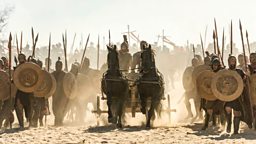
The 13th century BC is a period of rapid change in arms and armour and, therefore, warfare in the Aegean and Middle East. Types of armour and weapons from Central Europe and the Balkans are starting to replace the earlier styles that we know most about from Late Bronze Age Aegean art (and which most people will think of when imagining this period). The Iliad itself reflects a mix of cultural assumptions from earlier and later oral traditions. We see what seem to be Bronze Age styles of helmets and shields mentioned while some of the equipment seem more like the Iron Age. In Troy: Fall of a City, we sometimes mix older and later in the same way, as Homer did, but the primary inspiration is the Late Bronze Age.
Despite the world changing rapidly, in Greece and elsewhere, everything, even society itself, is still based around the chariot and chariot warriors.
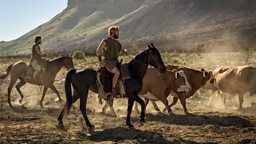
Despite the world changing rapidly, in Greece and elsewhere, everything, even society itself, is still based around the chariot and chariot warriors. The standard written greeting between kings of equal standing in the Late Bronze Age world of the Middle East and Aegean, in diplomatic letters accompanying rich gifts (reflecting trade) begins by reporting that the king’s house, horses, chariots and land are well and hopes the same is true for his brother king. Horses were only just beginning to be ridden more widely, and at this time the first horsemen, scouts mainly, are known in battle, but hard stirrups and saddles were unknown and most mounted warriors rode in chariots.
Charioteers could dismount to fight before this period, in certain circumstances, but this is what Homer assumes is natural in battle. It was less common in the Middle East, but it did occur, especially at sieges, and chariot crew are usually shown fully equipped for both roles: infantry and mounted warrior, heavily armoured, with shields carried in the chariots or by special shield bearers.
Homer’s Iliad envisages the heroes with spears that can be thrown or kept to thrust with. Combats are a mix of both. In the 7th century BC, Greek art shows early “hoplites” with a pair of spears, one for throwing and one for fighting with hand to hand. Later, it was a single spear alone for close fighting.
Siege warfare, not well developed in Greece, was highly advanced In the Middle East with its many strongly-fortified towns. Large siege engines designed to batter the walls, or pry away bricks or stones, were in the Iron Age often designed to look like powerful animals: elephants, boar, crocodiles. The ploy of the Trojan Horse can be understood this way, perhaps misunderstood, perhaps playfully re-invented, as well as simply a cunning trick.
Collapse
Historically, the world of the late 13th century BC was in crisis and on the brink of collapse. Within a generation, the great empires of the of Hittites, Egypt and the Middle East would be swept away or brought to the point of collapse. There are hints of this in Homer, in some ways Troy’s fall prefigures these events, but this story, of peoples on the move, of dislocation and wandering, is for another epic tale: The Odyssey.
More on Troy: Fall of a City
![]()
Play the Quiz
Test your knowledge with Nigel Tallis' quick quiz.
![]()
Who was Helen of Troy?
Historian Bettany Hughes writes about the myth of Helen and her continuing relevance.
![]()
Characters
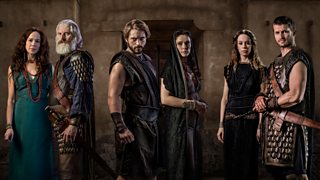
Meet the characters featured in Troy: Fall of a City.