Andrew's episode guide
It is well known that the Great War produced much remarkable British writing, above all poetry: verses of regret, sadness and loss, written mostly by soldier-poets in the damp and dangerous confines of the trenches. That poetry is widely celebrated, and deserves to be, especially in this year of centennial commemoration.
But what of those British servicemen and others who painted the war? Their lives and their work - which amounts to some of the angriest and most acerbic art of the early twentieth century - remain relatively unexplored. And their stories remain surprisingly unfamiliar, certainly to the public at large.
My new series, British Art at War, is an attempt to do justice to the work of three of those artists: to explore their very different experiences of war, to show how they reflected that in the pictures they created, and to examine how their lives were shaped by participation in that most terrible of conflicts.
Paul Nash: The Ghosts of War
The series begins with an episode about Paul Nash, who joined up shortly after the war began. He first enlisted in the Artists' Regiment, traditionally the regiment of choice for painters and sculptors. Frustrated by endless training exercises, he transferred to the Hampshire Regiment in the hope of seeing action, and saw it soon enough. He was sent to the front at Ypres in 1917, but stretchered back to England not long after, having damaged his ribs by falling into a trench while sketching - a comical mishap which probably saved his life.
During the months he spent recuperating, the Battle of Passchaendale was raging: 200,000 British soldiers dead or wounded, and Nash's entire regiment wiped out. After his recovery, he returned as an official war artist, but determined to complete a very unofficial, personal mission. He wanted to tell the unvarnished truth about the war, to bring his message home to the warmongers back in Britain, "and may it burn their lousy souls".
Above all Nash painted war-torn landscapes: the mortar-scarred mud of Flanders, festooned with barbed wire and awash with pools of viscous, oily water. He left out the dead and the injured, partly because their wounds were so horrific that he believed it would have been disrespectful to depict their mutilated faces and bodies: instead, he anthropomorphised the landscapes of war, depicted scorched earth and churned up soil with a violence that implied the disfigurement of flesh.
After the war, Nash turned to Surrealism, an art of enigmatic forms and mysterious, nightmarish juxtapositions which seemed, to many, the perfect reflection of a world gone mad. His lungs had been damaged by mustard gas and his life would be sadly cut short while he was still in middle age. But Nash lived long enough to see the Second World War and become one of its greatest chroniclers in paint. Totes Meer, or Dead Sea, his depiction of a great wave of downed German fighter planes, is one of the most haunting British paintings of the twentieth century. It was also, sadly, one of Nash's last creations.


Walter Sickert and the Theatre of War
The second episode focuses on the work of Walter Richard Sickert, best known now for the gritty urban realism of his Camden Town School paintings. But Sickert was also a brilliantly original painter of life during the wartime years. Too old to fight, he painted the conflict from the perspective of those left behind, who could only wonder about what was really going on at the front. Brighton Pierrots, a chillingly oblique depiction of seafront entertainers going about the business of raising morale at home, while war was raging just across the Channel, is perhaps his most memorable wartime picture. Sickert's subtly ironic attitude to war, and the posturing of nations, would persist throughout his long and remarkably prolific career.
David Bomberg: The Prophet in No Man's Land
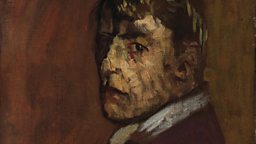
The third episode concentrates on the fascinating and much underrated David Bomberg, a young Jewish painter who enlisted in 1914 to fight for King and Country. Despite his tender age, Rifleman Bomberg was already a notorious member of the British avant-garde. Expelled from the Slade for his stubborn loyalty to the fractured style made popular by Picasso and his Cubist contemporaries in Paris - "the Picasso madness" as it was dubbed in the British press - Bomberg had created some of the most adventurous British paintings before the outbreak of war.
Briefly associated with the Vorticist movement, England's answer to French Cubism and Italian Futurism, Bomberg was a fervent believer in the Machine Age, subscribing to the widely held avant-garde view that a new utopia was about to be ushered in by the new technology of the early twentieth century. The experience of fighting in the trenches shattered his illusions, just as the heavy artillery brought in by the technological innovations of the time shattered the bodies of so many of his friends and fellow soldiers.
Bomberg was so appalled by the war that he briefly contemplated suicide, but he survived to paint his wartime masterpiece, Sappers at Work. It is a grimly geometricised vision of underground bombers tunnelling their way beneath the trenches: an official commission, intended to celebrate of military valour, which Bomberg twisted into a modern vision of hell. It would take Bomberg many years to get over the trauma of war, but he continued to develop and evolve as a painter into the 1950s, becoming one of the most influential artists and teachers of his time - greatly admired my many of the leading painters of modern times, including Lucian Freud and Frank Auerbach. It's my hope that this series will rekindle enthusiasm for the work not only of Bomberg but also of Nash, Sickert and indeed all the other British artists who went through the experience of the First World War.