It's a Wonderful Life: From festive flop to Christmas classic
17 December 2019
It's a film now indelibly linked to Christmas - but It's a Wonderful Life might have languished in semi-obscurity were it not for a copyright loophole that helped make it a permanent fixture in the seasonal schedules. MICHAEL PAPPAS tells the story.
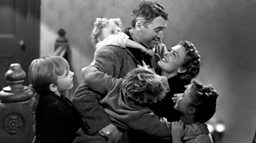
Seventy years ago, RKO Radio Pictures rush-released a film for the holiday season. It’s a Wonderful Life starred James Stewart as George Bailey, a savings and loans manager, who’s down on his luck and contemplates suicide, until convinced by an angel that the lives of the people around him would be worse if he was dead.
An adaptation of Philip Van Doren Stern’s short story The Greatest Gift, Frank Capra’s movie has managed to cement itself as part of the Christmas zeitgeist – despite Capra himself admitting in a 1984 interview: “I didn’t even think of it as a Christmas story when I first ran across it. I just liked the idea.”
I didn’t even think of it as a Christmas story when I first ran across it. I just liked the ideaFrank Capra
So how did a film which deals with dark themes, and which failed to perform at the box office – falling $525,000 short of its break-even point – manage to become what many think of as the definitive Christmas movie?
It all comes down to a legal loophole. The US Copyright Act of 1909, which protected films published before 1964, gave a body of work an initial copyright term of 28 years. At the end of that first term the copyright holder was permitted to apply for a second term of 28 years.
In 1974, at the end of its initial term of copyright, Republic Pictures, the original copyright owners of It’s a Wonderful Life, failed to apply for the second term – most probably due to a clerical error – and the film fell into the public domain.
It was at this point that American television studios, who were always on the lookout for cheap content, picked it up and, for almost two decades, played it over the festive holidays.
It was these repeated, royalty-free broadcasts that wove George Bailey, Mary Hatch, Clarence Oddbody and Uncle Billy into the fabric of our festive season. Capra later told the Wall Street Journal: “It's the damnedest thing I’ve ever seen. The film has a life of its own now and I can look at it like I had nothing to do with it.”
Things changed in 1993, however. While the film itself had fallen out of copyright, the story upon which it was based – The Greatest Gift – had not, and in fact was now owned by Republic Pictures.
And following a landmark ruling by the US Supreme Court in a separate case three years earlier, which determined that only the copyright owner of a story has the right to exploit derivative works such as films, Republic regained control of the picture. Today, NBC is now the only US broadcaster licensed to show the film on network television, and Paramount – who acquired Republic in 1998 – controls the distribution.
The film’s days of festive season saturation may be over, but thanks to those two ‘lapsed’ decades, It’s a Wonderful Life will remain a Christmas classic for many years to come.
A version of this article was originally published 23 December 2019
More on the film
![]()
Blizzard wizards
How the special effects team made the snow in It's a Wonderful Life.
More from BBC Arts
![]()
Picasso’s ex-factor
Who are the six women who shaped his life and work?
![]()
Quiz: Picasso or pixel?
Can you separate the AI fakes from genuine paintings by Pablo Picasso?
![]()
Frida: Fiery, fierce and passionate
The extraordinary life of Mexican artist Frida Kahlo, in her own words
![]()
Proms 2023: The best bits
From Yuja Wang to Northern Soul, handpicked stand-out moments from this year's Proms