A Cow and Bull story: How a dance collaboration was born
15 October 2014
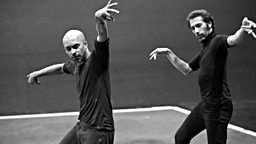
What happens when two internationally acclaimed contemporary dancers come together to create a new, experimental work? BBC Four’s What Do Artists Do All Day? captures the first steps of the collaboration between AKRAM KHAN and flamenco choreographer Israel Galván. Here London-born Khan tells BBC Arts how he and Galván fused Spanish flamenco and Indian kathak into a unique dance hybrid, to create their stunning new show TOROBAKA.
To be honest, I was never very keen on the idea of mixing kathak and flamenco. Most of the versions that I’ve seen have never been very exciting, even though I like flamenco itself. They’ve been quite superficial.
Then, when I saw Israel dance, I completely reversed my thinking. This man was phenomenal. I think he’s one of those artists that you can’t separate him from dance. Everything he does is dance. In his life, he’s constantly thinking about dance. He’s obsessed. I just wanted to collaborate with him. Then he came and saw me perform and we decided to work together.
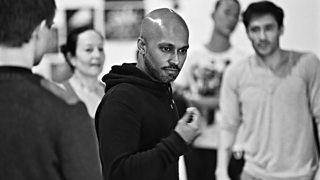
What he’s doing, you can’t put it into a box. It’s flamenco but he’s breaking the rules, deconstructing from within. That’s a very smart thing to do and very few people can do something like that.
The first sessions were tentative but it was okay because it was still very open. We hadn’t reached the difficult stage which comes after that when you go, “We now have to make a decision. And this decision has consequences”.
So at that early stage we were still in that phase where you’re just getting to know each other, exchanging ideas back and forth without committing to any single idea. We were inspired.
That initial moment of committing to the new world we wanted to create was complex and challenging. But then once we negotiated an aesthetic, a world that we were going to create or inhabit on stage, then it was really plain sailing from there. It was very exciting after that.
What Do Artists Do All Day?
What Do Artists Do All Day followed Akram Khan to Seville where he began to formulate the experimental work TOROBAKA with Israel Galván.
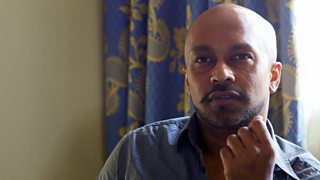
Watch on BBC iPlayer until 14 November 2014.
It was more the collaborators who were watching the rehearsal who were egging us on and saying, “Wow, this is really beautiful to watch. There’s something here” rather than us realising it. Because we were on the inside.
Once we're on stage, you’re outside the realms of time”
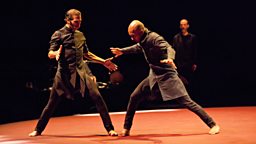
The title TOROBAKA came from Israel. It’s really about a celebration of rhythm, of energy. It’s also playful. We were both discussing the idea of animals and origin. The most important animal in Spain is usually the bull, which is toro. And in India one of the most sacred animals is the cow.
Vaca is Spanish for cow but then we tweaked it to Baka. So, TOROBAKA. One of the things we were very clear with each other was that we both wanted to exchange being the bull and the cow. It wasn’t stereotyped. It wasn’t he’s Spanish so he’s going to be the bull so I’m going to be the cow.
Of course a premiere is always nerve-wracking [TOROBAKA debuted in Grenoble in June]. Once you’re over that premiere and the more you perform it, the more confident you become. But to be honest with you, I’m very, very terrified before I get on stage. We were both terrified. Shaking, literally. The older I get the more terrified I become.
But once I’m on stage - and this is the same for Israel - once we’re on stage, you’re then outside the realms of time. You’re in the present. Something clicks and the future and the past become irrelevant. We don’t have time to worry or to fear.
Akram Khan and Israel Galván's TOROBAKA makes its UK premiere at Sadler’s Wells in London on November 3rd 2014.