Cat Stress
More than 4.5 million cats in the UK live in multi-cat households. Almost half (46%) of owners with multiple cat households report stress related behavioural problems that are severe enough to motivate the owner to find a solution.
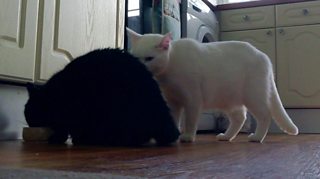
Cats have been living alongside humans for at least 4000 years, but in contrast to dogs, are considered to be only partially domesticated. Although cats live with humans and depend on them for food and shelter, cats retain many wild traits, including a need to have control over their access to essential resources, privacy and seclusion. And unlike highly social species such as dogs or humans, cats evolved to hunt alone, do not depend on social interaction for survival and are more solitary. So although they can form positive bonds with other cats, for many, living in a multi-cat household is a cause of significant stress.Alice
How to recognise if my cat is stressed?
Cats can become stressed as a result of living with another cat with which they are not socially compatible. The home environment might mean they are forced to share resources, such as food and water bowls, and litter trays. If resources within the territory are perceived as limited or scarce, this can be a cause of anxiety or conflict. Cats will either learn to avoid each other, using communication geared towards increasing distance between them, or adapt to the situation by suppressing natural behaviour to avoid conflict.
Examples of acute stress include – vocalisation, pupils dilated, whiskers back, abnormal toileting behaviour, crouching and shaking.
When stressed, some cats may indulge in normal behaviours that are deemed ‘safe’, such as grooming, sleeping and eating, but to an excessive level as a means to self-sooth.
In cases where an individual cat is unable to adapt, it may develop chronic stress over a longer period of time. Examples of chronic stress include hiding, urine spraying, scratching, fighting, and development of cystitis.
How can we reduce stress within a multi-cat household?
Determining stress within a cat can be exceptionally difficult, and is generally misunderstood by many owners. The first step is to recognise signs of stress, which can then allow cat owners to implement interventions to reduce stress – and this is where our Trust Me I’m A Vet study comes in.
Our Study
Our study was designed and carried out in collaboration with specialist Veterinary Behaviourist, Dr. Sarah Heath, to reduce cat stress levels in multi-cat households in which the owners felt they had an issue with stress.
The Trust Me I’m A Vet team recruited 3 households (with between 2-4 cats), to join the study. Each household was referred to Dr. Heath’s practice by their local veterinary practice. The clinical histories of all cats were reviewed, so as to ensure there were no underlying health problems. Dr Heath’s team assessed each case to determine if there were measurable signs of feline stress, but which weren’t severe enough to warrant intensive management.
Working with Dr. Heath, the 6-week study was set up with the aim to provide owners with the skills and actions to recognise and alleviate feline stress within their own home before it might progress to a more extreme level. In conducting the study it was important to realise that some cats are not socially compatible, therefore would never become completely relaxed around one another.
The step-wise plan to reduce stress within the home adhered to the ‘Five Pillars of a Healthy Feline Environment’ as published in the ISFM/AAFP Guidelines on Feline Environmental Needs.
The five pillars of a healthy feline environment are as follows:
Pillar 1: Providing a safe place for cats
Pillar 2: Providing multiple and separated key environmental resources: food, water, toileting areas, scratching areas, play areas, and resting or sleeping areas.
Pillar 3: Providing an opportunity for play and predatory behaviour
Pillar 4: Providing positive, consistent and predictable human-cat social interaction
Pillar 5: Providing an environment that respects the importance of the cat’s sense of smell
By grouping the pillars into three sections, the trial aimed to improve the environmental, social and sensory factors that can impact the stress levels of feline household.
Trial Description
Every 2 weeks, over a 6 week period a number of changes were made within the household-
Weeks 1 and 2: ‘Separation’. The number and position of basic resources were altered. This meant increasing the number of food bowls, water bowls, litter trays and beds, and separating them by placing them in different parts of each house. This was done to give the cats their own space in which to carry out basic needs.
Weeks 3 and 4: ‘Toys’. A variety of toys were introduced, including feeding puzzle toys, to encourage the cat’s play and foraging behaviour. Owners were encouraged to play with their cats using the toys.
Weeks 5 and 6: ‘Smell’. A pheromone diffuser was placed in the home. These are designed to spread a scent that cats find relaxing.
The week before the study started, and every week over the 6 week period, our volunteer households were asked to assess the state of stress in the household by filling in a survey. The survey was designed by Veterinary Clinician, Dr. Theresa De Porter. Owners were given a list of particular behaviours associated with stress (for example, cats chasing, stalking or staring at each other) and were asked to identify and log how intense the interaction between the cats was, and how frequently the ‘stress’ behaviour occurred. Owners were encouraged to spend time observing their cats, and avoid disciplining cats for stressed behaviour (such as vocalisation).
Dr. Heath and the Trust Me I’m A Vet team kept in frequent contact with the owners, who were also asked to try and capture footage of the their cats within their home (in order to minimize disturbance or stress with a film crew visiting).
Results
The data from the surveys was analysed by multiplying the intensity of stress behaviour by its frequency of occurrence for the multi-cat household as a whole. This provided a cat-stress score for each week of the study. The data for each household was plotted against time.
The stress score reduced markedly in all three households over the course of the study. Dramatic reductions in stress were recorded during the Separation phase (repositioning and allocation of resources) and also in the Toys phase (addition of toys and play), but the exact pattern in all three households differed.
In one household, the trend was disrupted, and in fact stress appeared to rise, between the Separation phase and the Toys phase. Dr Heath identified the likely cause as intrusion by an outside cat through the cat flap. A microchip-operated cat flap was installed and the household’s stress scores reduced consistently thereafter.
In all households, the combination of all three interventions appeared to be important in the significant overall reduction of stress.
Although this was a small-scale study and the data collected was qualitative, the results support prior research suggesting that these interventions are effective in reducing stress and give an indication of which are likely to be most effective.

Cat Stress
How to reduce stress in cats

