Beauty from chaos: War monuments are some of the most poignant British architecture of the 20th Century
11 November 2022
The memorials to the missing and dead of World War One are among the most poignant British architecture of the 20th century. On Sunday 13 November on BBC Four, Dan Cruickshank's Monuments of Remembrance tells the extraordinary story behind this humanitarian building mission, described by Rudyard Kipling as the greatest work 'since any of the Pharaohs'.
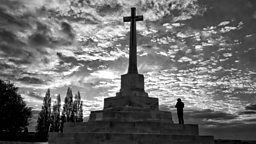
The American architect John Russell Pope was advised by Paul Cret of the American Battle Monuments Committee in 1925: ‘‘Do something beautiful. This is the most important monument and for this reason it has been entrusted to you.’’
To attempt to create a sense of beauty in a world of madness, in a landscape of industrialised mass-killing, was perhaps itself an act of madness.Dan Cruickshank
Both men were famous architects, and the subject was the monument at Montfaucon d’Argonne commemorating the American advance on Verdun in 1918.
Britain's version of the Committee was established by Royal Charter in 1917 as the Imperial War Graves Commission, and it had been founded on the vision of one man, Fabian Ware. Through his work with the British Red Cross in occupied France, Ware had realised that a sacrifice on such a scale had to be memorialised, and the idea of building memorials and cemeteries began to take shape.
The Commission employed the best architects of the age - Edwin Lutyens, Reginald Blomfield, Herbert Baker - and sculptors Eric Henri Kennington, Charles Thomas Wheeler, Gilbert Ledward and Charles Sargeant Jagger; Rudyard Kipling was appointed literary advisor for the language used for memorial inscriptions.
Art historian Dan Cruickshank is the presenter of Monuments of Remembrance, which explores the history of this endeavour. He says, "To attempt to create a sense of beauty in a world of madness, in a landscape of industrialised mass-killing, was perhaps itself an act of madness."
By 1918, the Commission had identified 587,000 graves and a further 559,000 casualties with no grave.
Thiepval Memorial to the Missing of the Somme
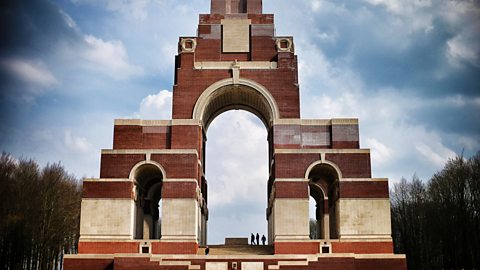
Thiepval Memorial
Thiepval Memorial commemorates over 72,000 servicemen missing from the Somme.
Edwin Lutyens, designer of the Cenotaph in London, was given the ultimate challenge of creating a memorial to the missing of the Somme. On a high ridge overlooking the Somme river at Thiepval, he created his great masterpiece. Unveiled in 1932, it is over 45 metres tall and dominates the surrounding landscape.
Dan Cruickshank says, "the power of Lutyens' work comes not just from the names, of which there are over 72,000, but from the monument itself. Power comes from the elemental abstract forms. The arches pirouette, they crest to north, south, east and west, symbolising a loss of direction, an uncertainty. This a great squatting beast of a building, a pyramidal spider in the landscape."
Next to the memorial is the Thiepval Anglo-French Cemetery, which contains equal numbers of British and French casualties, and cementing the links between the British and French Military on the Somme battlefield.
Completion of the Thiepval Memorial marked the end of the Commission's great building projects. By then over 500 cemeteries had been built in France and Belgium, with 400,000 headstones, a thousand Crosses of Sacrifice, and 400 Stones of Remembrance. Fabian Ware's vision had created order out of chaos, beauty out of ugliness, and would change forever the way we would remember our war dead.
Below, earlier examples of the architecture that characterised the cemeteries and monuments that were produced by this huge humanitarian undertaking.

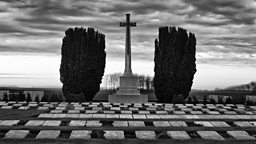

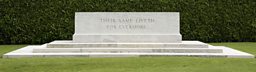
Rudyard Kipling and the Stone of Remembrance
Uniform headstones gave cemeteries abroad a uniformity of design, and were also fundamental to the Commission's stated aim for equality of treatment. As well as architects, the Commission employed a number of artists, designers and writers. Graphic designer Leslie MacDonald Gill created the sober Roman lettering that all headstones employed.
Drawing on his personal sorrow and biblical inspiration, Rudyard Kipling proposed 'Their name liveth for evermore'.
As Honorary Literary Advisor, writer Rudyard Kipling created much of the language used in memorial inscriptions. It was a task with deep personal significance, as Kipling was still grieving for his only son John ('Jack'), who went missing in September 1915 while serving with the Irish Guards at the Battle of Loos. Drawing on his own sorrow, and biblical inspiration, Kipling proposed 'Their name liveth for evermore'.
Kipling's words were used on the Stone of Remembrance, designed by Edwin Lutyens for larger cemeteries with more than 1000 burials. It was abstractly styled and avoided any religious symbolism other than its resemblance to an altar or sarcophagus. More than 500 were erected in France and Belgium alone.
Lutyens corresponded with Fabian Ware as his ideas for the memorial developed, writing in 1917: "Place one great stone of fine proportion 12 feet long and finely wrot... so that all men for all times may read and know the reason why these stones are placed throughout France.”
Dan Cruickshank says, "Lutyens sought to create a symbol that would endure in the landscape for centuries to come. It is for people of all faiths, or none... it is perhaps Lutyens' use of a system of proportions rooted in nature that gives this stone standing in the landscape, in the setting of nature, such an extraordinary and sublime beauty.”
Passchendaele: Tyne Cot Cemetery
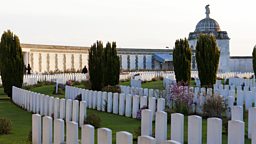
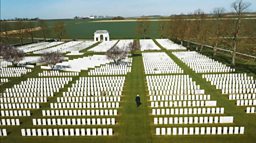
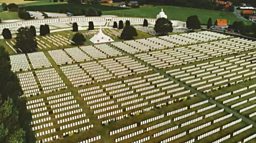
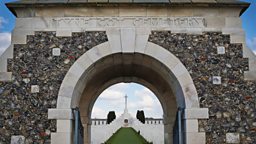
Tyne Cot is one of four memorials in Belgian Flanders and was the site of the Third Battle of Ypres, also known as the Battle of Passchendaele.
At the end of the day you have the headstones, and nothing can deny the horror of the headstones.Dan Cruickshank
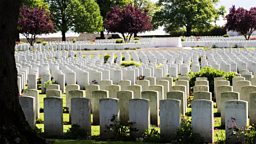
Tyne Cot was designed by Commission architect Sir Herbert Baker, who sought to create "the semblance of an English churchyard". Dan Cruickshank says, "Does it work? Maybe, maybe not. But at the end of the day you have the headstones, and nothing can deny the horror of the headstones".
With 11,956 servicemen buried or commemorated, it is the largest Commission cemetery in the world. 8,369 of the burials are unidentified. The wall at the back of the cemetery lists the names of 35,000 soldiers whose bodies were never found.
'Here Was A Royal Fellowship of Death': Royal Artillery Memorial at Hyde Park Corner
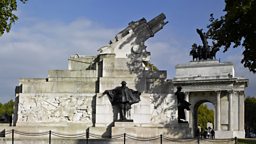
Following the public reaction in 1920 to Lutyen's Cenotaph in London being made a permanent structure, more than 50,000 monuments were built in Britain. Part of the motivation was that they were seen as a necessity for a grieving population without the means to travel to the Continent. Many were privately commissioned, and in the case of the Royal Artillery monument paid for by its War Commemoration Fund.
The more you look, the more they resemble nightmares conceived by Goya and carved by Donatello.Art critic Jonathan Jones
The memorial commemorates the 'Forty nine thousand and seventy six' dead of the Royal Artillery regiment. It was designed by sculptor Charles Sargeant Jagger, a “rising and vigorous artist” who had been wounded at Gallipoli, with input from architect Lionel Pearson. It was unveiled in 1925 at Hyde Park Corner in London.
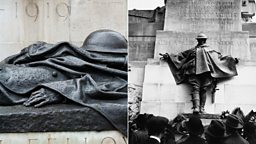
The monument features a sculpture of a huge howitzer on a large plinth of Portland stone, with stone reliefs depicting scenes from the conflict. Around its pedestal stand three bronze gunners. Jagger believed that a memorial should tell the public about the horror and terror of war, and late in the construction a fourth bronze was added at the sculptor's own expense. The figure lies dead under a greatcoat, above the inscription 'Here Was A Royal Fellowship of Death'. The text stands in contrast to the words of Kipling and only gained memorial committee approval through its literary origins in Shakespeare's Henry V.
Art critic Brian Sewell said it was "so modern that it makes Henry Moore seem shallow and Picasso frivolous." When it was restored in 2014, The Guardian's critic Jonathan Jones wrote, "these scenes might seem, at first glance, a conventional image of artillerymen at work... But the more you look, the more they resemble nightmares conceived by Goya and carved by Donatello. Like German expressionist images of the war, these formidable scenes convey the mess, filth, exhaustion and futility of the western front."
![]()
Watch Dan Cruickshank's history of First World War monuments
Dan Cruickshank's Monuments of Remembrance is on BBC Four and BBC iPlayer on Sunday 13 November.

Fabian Ware and the War Graves Commission
The Imperial War Graves Commission's founder, Fabian Ware, was a former newspaper editor who in 1914, aged 45, commanded a mobile Red Cross ambulance unit in France. Under his direction, Ware's unit began to catalogue the temporary graves they found as they swept an area following an offensive.
Central to the idea of memorial was a clear decision that the body should not be repatriated.
Ware realised early on that the sheer numbers were overwhelming. He secured funding from London to continue the work, and he and his men set about creating a register of the dead.
By 1915 the work done by Ware's unit was officially recognised by the War Office and it was incorporated into the British Army as the Graves Registration Commission. The Imperial War Graves Commission was established by Royal Charter in May 1917.
Ware invited architects Sir Edwin Lutyens and Sir Herbert Baker to France in 1917 to discuss plans for commemoration. Along with Sir Reginald Blomfield they were appointed principal architects to the Commission in 1918.
Central to the idea of memorial was a clear decision that the body should not be repatriated; the Commission's own cemeteries built on or near the battlefields would be the burial sites.
Key to the Commission's cemeteries was the (at the time radical) idea that, as stated in the Commission's 1918 report, "whatever their military rank or position in civil life, everyone should have equal treatment in their graves". The common nature of the sacrifice must be recognised, regardless of one's status, religion or ethnic origin.

Inequalities in commemoration
In 2021, a review by a special committee of the Commonwealth War Graves Commission found the organisation's stated mission had been significantly compromised as a result of "pervasive racism". There were "failures to properly commemorate black and Asian troops" who died fighting for the British Empire during World War One. Defence Secretary Ben Wallace made an official apology in the House of Commons over the findings.
More from BBC Arts
![]()
Picasso’s ex-factor
Who are the six women who shaped his life and work?
![]()
Quiz: Picasso or pixel?
Can you separate the AI fakes from genuine paintings by Pablo Picasso?
![]()
Frida: Fiery, fierce and passionate
The extraordinary life of Mexican artist Frida Kahlo, in her own words
![]()
Proms 2023: The best bits
From Yuja Wang to Northern Soul, handpicked stand-out moments from this year's Proms