Rabbit stress
After dogs and cats, our most popular pets are rabbits – there are nearly two million of them across the UK. But new research shows that many of them are experiencing unnecessary long-term stress.
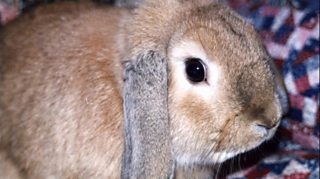
Healthy pet rabbits will behave like those in the wild – running, jumping, and standing up. Wild rabbits are social animals and tend to live in large groups. They will be active at dawn and dusk, when they come out of their burrows to feed, socialise and mark their territory. As a prey species, they don’t play in quite the same way as a dog or a cat but rabbits can be seen pirouetting or doing head flicks, running around at high speed, or twisting their head and body in opposite directions. This is called binkying and it’s what rabbits do when they’re having fun.
They are also naturally territorial and anything they see as theirs will be marked out using chin secretions, urine and droppings.
These are some of the key behaviours that tell you if your rabbit is as happy as a pet as it would be if in the wild.
The problem is that living as domestic pets, they don’t always have the opportunity to behave like this. Many pet rabbits are kept on their own in a small hutch.
New research from Bristol University Vet School shows that around two thirds of domestic rabbits live in hutches and are likely to be experiencing long term stress as a direct consequence of living alone and in cramped conditions. If stress is not recognised, it can become a serious health issue that affects their immune system and increases their risk of digestive problems and other illnesses.
What To Look Out For
Signs of stress can include your rabbit staying hunched up for long periods when awake; not being active at dawn and dusk; gnawing at the bars of its cage or the wire of its hutch; other repetitive actions that indicate anxiety. It may also be aggressive to people or other rabbits, particularly if the behaviour is unusual, and may resist handling.
What To Do About It
The research has shown that rabbits’ stress can be eased by two simple steps. First, changing their living space. Research shows that they need at least three metres’ length and sufficient head-room to be able to behave as they might in the wild – with running, jumping and standing up.
They also need features that mimic their natural environment including tubes like tunnels; objects they can stand on; a cosy place to hide and a space to forage and play. And above all, it should be safe from unwelcome predators.
The second step to consider is finding your rabbit some company. Rabbits are social animals who enjoy being with other rabbits. But choosing a companion is a more complex affair than it might seem. Rabbits are picky about who they spend their time with and should be allowed to bond first and choose any friends who are going to share their hutch. And if it’s a male and female pair, ask your vet for advice about neutering.
Our Study
We recruited a household with a pet rabbit they’d taken in a year previously – Peppa. He came with his own hutch, but his new owner, Paula, had been worried that he didn’t have enough space and that this was affecting his wellbeing.
With the help of Nicola Rooney of the University of Bristol Vet School, we placed cameras in the hutch to assess his behaviour over a 24-hour period.
We observed that Peppa was spending a lot of time in a hunched position and was inactive at dawn and dusk when he should naturally most active – behaviours that are associated with stress.
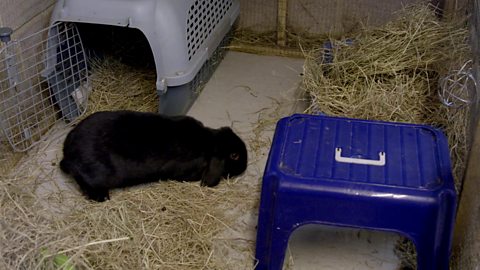
To find out whether solitary life in the hutch was causing Peppa’s stress, we replaced his hutch with an enclosure that was larger and contains features that mimic a rabbit’s natural habitat. These include tunnels where he can feel safe, objects to climb on and hide under and open spaces where he could run, jump and stand up.
Secondly, we found Peppa a companion. Tamarin, a female rabbit moved into the new enclosure with Peppa.
Once again, we installed cameras to record their behaviour for 24 hours to find out if the changes to his living environment had reduced Peppa’s stress. The footage showed Peppa being much more active and playful, especially at those key times of dawn and dusk.
It also showed he Peppa and Tamarin grooming each other, which meant they had bonded. And it revealed a sign that they are both content and relaxed – they stretched out in the middle of the night rather than remaining hunched and on alert.
Conclusion
Our small study showed the difference you can make to your pet’s stress levels in a relatively short space of time.
If you’d like to know more about how to improve your rabbit’s environment and quality of life, please go to:
Rabbit home improvements
Peppa the rabbit gets some home improvements and goes dating

