A history of the fall of the Aztecs
The meeting of the controversial Spanish conquistador Hernán Cortés and the formidable Emperor Montezuma in 1519 was one of the great hinge moments of world history, and the beginning of the end for the mightiest of the New World empires: the realm of the Aztecs.
The build-up to this extraordinary encounter is at once a thrilling adventure story and a tragic tale of violence, brutality and loss. It’s a story of temples and sacrifices, exploration and imperialism, with cataclysmic consequences for human history.
Just as he explores the rich history of the Aztecs on the latest series of Civilisations: Rise and Fall on BBC Two, historian Dominic Sandbrook also explores their world in his podcast The Rest Is History on BBC Sounds. In episode one, co-hosts Tom Holland and Dominic follow the young Cortés across the Atlantic to the Caribbean islands of Hispaniola and Cuba, where the search for gold comes at a terrible price. Here are some of the things we learned.
1. On 8 November 1519, one of the most important meetings in history took place.
It was the day Hernan Cortes and the Aztec emperor Montezuma met on the causeway outside the great city of Tenochtitlan (now Mexico City). “It is an extraordinary historical moment,” says Dominic. “It's the closest Europeans would ever come to meeting aliens – and the same, by the way, for the Mesoamericans. It's not just the meeting of two individuals, but it carries so much baggage now. It's a foundational moment in the story of colonialism, of European imperialism, of the Colombian Exchange between the great land masses of our planet, the old world, and the new exchange of viruses, foods, habits – all of these things.”
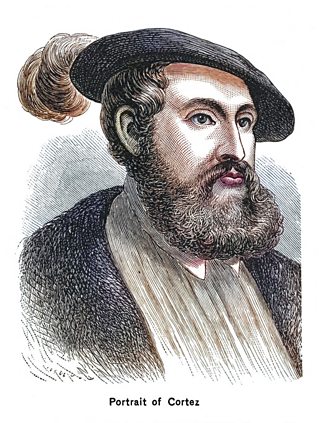
2. Much of the traditional story of the Aztecs and the Spanish could be wrong.
While many of us know parts of that story: for example, that the Aztecs thought the Spanish were gods, and the Aztecs surrendered their kingdom because the coming of the Spanish had been foretold. However, Dominic says, “A huge amount of that traditional story is probably completely wrong. And on top of that, the Spanish sources may be lying to us. They may have been lying to themselves about what happened, but they also may have completely misunderstood what was happening. So our glimpses of the story are always through dirty window panes – and that's the fun of it.”
3. The word “Aztecs” was coined in the 18th century.
It was then popularised in the 19th century as a way of distinguishing the Mexica (the people who live in Tenochtitlan in the Valley of Mexico) from modern Mexicans. “They never called themselves the Aztecs, rather like the Vikings didn't call themselves the Vikings,” Dominic explains.
4. Hernán Cortés was born in Medellín, Spain.
The Cortés family were not poor; they probably owned a beehive and a little mill and a vineyard, and a house in the center of Medellín. “And I think this probably matters; Medellin is a place where violence is not uncommon. It was famous in Spain for its lawlessness and its feuding and its factional violence, with punch-ups and stabbings in the town square.” Or as the historian Hugh Thomas put it: “Cortés emerged from a world of rebellion, war and conspiracy second to none.”
5. In the late 1490s, Cortes decided to go west to seek his fortune.
At this point, Christopher Columbus had already sailed to the New World, so many Spaniards were already heading west to seek fortunes of their own. “After a lot of toing and froing, Cortés decides that he will go west himself, because his sort of family connection called Nicolás de Ovando has been made governor of Hispaniola, of the great islands that today are Haiti and the Dominican Republic.”
6. Cortés was a gambler.
Dominic describes Cortes’ life serving as a notary on Hispaniola as “very boring”. He had found himself filling in ledgers and working as a pen pusher. But he was also a womaniser and a gambler. “I think that's an important part of his character. He was a gambler. He probably got into some drunken fights. There's a story that he has a scar on his chin from having a fight about a woman. But the truth of the matter is, I think there was a sense at the turn of the 1510s that Cortes’ great gamble of crossing the Atlantic hadn’t really worked. He was kind of going nowhere.”
7. Cortés wanted to be his own man.
Cortés left Hispaniola for Cuba in 1511, joining the wealthy landowner Diego Velázquez on a mission to conquer and colonise the island. Velázquez rewarded Cortés with a country estate. “But there are some signs that Cortés actually doesn't like being somebody else's creature. They have a massive row. Cortés has been flirting or ‘carrying on’ with a woman called Catalina Suárez, and she thinks he'd promised to marry her. He says no. So, Velázquez throws him into prison and sacks him from his job. Afterwards, Cortés has to apologise and marry her. He's described afterwards as being very downcast and humble, as if he had been the lowliest servant. Velázquez seems to forgive him and makes him the chief magistrate again of Santiago. But Cortés has a bit of a grudge about this.”
8. There was a good reason the Spanish were interested in gold.
When the Spanish encountered the Maya on the coast of what is now the Mexican state of Tabasco, they were given one or two trinkets of gold. It was this that most interested the Spanish. “Gold is so easily portable,” Dominic explains, “it's very easily divisible among your company, and it doesn't rust. You can take it back to Spain and use it to buy a nice farm or estate, and elevate your family. There's no point getting resources that you can't travel with.”
9. Sending Cortés west was a big mistake.
Before this, Juan de Grijalva, a relative of Velázquez, had been sent on an expedition west where he encountered the Maya and the Totanac peoples. They informed him of the existence of a larger kingdom inland, containing lots of gold. Juan de Grijalva sailed back to Cuba and told Velázquez of his discovery, who was delighted. He decided to send someone to stake his claim to these new lands. “However, he has to move quickly,” Dominic says. “He doesn't want [to send] someone who's too good. He wants somebody he knows who can be pushed around – a functionary. Somebody who's good at form filling. It's the greatest mistake that Velázquez would ever make. Because the man he picks is, of course, Hernan Cortés.”
To learn more about Cortés and the Aztecs, you can listen to The Rest Is History on BBC Sounds.
![]()
Not Just the Tudors
From the Aztecs to witches, Prof Suzannah Lipscomb talks all aspects of the Tudor period
![]()
Short History Of...
Witness history's most incredible moments and remarkable people.
![]()
You're Dead to Me
The comedy podcast that takes history seriously. Hosted by Greg Jenner.
![]()
Being Roman with Mary Beard
From a slave to an emperor, Mary Beard reveals the real people of the Roman Empire.