Capturing the heart of India
Broadcaster Sir Mark Tully, the BBC’s former Bureau Chief in Delhi, joined the BBC Scottish Symphony Orchestra on tour in April 2014. He reflects on the impact their music had on Indian audiences:
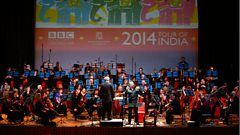
James MacMillan brought Gordon Cree’s arrangement of Scottish reels to a climax with a dramatic flourish of his baton. The audience, filling the concert hall of Mumbai’s National Centre for the Performing Arts, leapt to its feet cheering and clapping. The BBC Scottish Symphony Orchestra’s eleven day tour of India came to a triumphant end.
Some twelve thousand adults and children have been thrilled and entertained by the orchestra in three of India’s largest cities, Mumbai, once Bombay, Chennai, once Madras, and the capital Delhi.
I say entertained because the arrangement of Scottish reels was the last of three light-hearted encores, intended as fun, and accepted as that by the audience. There was nothing light-hearted about the thrilling performance of Tchaikovsky’s 4th Symphony that came before the reels.
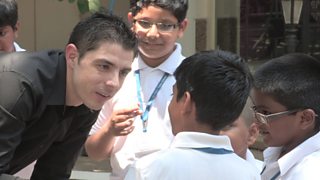
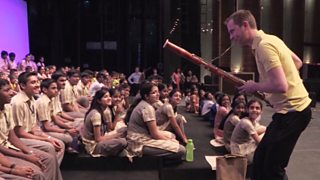
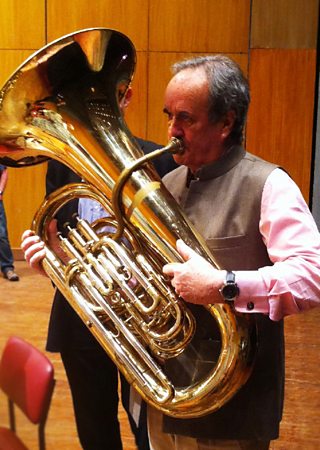
There was a concert aimed at families in the same auditorium, presented by music educationalist Paul Rissman. He introduced the four sections of the orchestra. The tuba proved a particular favourite with the children.
The conductor James MacMillan introduced the spoons from the percussion section and suggested that there were plenty of other kitchen implements on which children could practice percussion. The concert was part of the orchestra’s educational effort which also included workshops.
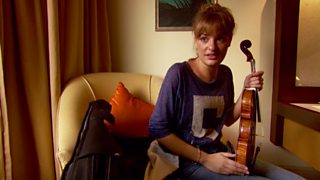
The Scottish solo violinist, Nicola Benedetti, who accompanied the orchestra as it travelled round India, described a workshop she had taught as “one of the most exciting I have ever done”.
It wasn’t just the orchestra which captured the heart of Indians. India captivated the orchestra. Second violinist Alex Gascoine said: “This has been the tour to end all tours." I had lunch with the group of students from the Royal Conservatoire of Scotland who were playing in the orchestra.
They were overwhelmed by the friendliness they found everywhere, and came armed with a multitude of questions ranging from India’s ancient multi-faith tradition to the survival today of the caste system.
The students’ musical skill was so highly admired that Kushroo Suntook, the founder of India’s only professional symphony orchestra, wants them to form a wind quintet and come to play in India for a year.
Summing up BBC SSO’s tour Kushroo said: “It has been illuminating because of the sheer excitement of their performance and the tremendous social cause they have served through their educational efforts.”
After the final concert the British Council, who generously assisted the tour, gave a reception at which it was widely agreed that this success should be the beginning of a lasting relationship between India and Scotland.
The aim would be to spread the love of western classical music more widely in India, increase performances, improve training for musicians, and provide work for them. How that may turn out only the future can tell, but if nothing is built on the goodwill the tour has created on both sides it will be a tragic waste.
![]()
The orchestra in India
Explore all coverage of the BBC SSO tour of India from BBC Arts.