"I use a ventilator, it doesn’t mean I’m dying”
By Sanjeev Mann // BBC The Social contributor // 05 May 2022
Since the pandemic, you’ve probably become a lot more aware of ventilators, but most people have the wrong impression about what they do and what it means for the person who’s using them.
I’m Sanjeev, and I regularly use a ventilator. To make things easier to understand, I’m going to go through a few different types of ventilators, the stigma I’ve experienced, and explain why using a ventilator doesn’t mean you’re dying!
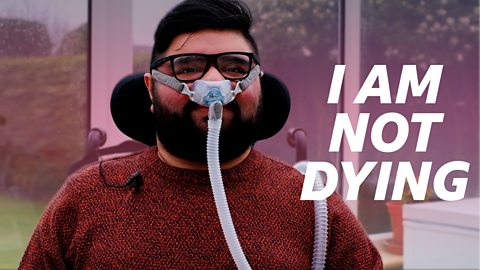
"Just because I use a ventilator, it doesn’t mean I’m dying”
Sanjeev explains the difference between different ventilators.
What do ventilators do?
There are a few different types of ventilators, but the two main ones are ‘invasive’ and ‘non-invasive’.
Invasive ventilators are usually used in hospitals to deliver oxygen and were used during the pandemic in hospital wards to help treat Covid-19. This type uses a pipe in your throat to breathe for you.

But the most commonly used ventilators are ‘non-invasive’, and they help with breathlessness, a lack of oxygen, too much Co2 or even snoring.
So, what exactly does it do? Putting it simply, the machine uses positive pressure to push air down and assist your lungs to breathe. People usually assume it's oxygen, when most of the time it’s usually air coming through the ventilator.
I use the ventilator to improve my oxygen levels, and therefore decrease the amount of carbon dioxide in the body. Too much CO2 can lead to headaches, tiredness, and breathlessness.
Despite how it may appear, using a ventilator of this type does not mean you’re dying, it just means you need a little bit of extra assistance with breathing.
My experience using a ventilator
Personally, I use a ventilator every night, and sometimes during the day, to assist with breathing. This is common for people with muscle wasting and other neuromuscular conditions like Duchenne Muscular Dystrophy, which is what I have.
Initially, I found it quite hard to get used to wearing something on my face, and it was quite difficult to find the right mask that was comfortable for me. But overall, ventilators are a great help to so many people including me, and it really improves the life expectancy of many conditions.
I’ve been using it regularly for a few years now, so it’s second nature and isn’t really something I think about until I go out. That’s when the anxiety hits, because often I feel people think less of me because they just don’t understand what it’s actually for. That’s why education is key to a more open-minded society, that supports rather than stigmatises people with health conditions.
The stigma of using a ventilator
There definitely seems to be a big stigma attached to wearing ventilators, especially in public. For me, I don’t really feel comfortable wearing it when out and about because it feels like people often stare, and are generally less likely to talk to me or approach me.
I don’t really feel comfortable wearing it when out and about because it feels like people often stare.
For example, when I went to the Euros at Hampden last summer, the stewards would talk to my personal assistants instead of me, because they presumed that I wasn’t able to talk.
This attitude only enforces the idea that disabled people can’t speak or think for themselves. It only adds to the perception that all disabled people are not mentally competent or have some form of neuro-developmental disorder.
This attitude has to change so we can move forward and accept all people with disabilities. The next time you see someone using a ventilator, don’t just assume that they’re recovering from cancer or Covid, but know that using a ventilator is a useful tool for many to go about daily life.