Guillermo Del Toro: Seven things we learned from his This Cultural Life interview
Guillermo Del Toro is a visionary filmmaker. His work, which includes Pan’s Labyrinth, The Shape of Water, Pinocchio, and the recent Netflix adaptation of Frankenstein, has won him three Oscars, among many other awards, and a loyal fanbase.
His own life has been every bit as dramatic as his movies. Speaking to John Wilson for This Cultural Life, Del Toro talks about a childhood that was haunted by fear of death and transformed by a shock lottery win. He also and explains why his father being kidnapped was less horrifying than his first Hollywood experience. Here are seven things we learned.

1. Life changed when his dad won the lottery
Guillermo Del Toro grew up in Guadalajara, Mexico, to very colourful parents. “My dad was a motorcycle racer and a ladies’ man,” he says. And his mother “was a sort of poet and a painter. She had the bohemian side.”
Things became distinctly more colourful when Del Toro was five. “In 1969, [my dad] won the national lottery,” he says. “He won six million dollars… Life changed.” He moved from a modest neighbourhood to one of the biggest houses in town. “[My dad] built this gigantic white elephant of a house. It was almost half a block. We could go weeks and weeks without seeing each other it was so big.”

2. He grew up terrified of death
Mortality and God have been frequent themes in Del Toro’s work. He says it all came from the deeply religious elderly relative who raised him.
“When my mother and father came into money, they decided to travel the world,” he says. Del Toro was left behind with his Catholic “grandmother”, who was actually his great aunt. “She raised me with the fear of purgatory, original sin. She used to explain to me that I needed to mortify the flesh to atone for the original sin, so she would put upside-down bottle caps [inside] my shoes, so my feet would bleed.”
She would tell him that God could take them at any time and bad behaviour would mean purgatory. “She said, ‘Imagine that you are on fire, but for… hundreds of years.' I’d say, ‘Hundreds of years?! But I’m only three!’”
3. He started making movies aged eight
Del Toro was always fascinated by cinema. His own start in filmmaking came with a casual gift. “When I was eight years old,” he says, “my father, who had many car dealerships, he took a Super Eight [camera] as down-payment for a car. He said to me, ‘You like movies. Why don ‘t you use it and tell me how it works?’”
He began making his own short films. “I created a story of the Planet of the Apes, in stop-motion [animation]. Crudely made. And then went to do a movie called The Killer Potato, about a potato that wanted to take over the world.” He loved it so much that when he was 11 and read Frankenstein for the first time, he “very earnestly said, ‘I’m going to make that movie.’ Took me 50 years.”
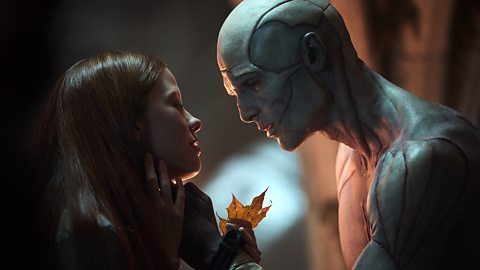
"Monsters have a clarity of purpose"
Guillermo Del Toro on his lifelong ambition to adapt Mary Shelley's Frankenstein.
4. Working with the Weinsteins was tougher than his dad getting kidnapped
Del Toro directed his first film, Cronos, in 1993. It was well-reviewed and he was soon offered a directing job in Hollywood. Mimic, a horror movie released in 1997, was a flop. “I’ve been making movies for more than 30 years and that’s my only bad experience,” says Del Toro. He was working with producers Harvey and Bob Weinstein, many years before Harvey Weinstein was convicted on sexual assault charges. “They were very powerful, almost untouchable at the time,” he says. “They would hire you for who you are, then they didn’t want your personality on [the film]. They wanted to suffocate every instinct you had as a filmmaker.”
Shortly after making Mimic, Del Toro’s father was kidnapped and held for ransom (he was eventually freed). He says working with the Weinsteins, “was even more harrowing than [my father being kidnapped]. At least the kidnapping had a certain logic. They wanted money and we wanted my father. With Mimic, I didn’t know what they wanted.”
5. There’s always something of him in his characters
“Every character I write has to have something of me,” says Del Toro. He says that’s always been the case, but there’s been a change in how he relates to his characters. “The difference is that when you write when you’re young, you write as the protagonist of your film. The older you get, you write yourself as the antagonist.”
6. He has no interest in AI
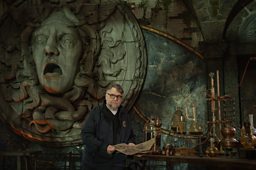
Del Toro has always embraced technology in filmmaking. He’s made several stop-motion animated movies. He’s made huge special-effects blockbusters. He even used to run a special effects business, before becoming a director. But asked what filmmaking opportunities AI presents for him, he replies, “I’m not interested at all. Artificial intelligence is a very tricky subject for me. I understand it in disciplines like architecture, engineering, science, medicine – things that depend on… ideas that can be cross-pollinated. I find it no use in art.”
If it looks like nobody should make that movie, that’s the movie I want to make.Guillermo Del Toro
He says storytelling has to come from experience – “a testimonial of somebody that lived” – but “ones and zeros don’t experience loss or gain or pain or bereavement. How can they speak about love or transcendental emotions?”
7. He is the “seeker of impossible movies”
After over 50 years as a filmmaker, Del Toro has no plans to slow down. His next movie will be a stop-motion animation of Kazuo Ishiguro’s The Buried Giant, a fantasy set in post-Arthurian England. It might be hard to imagine any other filmmaker making such a project, and that’s what Del Toro loves.
“I really want to do things that nobody else wants to do,” he says. “If it looks like nobody should make that movie, that’s the movie I want to make. I am the troubled seeker of impossible movies.”
More from BBC Radio 4
![]()
This Cultural Life: Guillermo Del Toro
Listen to the director's full interview on This Cultural Life.
![]()
Sam Mendes: Nine things we learned from his This Cultural Life interview
The director on learning to tell stories and why he took the James Bond job.
![]()
Florence Pugh: Nine things we learned from her This Cultural Life interview
Actor Florence Pugh talks to John Wilson about her career and formative influences.
![]()
Screenshot: Frankenstein
Ellen E Jones and Mark Kermode explore the enduring appeal of Frankenstein.