Monteverdi's Orfeo at the Roundhouse
28 January 2015
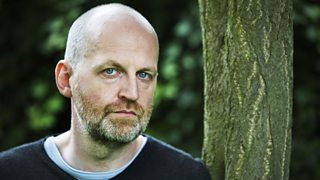
BBC Arts live-streamed Orfeo, the Roundhouse and Royal Opera House’s acclaimed co-production of Claudio Monteverdi’s masterpiece, from the Roundhouse in London on 21 January. It was also available on demand for six months. Below, DON PATERSON, who wrote the new English translation of the libretto, discusses the enduring appeal of the world's first opera.
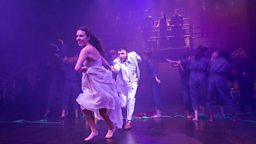
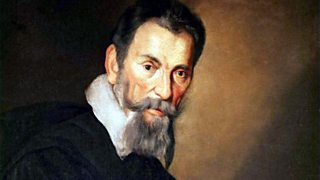
Monteverdi’s L’Orfeo is the earliest true opera still performed, and to some extent can be credited with shaping our idea of what, exactly, an opera is.
Monteverdi’s choice of subject now seems inevitable. The Orpheus myth is one of our most primal and powerful: it’s really a series of archetypes – a story of love, death, music, defiance, and the immutable nature of The Law.
We are left in no doubt that the law is the law, and that the rule of the law is everything
In Monteverdi’s telling, Orfeo, the poet-celebrant and Earth’s first great singer-songwriter, loses his beloved bride Euridice to a snake in the grass, and runs off to Hell to retrieve her. He uses his voice and his lyre to sneak past Charon the ferryman, and then soften the heart of Pluto, King of the Underworld.
And he nearly succeeds in his plan; alas, he fails to stick to the silly rule that Pluto has decreed: he cannot look back as he is leading Euridice towards the sunlight. (There’s a real sense that he’s been set up: the rustle of a curtain tricks him into turning round.)
We are left in no doubt that the law is the law, and that the rule of the law is everything. The grieving, hysterical Orfeo is saved by the benevolence of the patriarchy: Father Apollo descends from heaven and sweeps him upstairs.
All this will have been precisely the kind of thing Monteverdi’s audience wanted to hear. L’Orfeo was written in 1607, specifically for a performance for the Mantuan court during the annual Carnival. There can be little doubt that Monteverdi and his librettist, Alessandro Striggio, had the entertainment of their patrons uppermost in their minds.
La Musica - music personified - opens the opera with an aria flattering her rich and powerful audience to within an inch of their lives, with much talk of their bravery, nobility and all-round wonderfulness.
Monteverdi’s paymaster, the Duke Vincenzo Gonzaga, was a great patron of the arts and sciences, and there are several passages clearly shoehorned in with him in mind: at one point, the infernal spirits – apropos of nothing much in particular - strike up with a hymn to the great works of mankind: ’Man will never once fail in his adventure / nor can his will be disavowed by Nature / for he can sow the future: / he stills the rolling meadows, and seeds he scatters /until the deserts bloom with harvests golden.’ One can feel Gonzaga’s satisfied smile at these words, however ironic they will soon be shown to be.
The end of the tale, too, was judiciously revised. In the canonical myth, Orpheus is murdered by the maenads, the crazed followers of Dionysus – but Striggio and Monteverdi plump for an even more sinister ending, with the inconvenience of the broken, mad Orpheus simply cleared off the face of the earth, all his wailing about the injustice of the heavens swiftly muted, and the status quo smoothly resorted.
The story of Orfeo incarnates a deep truth about human nature
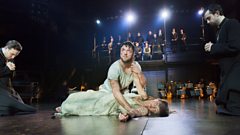
The cleverness of Michael Boyd’s staging illuminates not just the story, but the political forces which shaped it. While the opera still very much reflects the huge Italian enthusiasm for Arcadian pastoral drama at the turn of the 17th century, we also feel the stern presence of the catholic church and the Mantuan court – and are never allowed to forget the powers that really lie behind the kind of tragedy that befalls all defiers of the law, from Orfeo to Giordano Bruno. (Boyd makes a pun on pastore -’shepherds’ - and ‘pastor’ to provide a neat hinge within the text itself.)
Does this tale still have relevance for us? How could it not? Its political resonance apart, the story of Orfeo incarnates a deep truth about human nature.
We are ghosts - or at least not things with any permanence on this earth. Apart from one another, our principal comfort is art. Art, and especially music, seems to defy and stand apart from time. (Or as the German poet Rilke shows in his Sonnets to Orpheus – it is song which bridges the gap between the two realms of life and death, between the here-and-now and the timeless eternal, and allows us to be reconciled to our own riven state.)
There is no better proof of music’s ability to defy time - that force that separates us from each other by death and decades - than the timelessness of Monteverdi’s music. Orfeo is full of startlingly contemporary harmony and eerie Mediterranean influence. The Roundhouse, too, feels an oddly perfect venue for a piece that goes to the democratic heart of who we are.
As you’ll hear, a beautiful acoustic has been ingeniously conjured from this Cathedral of Rock that makes you wonder why opera hasn’t been staged here before - and it has also attracted a whole new audience. Though as one new opera-goer discovered on the first night, shouting out ‘She’s behind you!’ still isn’t quite the done thing.
More on Monteverdi
![]()
Monteverdi in Mantua: The Genius of the Vespers
Simon Russell Beale travels to Italy for BBC Two to explore the story of the notorious Duke of Mantua and his long-suffering court composer.
![]()
Claudio Monteverdi at BBC Music
Biographical information plus a selection of BBC clips related to the Italian composer.
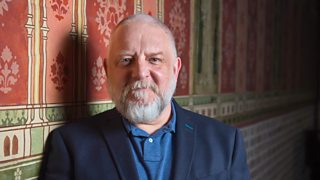
Photo gallery
Orfeo credits
Performance
Director – Michael Boyd
Set designs – Tom Piper
Lighting design – Jean Kalman
Conductor – Christopher Moulds
Orchestra – Orchestra of the Early Opera Company
Orfeo – Gyula Orendt
Music / Euridice / Echo – Mary Bevan
Nymph – Susanna Hurrell
Persephone – Rachel Kelly
Pluto – Callum Thorpe
Charon – James Platt
Messenger – Susan Bickley
First Shepherd – Anthony Gregory
Second Shepherd / Apollo – Alexander Sprague
Third Shepherd / Hope – Christopher Lowrey
Presenters - Morgan Quaintance & Jane Young
Live stream production
Director - Ian Russell
Producer - Marta Sala Font & Tony Followell
Camera Supervisor - Chris Goor
Camera Operators - Tom Bowles, Wai King Cheung, Leo Fakes, Mark Faulkner, Mark Gee, Joe Hallgate, Giles Pritchard
Script Supervisor - George Pursall
Sound Supervisor - Mark Johnston
Production Coordinator - Emma Davis
Floor Manager - Chloe Millers Smith
Production Assistant - Rose Slavin
VT Production - Alice Sephton, Francis Sylver, Pippa Riddick, Aidan Stimson, Harry Balding, Benjamin Neustadt, Jane Young.
Sound courtesy of BBC Radio 3
About the production
Marcus Davey and Kasper Holten on Michael Boyd's staging at the Roundhouse