Object of the Week
Each week we'll introduce you to one of the many intriguing objects found in the museums we visit...
Week 4: Dr. Janina Ramirez
“Take this trumpery out of my sight…”

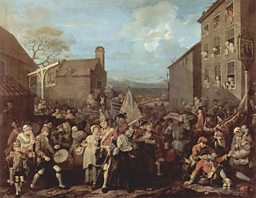
Now one of the best-loved paintings in the Foundling Museum, ‘The March of the Guards to Finchley’ was despised by its intended owner: none other than the King of England, George II. Never one to shy away from comedy and satire wherever he perceived it, Hogarth had painted this large-scale piece for the King to commemorate the successful suppression of the Jacobite rebellions. It depicts the royal troops readying themselves for a battle in the background – regimented and ordered – while in the foreground the soldiers are embroiled in chaos and bad behavior.
Every shade of misdemeanor is alluded too. At the far left, a solider urinates against a wall and his face is contorted with pain, for he has contracted a venereal disease which makes the act excruciating. In the centre two women fight over the affections of a solider. One has copies of ‘God Save the King’ tucked in her basket, symbolizing the Protestant Hanoverian monarchy, and the other clasps a Jacobite newspaper, symbolizing the Stuart pretenders to the throne. To the right of these a solider has collapsed paralytically drunk, yet rejects the water his friend offers him, reaching instead for another shot of gin. Prostitutes lean out of the windows of Mother Douglas’s house, boxers fight in the street, civilians are robbed at knife-point, and a couple embrace passionately. This is London at its most bawdy, lawless and immoral. Yet, Hogarth’s deeper message was that even the most ill disciplined men could be turned into an effective fighting machine with training and a firm leadership.
When the painting was brought before George II the following exchange took place:
"Pray, who is this Hogarth?"
"A painter, my liege."
"I hate painting and poetry too! Neither the one nor the other ever did any good!"
"The picture, please your majesty, must undoubtedly be considered as a burlesque!"
"What? A painter burlesque a soldier? He deserves to be picketed for his insolence! Take this trumpery out of my sight."
Far from a lofty and declamatory painting praising the King’s troops, Hogarth created something chaotic and full of those base human acts which fly in the face of civilized society. Were I the king, expecting a delightful painting of my well-trained and praise-worthy soldiers, I would have been shocked with what I was being shown. But its shocking qualities are what make it such an impressive work of art. Hogarth manages to catch the complexity of life with more intensity than any of his contemporaries, and he had the artistic skill to back up his avant-garde style.
A canny business man, as well as a brilliant artist, Hogarth reproduced the painting as a print, and managed to lure his patrons into parting with more money by paying extra to enter a raffle to win the original work. He gave 10% of the tickets to the Foundling Museum, a cause he took a great personal interest in, and unsurprisingly they won the painting. It still hangs there today, and only by seeing it up close can you appreciate the true potency of this piece of ‘trumpery’.