Blood, tears and rain: Forging the Blade Runner universe
6 October 2017
As Blade Runner 2049 arrives in a promotional whirlwind and stories of on-set camaraderie, the creation of Denis Villeneuve’s sequel contrasts markedly with Ridley Scott’s original. Time then to compare the making of a would-be classic and a film once known simply as ‘Blood Runner’.

The crew nicknamed it 'Blood Runner'
Blade Runner 2049 picks up the strands of the original film 30 years on in a Los Angeles even more environmentally ravaged than in the fictional 2019. A young replicant cop ('replicant' being the film's term for androids), played by Ryan Gosling, is tasked with hunting down and retiring rogue older models.
It was a bitch. Working every night, all night long, often in the rain.Harrison Ford on Blade Runner
The set reports from Blade Runner 2049 appear to point to a relatively harmonious production, suggesting any grudges from the first production have been lost in time. The sequel's director, Denis Villeneuve, is said to have described both Harrison Ford and Ryan Gosling as gentlemen, "they were troopers and never complained."
Ridley Scott has stayed on as Executive Producer for the new film but, considering the legendary difficulties on the original, Harrison Ford's return could be considered a surprise.
"It was a bitch", said Ford, "working every night, all night long, often in the rain". With much of the film shot between sunset and sunrise, Blade Runner was so fraught with on-set problems its stories have filled several books and documentaries.
The t-shirt wars between the British and American crews became written into film history. American crew members wore t-shirts saying ‘Will Rodgers never met Ridley Scott’, a reference to the fact that Will Rodgers famously claimed ‘he never met a man he didn’t like.’ While the British crew responded with Xenophobia sucks.
Reportedly, after working on the 1982 original, some crew members lost their desire to work in the film industry altogether and dubbed the film "Blood Runner".
Production design: Living up to a legacy
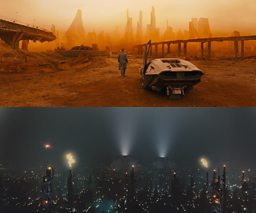
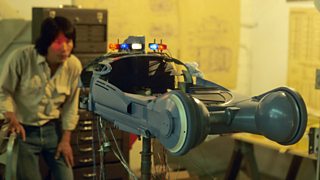
Syd Mead, an industrial illustrator and designer, became the stylist on the first movie. Mead's designs for furniture and flying cars, or Spinners as they are known, became iconic symbols of this alternative American world.
But it would fall to production designer Lawrence G. Paul to bring the creative collaborations of Scott and Mead to a film-able state. Scott was ordered to use the Warner Bros. back lot in Burbank, Los Angeles County, so hundreds of craftsmen and women were brought in to retro-fit the average-looking streets into a dark futuristic, grubby L.A.
James Bond designer Dennis Gassner took over the production design for the sequel, but such was the influence of Mead’s original work that Villeneuve brought him back to design the scene in which Officer K looks out at a ruined cityscape.
The new film was shot in Hungary using elaborate sets across nine different sound stages in the hope that they could echo the realistic feel of the 1980s version. But by all accounts the CGI in the new film is equally impressive, with Guardian film critic Peter Bradshaw describing it in glowing terms as "like nothing I’ve ever seen."
An 'Alien' directing style
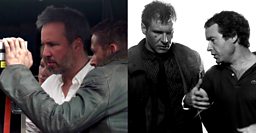
Ridley Scott wasn’t allowed to operate his own camera on set, as he had with the British crew on Alien, due to US union rules in the 1980s. Unfortunately, his American cinematographer Jordan Cronenweth was suffering from undiagnosed Parkinson's Disease. By the end of the movie Cronenweth was using a wheel-chair.
Scott would line up the shot and then occupy a video playback booth, isolating him from his crew and actors. This resulted in creating a strain between him and Harrison Ford, who was keen to collaborate on set.
However, the on-set atmosphere in the 2049 film is reportedly much more collaborative, so much so that Denis Villeneuve is said to sometimes shoot two different versions of a scene in response to an actor’s ideas. Although his running time of 2 hours and 43 minutes has left Scott's 1 hour 57 minute duration looking measured.
Casting: Would Spielberg have the answer?

The sequel sees Ryan Gosling, Jared Leto and Robin Wright join the cast. In an interview with the Metro newspaper, Villeneuve claims that the part of Niander Wallace was originally intended for David Bowie, but that after his sad passing he looked to Leto to bring something similar.
Both Robert Mitchum and Dustin Hoffman were considered for the role of Deckard
While Ryan Gosling may have seemed an obvious choice for the lead in Blade Runner 2049, on the back of smoldering performances in Drive and The Place Beyond the Pines, and the commercial success of La La Land, it was a different story on the original.
Surprisingly, Ford was not the first actor considered for the role of Deckard. Both Robert Mitchum and Dustin Hoffman were considered. Mitchum was dropped when the role of Deckard evolved from the original, more bureaucratic character of the book and Hoffman was dropped because his enthusiasm was thought to be getting out of hand.
Ford landed the role when, at Steven Spielberg's invitation, Ridley Scott flew to London to view the dailies from Raiders of the Lost Ark, which was being filmed at the time. After a few minutes, Scott and producer Michael Deeley knew they had found their lead. Although they were disappointed to find Spielberg had beat them to it with the Fedora.
Is Deckard a Replicant or not?

Replicants are like any other machine. They're either a benefit or a hazard. If they're a benefit, it's not my problem.Rick Deckhard, Blade Runner (1982)
The main point of disagreement between Scott and Ford was that the director believed that Deckard should be a replicant or, at the very least, that this aspect of him should remain ambiguous.
Ford on the other hand believed that “the audience deserved one human being on the screen that they could establish an emotional relationship with.”
While 2049 may keep us guessing, the fact that 30 years have passed in Blade Runner world and Deckard appears to have aged accordingly could perhaps be a clue as to what is to come….?
Script wars

In the late 1970s, the Philip K. Dick novel Do Androids Dream Of Electric Sheep? had become available for option and actor Hampton Fancher, keen to make a little money, adapted the original screenplay.
As the script developed it was good enough to secure visionary director Ridley Scott, fresh from the success of Alien (1979). But the attachment of Scott to the project came at a price. Fancher was deemed too slow at re-writes and was replaced with David Peoples, who was able to write harder dialogue, faster. Peoples came up with the term "replicant".
Fancher, who was told of his replacement by producer Ivor Powell at a Christmas party was left in tears at the news though he was retained an Executive Producer credit.
However, 35 years later Fancher and Scott have been reunited to bring Blade Runner 2049 to screens. This time with second screenwriter Michael Green, famed for penning Wolverine solo film Logan. Scott, who is producing 2049, is reported as saying that he only managed to convince Harrison Ford to join the sequel on the strength of Fancher’s new script.
The soundtrack: Putting Zimmer in the frame

Icelandic composer Jóhann Jóhannsson had been Denis Villeneuve’s collaborator on previous films Sicario, Prisoners and Arrival, and was originally attached as sole composer on Blade Runner 2049.
However, in July 2017 it was reported that Hans Zimmer would be joining him. Jóhann’s agent later confirmed that Jóhann would no longer be involved with the film in any capacity. Instead Zimmer, who has worked on such films as The Lion King and Gladiator, collaborated with Benjamin Wallfisch who worked on the recent release It.
Greek composer Vangelis created the iconic score for the original movie: combining noir jazz riffs with electronic synth sounds to create a unique sound, which remains a huge inspiration to musicians today.
Legacy
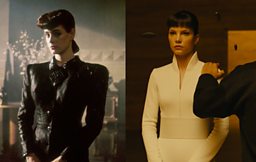
Blade Runner was released just two weeks after E.T in 1982, which hampered the film's initial box office take, and its critical reception was mixed - one LA Times critic dubbed the slow-paced movie 'Blade Crawler'. But the VHS rental explosion, midnight screenings and fan clubs turned the film a cult classic.
It has inspired generations of filmmakers, musicians and fashion designers.
As today's ultra-evolved PR machine launches the latest installment of Blade Runner, it may be some time before the orange dust settles and we discover what Blade Runner 2049 was really like to make. But for now the future of the Blade Runner franchise looks bright.
Blade Runner 2049, directed by Denis Villeneuve, is in UK cinemas now.
More Blade Runner
![]()
Inside sci-fi classic Blade Runner
A photo archive revealing the painstaking handiwork behind the 1982 film's hugely influential visuals.
![]()
Listen on Radio 4
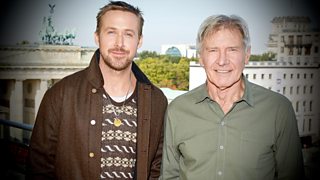
Ryan Gosling & Harrison Ford, Front Row on Friday 6 October.
![]()
Watch on BBC Two
Ryan Gosling & Harrison Ford, Front Row, Saturday 7 October.

More from Front Row
![]()
Shows within shows
The animated characters who watch other shows on TV.
![]()
Podcast transitions
Can your favourite audio survive a move to the screen?
![]()
Ready to rumble?
Seven times the art world grappled with wrestling.
![]()
Apocalypse now
Seven doomed futures from E3’s hottest games.




More from BBC Arts
![]()
Picasso’s ex-factor
Who are the six women who shaped his life and work?
![]()
Quiz: Picasso or pixel?
Can you separate the AI fakes from genuine paintings by Pablo Picasso?
![]()
Frida: Fiery, fierce and passionate
The extraordinary life of Mexican artist Frida Kahlo, in her own words
![]()
Proms 2023: The best bits
From Yuja Wang to Northern Soul, handpicked stand-out moments from this year's Proms