Bwani Junction: Reimagining Paul Simon's Graceland
21 January 2016
Paul Simon’s 1986 LP Graceland, recorded in South Africa with local musicians, was a landmark in the popularisation of so-called world music. To celebrate the album’s 30th anniversary, Edinburgh indie/roots quartet Bwani Junction are presenting their own lovingly-adapted versions of those seminal songs at the Celtic Connections festival in Glasgow - where they'll be joined by some of the South African musicians who played on the original recording. BRIAN MORTON spoke to them about the legacy of an extraordinary musical milestone.
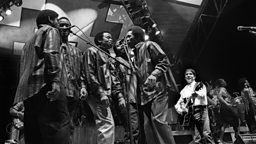
Semper aliquid novi Africam adferre: though often misquoted, Pliny’s line about there always being something new coming out of Africa applies without question to popular music.
Both jazz and rock have regularly taken new rhythmic turnings as a result of fresh exposure to African sounds. But 30 years ago it was what – or rather who – was going into Africa that caused controversy.
Graceland can now be appreciated for what it is, a supremely elegant and adventurous rock record
Paul Simon’s decision to work with Cape musicians on his Graceland album was seen as a betrayal by the anti-apartheid movement, bringing down fierce criticism on the American’s head and taking pop off the music pages and into unwelcome headlines.
Now, of course, with apartheid at least officially at an end, Graceland can be appreciated for what it is, a supremely elegant and adventurous rock record suffused with rhythms and horn sounds that bring Pliny’s throwaway line in Historia Naturalis bang up to date. And it was as a piece of pop history that a young Edinburgh guitarist and his friends heard it and fell in love with it.
The boys had some leverage in that history themselves. The father of guitarist Dan Muir had been British manager of the paradigm shifting Bhundu Boys in the 1980s, and Dan took some ear-opening lessons from the group’s charismatic lead guitarist Rise Kagono.
Muir’s first group had established a modest presence on MySpace as Band 411, but it is as Bwani Junction that they have brought a fresh mash-up of Afrobeat, Postcard-tinged indie pop and a few inevitable hints of the Proclaimers to the Scottish music scene.
From the archive
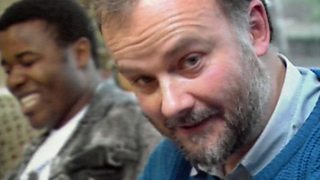
The Bhundu Boys, their manager Gordon Muir, singer Peter Gabriel and record producer Robin Millar are interviewed about the band’s success. They also meet John Peel, who samples some traditional food from their native Zimbabwe. Originally broadcast on The Review Show on 22 November 1987.

Lead singer Rory Fairweather describes the impact of Graceland, and of the Bhundu Boys back-story, as “a revelation; the first time you hear that stuff you think ‘what’s going on?’ and it takes a while but you realise that it’s simply a case of the beats being in unfamiliar places, not where you expect them to be at all.”
The idea was that we’d do a cover of one of our favourite albumsRory Fairweather
Bwani Junction took their name, a little corrupted, from a once-popular and still racy novel, Bhowani Junction, which seems to have had a walk-on part in Fairweather family history.
The group has now released two critically acclaimed albums, Fully Cocked and Tongue of Bombie and are currently bunkered in a Leith studio making a third that, Fairweather explains, may take a small diversion into a new, more disco-influenced sound.
“But we realised that we hadn’t played a gig in ages and that we didn’t have any new songs to play, so the idea was that we’d do a cover of one of our favourite albums, all the tracks.”
A number of contenders were put up on Facebook. The first two were Elvis Costello’s My Aim Is True and the mighty Clash on Broadway but, says Fairweather, “we were really pleased and quite relieved when the fans picked Graceland.”
More on Celtic Connections
![]()
Celtic Connections 2016
All the BBC's coverage from this year's festival, on radio, television and online
![]()
Six of the best
Jim Gilchrist casts an eye over this year's line-up and picks out his six must-see shows
Related Links

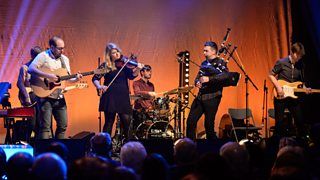
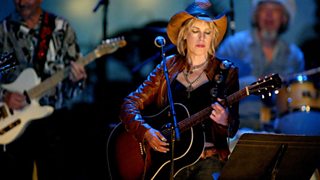
Bwani Junction - Diamonds On The Soles Of Her Shoes
Bwani Junction perform on The Janice Forsyth Celtic Connections show
The group recruited a local horn section and veteran accordionist Phil Cunningham and played a stop-gap gig last July at a small Edinburgh club. It was heard by Celtic Connections director Donald Shaw who there and then offered a reprise of the performance at the 2016 festival in Glasgow.
[Paul Simon] gave Africans an opportunity to showcase to the world and break the circle of apartheidBarney Rachabane
Some offers don’t need to be sugared, but what makes the second version of Bwani Junction’s Graceland tribute so special is that it features not just a horn section but some of the original musicians – and there were more than 40 of them, excluding singers – from the original sessions, which were recorded in New York, London, Los Angeles and Louisiana, as well as South Africa: semper aliquid novi...
Among those joining Bwani Junction at Celtic Connections are saxophonist Morris Goldberg, whose contribution to You Can Call Me Al is probably the most famous penny whistle solo in rock history, singer Sonti Mndebele and the father and daughter pair Barney and Octavia Rachabane.
Barney’s saxophone solo on Gumboots is another album highlight. He told BBC Arts Online that he was excited and honoured to relive Graceland one more time.
“I have great memories of being in Scotland during the World Tour with Paul and the original musicians. It is and always will be a highlight of my life, because Paul is the most humble and caring person I have ever met in the industry.”
And on the controversial question of whether Simon should have broken the moratorium on working with SA-based musicians, Rachabane speaks plainly and with some emotion.
“At a time when there was apartheid in South Africa and blacks like me were nothing but just labourers, he saw beyond that and gave Africans an opportunity to showcase to the world and break the circle of apartheid.”
Simon showed that an apparently unpolitical – indeed, a highly personal and apolitical – creative statement could have profound and widecast implications, just because of the circumstances of its creation.
Thirty years on, Graceland still refuses to relax into just-another-album middle age. Its music is as fresh and as moving as ever and, for an album so much concerned with youth and when the world seemed a great place, rightly consigned to younger hands.
Bwani Junction perform Graceland and Moh! Kouyaté at the Old Fruitmarket, Glasgow on Saturday 23 January 2016 as part of Celtic Connections.
The Graceland controversy
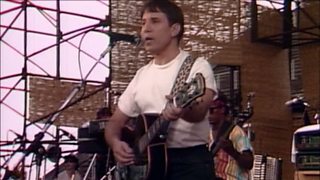
In Paul Simon's Graceland - Under African Skies, BBC One's Imagine captured Simon's return to South Africa 25 years after the recording of Graceland. Did his unique collaboration with South Africa's township musicians set back the clock of South African liberation or drive it forward?
From the archive
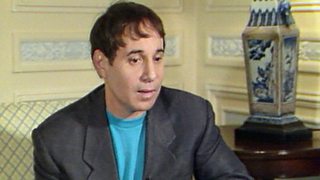
Paul Simon discusses his album on the BBC's Breakfast Time, along with clips from the promo video for Homeless. Originally broadcast on 29 August 1986.
More from BBC Arts
![]()
Picasso’s ex-factor
Who are the six women who shaped his life and work?
![]()
Quiz: Picasso or pixel?
Can you separate the AI fakes from genuine paintings by Pablo Picasso?
![]()
Frida: Fiery, fierce and passionate
The extraordinary life of Mexican artist Frida Kahlo, in her own words
![]()
Proms 2023: The best bits
From Yuja Wang to Northern Soul, handpicked stand-out moments from this year's Proms