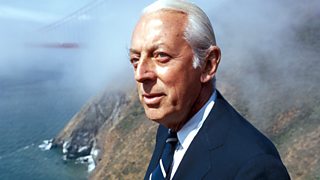
Reagan meets Gromyko
A Happy New Year to you! That, I imagine is a greeting that will startle more listeners than it will delight, but throughout the day last Wednesday and increasingly towards sundown, you had only to turn on the radio to hear it repeated at the end of various programmes and hear it live, so to speak, from the shopkeepers round your corner. I had it from the men in the liquor store and from the owner of the drugstore but not, I might say, from the girls in the Korean fruit store or from the merry little Vietnamese who sells us our newspapers.
But these salutations made it vividly clear that you were living in the city that houses more Jews than any other city on earth. After sundown, there was, there always is, a noticeable slackening of the business in restaurants, theatres, nightclubs and so on.
The occasion of Rosh Hashanah was taken by some prominent Jews to ask Mr Gromyko, who was here for the opening of the annual United Nations General Assembly, if the Soviet Union will ease the emigration of Russian Jews into Israel. Mr Gromyko who, in the teeth of the facts is probably the most unflappable diplomat alive, said that all the Jews who'd wanted to leave had already gone. But he was told what he surely knows – that there are hundreds of thousands of Russian Jews who are trying and failing to be let out.
There was no report about Mr Gromyko's response to this assertion in this plea which has been made regularly by at least four administrations, but it's fair to assume that he didn't argue the point. He just let it go. After all, once you've said, 'But they've all gone!', there is no more to say.
Placidly, Mr Gromyko moved on to a meeting with Secretary of State George Shultz and then with the Democrats' presidential hopeful – faintly hopeful – Mr Mondale and then with the president. I can't remember when Mr Gromyko ever gave a friendly or accommodating speech before the United Nations or came out of a meeting with American officials with a wave and a grin. He is not, of course, unlike Mr Reagan, the grinning kind and from the prompt thumbs-down reaction of Tass, the Soviet government's press agency, to Mr Reagan's speech before the UN which was regarded here as a dramatic move towards conciliation with the Russians, it seems to me very unlikely that Mr Gromyko is going to recognise an olive branch and seize it.
Wearily and steadily, the Russians from Mr Chernenko on down continue to lament that Mr Reagan's new offering is a vessel with nothing inside it. When the president was back at the White House, a reporter asked him how he explained Mr Chernenko's remark that the United States doesn't understand the need to normalise relations. Mr Reagan simply said, 'I don't explain'. So, for all the huge build-up of suspense and speculation about the president's first meeting with a top Soviet leader, the result seems to be no business, as usual.
When it was announced that the president would, for the first time, come face to face with Mr Gromyko, the knowing interpretation said that the Russians had finally decided Mr Reagan was in for four more years and that they'd better sit down with him and begin to negotiate about all our woes, including the iron stalemate in the nuclear game.
It looks rather as if the Russians had concluded that Mr Reagan is, indeed, going to stay in the White House and decided to send their top diplomat to New York to remind him that they stand where they did and are not going to renew arms talks or shift their position on the Middle East, on Afghanistan, on their general laments over American policy. They are, however, happy to receive a fat loan to enable them to buy American grain. End of big diplomatic breakthrough.
Meanwhile, the presidential election campaign booms on but it's been booming away so long that, in spite of the assiduous television coverage of the rallies all over the nation, the whipped-up crowds, the cheers for both candidates, I suspect that the attitude of most Americans is that of the people who lived on the coast of Kent during the Second War. The guns rumble away like muffled and distant thunder, become so much part of the daily weather that people sigh once in a while and then go briskly about their daily business.
Not least in Washington and one of the surprising, almost cheeky, notes about the conduct of business in the Congress is the sudden speed with which they're disposing of bills and arguments that have been racking them throughout the winter.
In an election year, not only in a presidential year but once every two years since, at that interval, the whole of the House of Representatives has to be replaced, congressmen have to get home and get busy re-electing themselves or being beaten by some upstart opponent. Consequently, the Congress will adjourn next Thursday 4 October.
First thing they had to do this week was to pass bills to keep the government going. Literally, to pay the wages and operating expenses of the government departments. There have been years – I think last time was two years ago – when Congress has been so laggard in doing this that suddenly thousands of employees in the various departments, agriculture, commerce, the national parks, ports and customs, even the treasury, have virtually gone on strike.
You'd think that a great going democracy, even with a government establishment that has quadrupled in numbers since the Second World War, would provide automatically to keep itself going, but this year is no exception. For months, Congress has been debating money bills for this housekeeping purpose alone. With only a week to go before those legions of government employees were due to stay home, the whole House and, after it, the Senate Appropriations Committee, in one day passed four – by now they're called emergency – spending bills of – how much do you think? – $50 billion dollars, BILLION dollars, each. The republic has been saved. The janitors will sweep the marble halls of Congress, the firemen will be on hand, the secretaries will be ready, 'Yours of the 26th inst.'.
But what is even more invigorating, even comic, in its sense of urgency is that the two Houses, after dithering and quarrelling for many months on end actually dowsed, in one day, several of the burning issues of our time, or at least of the long election campaign.
Example, the anti-crime bill. It has been fiercely debated for over a year whether the federal courts should have new procedures in sentencing convicted criminals, whether defendants with a record or otherwise thought to be dangerous can be detained indefinitely, whether there should be heavier bail for certain criminal charges, whether the laws for possession of drugs should be tougher.
Last February, the Senate had no misgivings about these new laws, well, one misgiving, since the vote in favour was 91 to one. It has taken seven months of on and off debate in the House. On Tuesday, the 435 members of the House or the 400-odd of them present looked at their watches, read October 4 and hey presto, passed the whole anti-crime package in a trice.
But the most remarkable of all these examples of instant law-making happened in the Senate. If there's one great and intensely debated issue of the present Congress, one theme that has divided the country into passionate factions, one issue that has ranged the president and his conservative supporters against the Democrats and the men in the centre and the women in the centre and on the left, it is surely the issue of abortion.
One distinguished news magazine – and an English one at that – has called it 'The Enduring Debate'. It's been going on since the first two years of the 1970s. In 1973, the Supreme Court spoke what we all took to be at the time the last word, the Supreme Court made abortion legal. This was an historic decision and a bold one, certainly in a nation where a quarter of the population is Roman Catholic, but it was not the last word.
It fired a new national debate which eventually split the country into two dogmatic opposing sides. The people, including many of the churches and the right wing of the Republican party and the revived fundamentalists of the South, what in the 1920s Mencken called the Bible Belt, they all stood against abortion for whatever cause on principle. They call themselves the Right to Lifers.
Against them stood most of the Democrats, most non-conformists, most non-believers, moderates of both parties and the regiment of women liberals. They asked, 'What kind of life could be expected of a child about to be born to a slum mother with six or seven other children living in wretchedness?' The pro-lifers said abortion was murder. The abortionists said it should be the personal choice of the mother. In 1983, the Supreme Court, considering another challenge, reaffirmed its ruling of ten years before.
Since then, the Catholic bishops have arisen and indiscreetly advised their flocks that no good Christian could vote for abortion. President Reagan wanted, and still wants, an actual constitutional amendment outlawing abortion. The pro-abortionists have recruited liberal Catholics and question the mating of politics and religion in a nation that laid down in the first sentence of its bill of rights that there should be 'in this country no established church'.
This relevant issue has been more fiercely debated since Mrs Ferraro, the Democrats' candidate for vice president has stated her position. She is personally against abortion but in favour of letting other women decide for themselves. It is the position of the Democratic party, as also the plea to allow women to abort who've been made pregnant through rape or incest.
The right-wing Republicans, the president included, would allow abortion only when the mother's life is in danger. This profound and unresolved issue was, in one morning in the Senate, suddenly resolved. For the time being anyway. In less than two hours, the full Senate voted – by a voice vote at that – to provide federal medical funds in all cases of rape, incest or an endangered life.
Maybe in future we should let the Congress stay home for 50 weeks of the year and summon it to do all its business in two weeks against an October deadline.
This transcript was typed from a recording of the original BBC broadcast (© BBC) and not copied from an original script. Because of the risk of mishearing, the BBC cannot vouch for its complete accuracy.
Letter from America audio recordings of broadcasts ©BBC
Letter from America scripts © Cooke Americas, RLLP. All rights reserved.
![]()
Reagan meets Gromyko
Listen to the programme