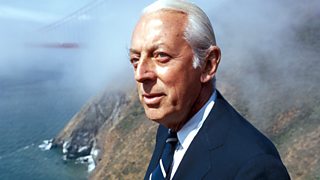
President Alfonsin of Argentina
I'm sure I've mentioned it before but, in the light of what's happened in Argentina, I think it worth reminding you of a remark of the old and I must say much lamented, cowboy philosopher, Will Rogers, which illustrates an attitude common to both Britons and Americans.
Rogers once said that whereas in the United States any boy can get to be president, in the countries of Central America, every boy has got to be president. He could have added that whereas in the United States a soldier frequently gets to be president, in South America, every soldier has got to be president.
I don't know anybody with even a phenomenal memory – the sort of person who can rattle off the rulers of England or the state capitals of the 50 states – I don't know anybody who can call off in succession the names of the generals who have taken over the governments of Argentina or Brazil or wherever in military coups. Most of us, I'm afraid, couldn't even call off the countries of South America, let alone their sudden rulers and this is true of North Americans who, as Mr James Reston recently said, will do almost anything for Latin America except read about it.
And the other day I read a sympathetic article about a distinguished American, or should I say Anglo-American conductor who's so dedicated to ceaseless hard work that he won't consider taking a holiday in any country not famous for its music. So that when his wife suggested the need for a holiday in Bermuda, he said, 'Why Bermuda? There isn't an orchestra in the Caribbean!' His wife could have responded, 'There isn't even a Bermuda in the Caribbean.'
But since we've all come to know something about the Falklands, even to being able to say where they are, Argentina has remained very much on the minds of the people who make or break foreign policy both in Britain and in the United States. In Britain, for the obvious reason that if she insists on maintaining sovereignty over the islands, the taxpayer is going to have to cough up between six and seven billion pounds in the next ten years, or perhaps Lord Shackleton's more modest figure of only 2.1 billions.
The American interest is less obvious but it is constant nonetheless. It took a lot of midnight oil and sweat for President Reagan and the-then secretary of state, Alexander Haig, to decide to come in on the British side, so to speak, in more than sentimental ways. The sharing or feeding of intelligence in the military sense was a very necessary, if not a crucial, element in the British victory and the decision to do this was made with a lively fear that not only Argentina would remember and deeply resent it, but also all the countries that compose the Organisation of American States, which you may recall unanimously condemned the United States.
Washington was thinking not only of its future relations with Argentina, but with all the South American countries that might, by way of retaliation, give future aid and comfort to rebellions in the countries of Central America – Nicaragua, Panama, El Salvador, Guatemala, Honduras and, so help us, Mexico. All the countries that in the age of the missile and foreign subversion from within are rightly or wrongly considered as possible threats to the security of the United States.
The later decisions to support the government of El Salvador and to try and overthrow the Sandinistas of Nicaragua and then the decision to invade Grenada were, of course, direct responses to what the administration took to be indirect, but powerful intervention by the Soviet Union and the Russians' all-American guerrilla ally, Cuba. But they were also done to warn or reassure the South American countries that the United States will not stand for a large-scale eruption of Marxism below the Rio Grande.
To do this and at the same time repair old friendships with the nations of South America is one of the more difficult exercises of American policy and it's thwarted by the constant drumbeat of protests for which there's much to be said among liberals, and now, every Democrat running for president – in the United States practically every Democrat has to run for president – that the administration is eager to restore the freedom of countries suffering from leftist dictatorships, but not so concerned for the liberties of people suffering from rightest dictatorships.
Well, the president certainly knows by now that his presidency is most vulnerable on foreign policy which so often seems to blow an uncertain trumpet. He's recently tried to do something about this by having his ambassador to El Salvador sternly condemn both the murderous leftists and the government's own inability to put down the death squads of the right.
So, South and Central America are both very fractious regions of the world in which to preach and practise American ideas of freedom and democracy. What rejoicing, then, was there when the Argentinians elected as their new president a man who has not only been a courageous opponent of previous military regimes but has known in his own body the trials of imprisonment and torture. At the moment, President Alfonsin is a godsend to the administration. Here for the first time anyone can remember is the head of a South American state who says the extreme violations of rights that comprise the essence of human dignity cannot go unpunished. And to make quite clear what he's talking about, he cites the 6,000 Argentinians who disappeared during a recent military government campaign to smother leftist subversion.
What's more President Alfonsin has issued a decree to prosecute seven terrorist leaders, allies or agents of that government. You may remember that as late as this September, the last government granted amnesty for the terrorist leaders. President Alfonsin has withdrawn the amnesty decree which, he says, is morally unacceptable.
Now among the seven bad men to be tried, we've all been quick to notice, is General Galtieri and two others who were apparently guilty of crimes against the disappeared but who, incidentally, failed conspicuously in the prosecution of the Falklands war. The fate of General Galtieri in particular is one that not many Argentinians will grieve over and, for Britons and Americans, it's almost too true to be happening in life. It's so close to a Hollywood script. I'd be surprised if, indeed, some studio or rather some wealthy independent producer, a rock star, say, or a fashionable dress designer, wasn't already having the script sketched out.
Big, swaggering general, dictator of some unnamed South American country, turns greedy eyes on peaceful, little island, populated by peace-loving shepherds. General suddenly mobilises his army which descends on little islands as thousands on the mainland cheer. But, the little islanders, wards and descendants of other famous little islanders thousands of miles away, get the word that help is on the way. Swaggering general promises his ecstatic people that a new era is also on the way.
However, the big ships arrive. There is a slap-up naval battle and the wicked general who, it's revealed, had drafted into service raw boys barely able to handle a rifle, is beaten. He sulks in his unnamed capital and blames his defeat on the intervention of help of the big bully of the north. What is the fate of the bad general? Believe it or not, his whole population suddenly turns on him, elects a democratic president and the bad general is tried and sent to jail. As democracy triumphs, the peaceable shepherds go back to their peaceable sheep and there is a fade out as the soundtrack thunders with something like the American marine anthem or 'Rule Britannia', according to the nationality of the producer.
I can imagine how the late Akim Tamiroff would have itched to play the part of the bad general and, maybe, George C. Scott has already developed the itch.
Well, to get back to real life, as I was saying, the election of President Alfonsin lifts a heavy and nagging anxiety from off the shoulders of the United States, which can now say that in helping Britain resist the invasion of the Falklands, she intended no harm to the good Argentinian people, but only to their bad leaders and, as we've been saying all along, the American interest is in reviving democracy and now it's happened.
And so, the United States can, with a good conscience, resume honourable relations with Argentina and, incidentally, renew the shipment of arms and, sure, the United States will do everything in its power either as a big friend or, through the United Nations or somehow, to help bring about a fair settlement of the Falklands issue.
At this point an awkward, but so far unspoken, rift begins to appear between Britain and the United States. America does not see the future of the Falklands quite in the way that the present British government does. It is embarrassed, or soon will be, by the very practical misgivings which have occurred to some Britons quite openly in the House of Lords.
Namely, that while it's a rousing thing to have an Argentine democracy newly installed and nobody should doubt the integrity of President Alfonsin, there have been new and promising governments in Argentina before, that a military coup is far more common there than a stable, democratic government and that the remote Falklands still control shipping routes around the African Cape and Cape Horn and would become strategically vital again if, for instance, the Suez and Panama Canals ever came to be blocked by – who do you think? Well, how about the Soviet Union and/or its surrogates?
I seem to be anticipating trouble over the settlement of the Falklands and I am. Both in the United Nations and in discussions between the State Department and Argentina, the whole topic is being briskly revived. Any American inclination to start quarrelling with the Argentinians will certainly have to wait till Mr Reagan is back again in the White House for, God willing, another four years.
This transcript was typed from a recording of the original BBC broadcast (© BBC) and not copied from an original script. Because of the risk of mishearing, the BBC cannot vouch for its complete accuracy.
Letter from America audio recordings of broadcasts ©BBC
Letter from America scripts © Cooke Americas, RLLP. All rights reserved.
![]()
President Alfonsin of Argentina
Listen to the programme