Victoria Wood: "The heart of That Day We Sang is music and the second chances of trying to find love"

Writer and director of That Day We Sang, Victoria Wood is highly regarded as one of Britain's best-loved comedians. She first came to prominence when she collaborated with Julie Walters in the sketches Wood and Walters, Victoria Wood As Seen on TV, Pat and Margaret and the award-winning Dinnerladies. Victoria wrote and directed That Day We Sang for the 2011 Manchester International Festival. Here, she discusses her inspiration for the story and how she turned an acclaimed stage musical into a funny and heart-warming television drama.
This film is proof that Michael Ball was my dream man for Tubby all alongVictoria Wood
Did you always intend to adapt That Day We Sang from the original stage play into a film?
That Day We Sang originally only had ten performances as a play, during the Manchester International Festival, and I always felt that it needed to have another life. So I went to the BBC and asked if it would be possible to turn it into a film and give it the opportunity to return.
What inspired you to write the original play?
I knew about the children's choir recording 'Nymphs and Shepherds' in the free trade hall in 1929. Then when I was in my early twenties, I saw a documentary about the reunion of those choir members, 45 years after they made that record. The idea popped into my head about people having a big, golden memory of something that had happened to them as a child and how perhaps their intervening lives did not yield that same level of joy.
What personally captivated you about the story?
I liked the idea of the children’s choir going to the free trade hall to make a record, and how exciting that must have been for them. But the idea that really interested me was that of someone hearing themselves singing on the record 45 years later, and being reconnected with the emotion that they had in their lives when they were 10. This is exactly what happens to our main character Tubby and sets up the driving force behind the story.
What are the themes of That Day We Sang?
The heart of That Day We Sang is music and the second chances of trying to find love. In 1929, Jimmy is auditioning for the Manchester school choir and makes a record. Running parallel to that story is the relationship between Tubby and Enid, who meet at a reunion of the choir. Tubby, in his overenthusiastic way, thinks he has a chance of a relationship with her and there are a few obstacles in the way of them getting together.
Are there any differences between the original play and the film?
All the musical numbers from the stage play are in the film, but two of them have been expanded upon and there is a new song for Enid. The orchestra was bigger in the stage version because we had the Hallé Youth Orchestra performing. For the film, we had a massive band organised by Tim Walker, but we did have the Hallé Youth Orchestra and the Halle Children’s Choir play 'Nymphs and Shepherds'as it was on the original record, so we got as near as we could to reproducing the original event.
Did you always want to direct the film?
I didn’t want to direct the first few things that I had written as I didn’t feel I had the capability. But over the years as I’ve done more things, more and more people have said I should direct and it started to feel like the right next step to take.
What was the casting process like for That Day We Sang?
When we first started to cast for the original stage production, I thought Michael Ball would be perfect for the part. We phoned his agent, who told us he was free which I found quite surprising! But it turns out we had phoned his acting agent; his singing agent told us he was booked up all year and unavailable. But this film is proof that he was my dream man for Tubby all along.
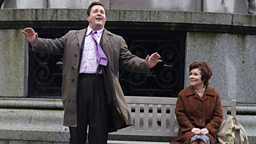
I am a massive fan of Imelda and have worked with her twice before, once in Kenya on Millennium Night and she was in one of my Christmas specials the following year. She’s an unusual combination of a powerful straight actress, but also very funny. I had seen her sing in Cabaret and she has a fantastic voice.
Frank and Dorothy, the sidekicks to Tubby and Enid, were the next two important characters to cast. The characters are rather ghastly people who are hosting a viewing of the documentary at their posh modern house. Conleth Hill was perfectly cast a Frank. He is now known for doing Game Of Thrones. But I had seen him originally in Stones In His Pockets in the West End; an Irish play where Conleth played all the parts, including the women roles. It was a really brilliant performance, so I arranged for somebody to introduce me to him. Dorothy was harder to cast, but the moment Sophie Thompson came into read for it and sang the hell out of it, I knew it was her.
What is your favourite scene?
All I do is put everything I can into the project and send it out to the world and wish that it is as entertaining as it can beVictoria Wood
One of my favourite scenes is when Tubby and Enid are at the bus stop. It’s nicely shot, the sky is quite grey and they are standing there in dull clothes. The music starts and Tubby sings ‘Was that me? Did I sing?’ I like the transition from talking to singing, especially when they are singing about not be able to sing; something you can only do in a musical.
How did you create the variety of the dances in That Day We Sang?
I wanted to create musical numbers in the film to echo the films that would have been in the world of Jimmy, Tubby and Enid. When Enid has a fantasy number, she is calling on those memories of seeing films like The Sheikwith Rudolph Valentino, West Side Storyand Sweet Charitywith Shirley MacLaine. We drew on America and Paris a lot for inspiration on the design of the dances, especially the use of painted backdrops for the fantasy numbers. I first met my choreographer, Sammy Murray Brown, when I had to learn how to tap dance for the Acorn Antiquesmusical and I’ve worked with her ever since. She choreographed some beautiful numbers; the Ginger Rogers and Fred Astaire number where we have five couples dancing is stunning.
The period details really make it stand out (the Bovril tram, an ‘avocado bath’) did you slip anything from your own home or personal recollections?
The 60s period details are down to our brilliant designer Tom Burton. When we shot in Frank's house - a real house which we dressed with our own 60s props - all the cast and crew over a certain age went round saying: "ooh we had one of those!"
What does it feel like to see your play come to life as a film?
To have an idea and see that come to life in any form is very lucky. So I was extremely lucky to be given the opportunity to make That Day We Sanginto a stage piece and a film.
What are your other favourite musicals?
I think the Sound of Music is a brilliant film though I don't actually like it. I love the score of Gypsy - I recently saw a brilliant performance by Imelda as Rose - Guys and Dolls, Hairspray and Book of Mormom. I'm rather fond of Bedknobs and Broomsticks just because I used to watch it a lot with my children.
What captures the heart of the audience when they see the play?
I couldn’t tell you what audiences take away from anything that I do. All I do is put everything I can into the project and send it out to the world and wish that it is as entertaining as it can be.
Why should we watch That Day We Sang this Christmas?
I hate having to say what's good about something I've written - but I can quite happily advise people to watch That Day We Sang because the central performances of Michael and Imelda are so beautiful and moving - and we have a great cast in Sophie Thompson, Vincent Franklyn, Conleth Hill, Dorothy Atkinson, Jessica Gunning and Daniel Rigby.

