The International Space Station - all you need to know
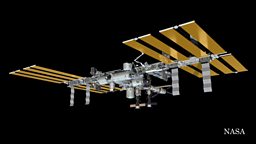
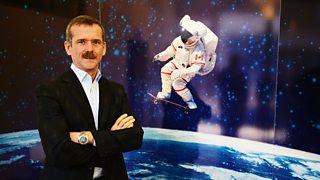
As Commander Chris Hadfield shares his Desert Island Discs, we take a detailed look at the space oddity that is the International Space Station (ISS).
The ISS is perhaps the most complex international engineering project ever built. It orbits the Earth roughly every 90 minutes, meaning that its inhabitants experience a sunset or a sunrise every 45 minutes.
Hanging in low Earth orbit, it travels at 17 000 – 17 500mph and for fifteen years humans have lived and worked on board. Major Tim Peake is the 221st person to enter the ISS, and the first Briton to do so. Crews are sent up to the space station in the Russian Soyuz rocket, which takes three people at a time.
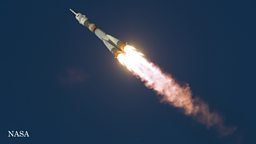
In a Soyuz you're strapped in to a couch type tub seat which is specially moulded to fit your body. You launch lying down so that the G-force presses on your chest (rather than from top of your head down, which would kill you!) After six months in space you can be up to 2cm taller as without gravity pushing you down, your spine opens up a little.
Each crew on a 'long duration' mission tends to stay up for around six months, though Scott Kelly (NASA) and Mikail Kornienko (Roscosmos) are taking part in a year-long mission to study the effects of being in space for such a long time, in the hope it will help us plan for future missions to Mars.
Scott Kelly has an identical twin brother, Mark, who is also an astronaut, and during Scott's year-long stay on the ISS they're doing lots of tests to understand how his body compares with Mark's on the ground. It's the ultimate twin study!
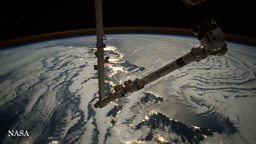
The space station is made up of the Russian segment and the U.S. Segment, though there are modules from the European and Japanese space agencies too, as well as the Canadian Canadarm-2, a large robotic arm that not only helped move modules into place when the station was being built, but is also used to capture supply capsules that are sent up to the station by companies like SpaceX.
Although the astronauts appear weightless on the ISS, it's wrong to assume that there is no gravity on the space station. In fact it's gravity that keeps them in orbit around the planet, but the speed that they are travelling at means that as the station falls toward Earth, it continually 'misses' it, and keeps falling round and round the planet. Since the astronauts and everything on board the station are falling at the same rate, they do not feel the effect of gravity, and float around. When you sleep on the space station, if you don't tuck your arms into your sleeping bag, they float up, making you look a little like a zombie.
The ISS is about the length of an American football field, and though it might seem like you would be squished in with other people for a long time, you can actually go a whole day without seeing people if you're working on an experiment in a different module.
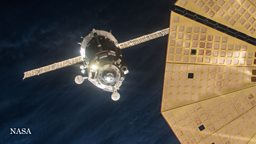
Canadian astronaut Chris Hadfield brought life on the space station to the public's attention, posting videos about simple tasks in space, and famously recorded David Bowie's 'Space Oddity' on board, releasing the video on YouTube just before he left in his Soyuz capsule to head back to Earth. He modified some of the words to include a reference to the capsule he was flying home in (Listen to Chris Hadfield's Desert Island Discs).
US Space Shuttles (no longer in use) landed much like planes on a runway, whereas the Soyuz capsule lands on the ground on the steppes of Kazakhstan (a little like the Apollo capsules, but not on water). Landing in a Soyuz has been described as several car crashes whilst being in a barrel going over Niagara Falls (though the Russians consider it 'more romantic' than a Shuttle landing).
There is no shower on the space station, instead you use moist towels, so it is a bit like camping and using wet wipes to keep clean. There is also no washing machine, so astronauts tend to wear t-shirts for a few days, sleep in them a few days and then finally wear them while exercising for a few days, before they are finally discarded.
Astronauts have to do two hours of exercise every day to prevent their bones and muscles deteriorating too much. They may also suffer from 'space sickness' when they first arrive, since the part of the ear that helps you with balance and movement contains liquid and relies on gravity. When you're in space, the liquid floats around and activates cells that send signals to the brain to tell you you're moving, upside down, etc. However, your eyes tell you something different and the conflict can make you sick. It's known as space adaptation sickness, or space sickness for short.
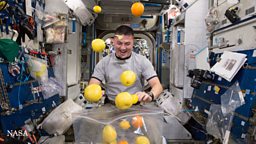
Astronauts love it when they get fresh fruit delivered from Earth since their veg tends to be dehydrated, heat-treated and vacuum packed. They add hot water to rehydrate it. Drinks come in flat silver packets and you add water. There are special straws that can be clipped shut to stop the liquid floating away, and there is Velcro on all the pouches so you can attach things to the wall and stop them floating away.
You don't want to make a mess on the station as dust won't settle like it does on earth. Astronauts eat tortillas instead of bread as that would make too many crumbs! When cutting hair they have a razor with a mini vacuum that sucks away the cut hair. For finger nails, you cut them near an air filtration vent so that they get sucked towards it rather than floating around the cabin. You have to remember to pick them up and clear them away though, else you'll upset your crewmates come cleaning day (usually Saturday). It's super important to keep tidy otherwise things float away and get lost. Just recently a spanner was found that had been lost up there for seven years.
Astronauts have decent internet access for about half the time, and are able to use VOIP to make phone calls home. The phone number sometimes shows up as the reception number from Johnson Space Center in Houston.
Chris Hadfield is not the only astronaut to have played music in space. Cady Coleman took her flute, and as well as a guitar, there is also a keyboard on board. Recently, astronaut Kjell Lindgren played the bagpipes up there, too.
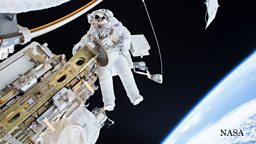
Astronauts' time is scheduled down to the minute when they are on the space station, and as well as doing two hours of exercise and enjoying the spectacular views, they work hard maintaining the station (which occasionally requires a space walk) and conducting many experiments. The ISS allows us to study things without the effect of gravity, and experiments range from seeing how the human body copes in space, growing plants and bacteria, and testing potential new medical advances, to studying crystal growth, materials science and even combustion.
As well as conducting experiments that have been sent up to the space station, the astronauts themselves are test subjects and undergo measurements before, during and after their space flights to help us better understand how humans can survive long duration missions. It is hoped that work looking at bone loss in space can be translated down to Earth, as it may help us understand how to counter osteoporosis here on Earth.