Celebrated young actor takes leading role in Stafford
The Young Roscius (William Henry West Betty, 1791-1874) was a celebrated young Shakespearean actor who first took English and Scottish theatres by storm in 1804.
He was one of a number of children who were put on the stage by their parents in the early years of the 19th century.
![]()
Much ado near me
Hear more Shakespeare stories on BBC Radio Stoke
![]()
Shakespeare Festival 2016
The BBC celebrates the genius of the bard

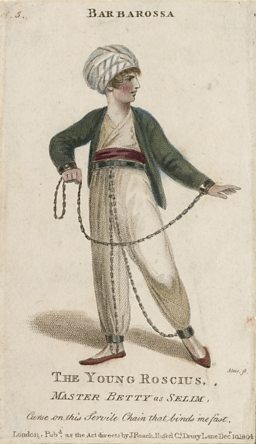
The word 'Roscius' is an allusion to a Roman actor; Quintus Roscius Gallus who was known for his great skill.
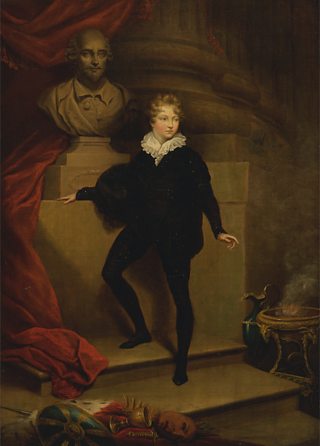
...his talents were considered a serious threat to the greatest Shakespearean actors of the day, such as John Philip Kemble.
Betty was probably the most famous 'young Roscius'.
From his first appearance aged 11 in 1804 in London, audiences were enthralled.
At one point he was so in demand that he appeared at both Covent Garden and Drury Lane theatres on succeeding evenings.
Master Betty performed in whole plays where the rest of the cast were adults.
His best-known Shakespeare roles were Romeo and Hamlet, and his talents were considered a serious threat to the greatest Shakespearean actors of the day, such as John Philip Kemble.
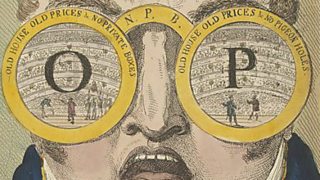
In fact, a hand coloured etching by Thomas Rowlandson, in the Victoria and Albert Museum’s Theatre collection, shows the child prodigy leap-frogging over the more mature Shakespearean actor.
In Shakespeare’s day, players of adult actors also faced a challenge from young actors.
From the 1570s, theatrical troupes in which all the performers were boys, competed for audiences.
These included companies like The Children of Paul’s.
Shakespeare mentions this trend in Hamlet, when 'tragedians of the city' are forced to go on tour because of the popularity of children on stage.
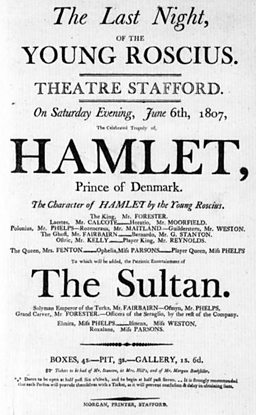
This 1807 Hamlet, with the sixteen year old William Betty in the lead role, would have been a popular draw for the people of Stafford.
About Shakespeare on Tour
From the moment they were written through to the present day, Shakespeare’s plays have continued to enthral and inspire audiences. They’ve been performed in venues big and small – including inns, private houses and emerging provincial theatres.
BBC English Regions is building a digital picture which tracks some of the many iconic moments across the country as we follow the ‘explosion’ in the performance of The Bard’s plays, from his own lifetime to recent times.
Drawing on fascinating new research from Records of Early English Drama (REED), plus the British Library's extensive collection of playbills, as well as expertise from De Montfort University and the Arts and Humanities Research Council, Shakespeare on Tour is a unique timeline of iconic moments of those performances, starting with his own troupe of actors, to highlights from more recent times. Listen out for stories on Shakespeare’s legacy on your BBC Local Radio station from Monday 21 March, 2016.
You never know - you might find evidence of Shakespeare’s footsteps close to home…
Craig Henderson, BBC English Regions
Shakespeare on Tour: Around Stoke
![]()
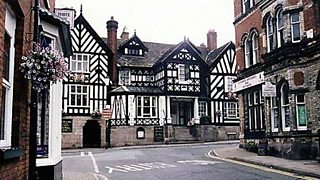
Small town proves a big attraction for Shakespeare's players
Congleton recorded as a regular stop for the King's Men
![]()
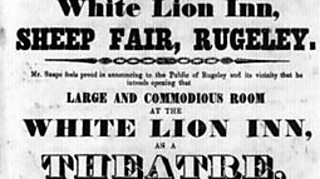
Travelling players put on Macbeth in an unconventional setting
Travelling theatre company puts on Macbeth in the unconventional setting of a sheep fair
![]()
Shakespeare Lives
The nation’s greatest performing arts institutions mark 400 years since the Bard's death

Related Links
Shakespeare on Tour: Around the country
![]()
The 1809 ticket price riots
The most famous riots in the history of theatre
![]()
Cambridge students put on a Christmas satire
Shakespearean style 'Footlights'
![]()
North West's influence on Shakespeare's success
Plus, the small Cheshire town that attracted Shakespeare's players
![]()
Salisbury shadows play Shakespeare
A dreamy performance of Shakespeare