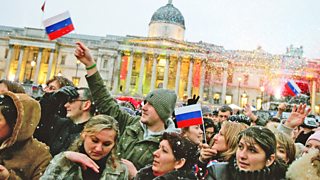
Five things we learned about Russians in the UK
The Skripal poisoning case, allegations of international cyber-warfare, and the Syrian conflict have put an intense spotlight on Russia and its citizens. Hundreds of thousands of Russians are thought to live in the UK, a quarter-million of them in London, where so many oligarchs own luxury properties that activists are running "kleptocracy" tours taking journalists round what's known as "Londongrad".
In Russians in Britain: A Handbook, Lucy Ash asks: Who are these Russians? Why is Britain so popular with them? And what do they really feel about relations between their adopted home and Vladimir Putin's Russia? Here are some of the answers.
1. Russian money is woven into the UK landscape
Premier League football clubs, Scottish country estates, the Waterstones bookshop chain, the London Evening Standard, the extension of Tate Modern – all are underpinned by Russian money. But conspicuous consumption is often hidden as Russian homeowners employ craft workers to gild their nests – often literally – behind the closed doors of their luxury mansions in the gated communities of London's most expensive addresses.

Where did the money come from? In the chaotic transition to a market economy after the collapse of the Soviet Union, a small group of well-connected types picked up oil wells, gas fields and gold mines for next to nothing, turning state assets into private assets and becoming billionaires almost overnight. History suggested that this wealth needed to be exported to safe havens abroad, of which the safest was London, where a political move to make the city the world's leading financial centre welcomed foreign investment, not least through the investment visa scheme. London's other attractions for Russians included being only four hours from Moscow, having a cosmopolitan community, having a great cultural life and providing the best schools.
2. Russian immigration is nothing new
Russians have been coming to Britain in significant numbers since the Revolution of 1917. A second wave came during WW2 as Russian POWs escaped Nazi Germany, often settling in the north of England. But unlike incoming Poles who set up social clubs wherever they went, the legacy of pogroms, political exile and espionage promoted a more cautious approach to fraternisation on foreign soil.
3. Today, many Russian immigrants are in voluntary exile
Under Putin, businessmen are left alone as long as they steer clear of politics. For many who have upset the regime, the UK is regarded as a safe haven. The annexation of Crimea and the Ukraine conflicts have triggered a further influx. Many are professionals and entrepreneurs who have started their own businesses entirely free of any political or commercial baggage from their previous lives. Their embrace of British culture and values is often complete.

4. Cultural traditions are strong, reciprocal and enduring
Russian culture has always been respected in the UK, and Russian artists have traditionally been welcomed here. Writers such as Tolstoy and Pushkin are revered; there is an enduring fascination for Russian visual art of all periods; the UK provided a home for ballet star Rudolf Nureyev when he defected; Russian composers and performers such Stravinsky, Shostakovich, Ashkenazy and Rostropovich were feted; Gennadi Rozhdestvensky was chief conductor of the BBC Symphony Orchestra, Vladimir Jurowski led Glyndebourne, Valery Gergiev the London Symphony Orchestra and Vasily Petrenko is the current music director of the Royal Liverpool Philharmonic.
In the wake of the Russian influx, throughout the UK, Russian-based cultural associations, including folk groups and choirs, have flourished. For example, London is home to the London Russian Ballet School, run by former Bolshoi Ballet dancer Evgeny Goremykin.
5. There is more common ground between Russians and Brits than not – this balance is now in jeopardy
Commentators point to two rather insecure states, previously very powerful and now less so, finding their way in a new world order. Perhaps there is a sense that if Britain had been more vigilant and less keen to cash in on Russian money, there would be less resentment at local level about Russians flashing their cash in "Moscow-on-Thames" - a state of affairs, combined with recurrent spy scandals, which is undoubtedly harmful to relations between the two countries.
But "ordinary" Russians are sad about this state of affairs, noting a shared history of suffering in two world wars. There is genuine regret that retaliation against the post-Skripal diplomat expulsions included the Russian Foreign Ministry ordering the British Council to cease operations at its only remaining Russian office in Moscow, where the Council has worked continuously since 1959. This is more damaging than the diplomatic fallout from the Litvinenko affair in 2008.
Notwithstanding, while the risk is that feeling scorned will fuel the siege mentality promoted on Russian state TV and lead to more isolation, Russians in Britain are here to stay: relations will remain as nuanced as they always have been. In talking about them, the important thing is to resist the easy cliché.
![]()
Russians in Britain: A Handbook
Oligarchs, dissidents and beyond – Lucy Ash meets the Russians of the UK.