Five things we learned about Keir Starmer’s music taste from Private Passions
On Sunday 26 October, Michael Berkeley is joined by the Prime Minister, Sir Keir Starmer, for a special edition of BBC Radio 3’s Private Passions.
Keir Starmer on Private Passions
![]()
Listen now on BBC Sounds
Private Passions is the programme where guests from all walks of life reveal their musical passions and explore the influence music has had on their lives.
Here are five things we learned from their wide-ranging conversation about politics, family, and music. Listen to the full episode on BBC Radio 3 and BBC Sounds.
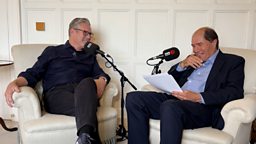
1. The PM plays four instruments
In his youth, Sir Keir was a keen amateur musician and played flute, piano, recorder and violin. He won a Guildhall School of Music and Drama scholarship, which gave him weekly music lessons, and played flute in a youth orchestra.
I think we’ve let music, creatives and art slip too much
“It instilled in me a lifelong belief in the importance of music, over and above the beauty and the joy of listening to music,” he tells Michael Berkeley in Private Passions. “It taught me skills such as watching someone’s eye, so you know when to come in – having responsibility. If you're playing in a quartet, you have to be fully playing your part and communicating.”
The experience convinced him that participating in the arts – especially music – gives children vital skills that they take into adulthood. Yet in the present day, Michael points out, 42% of state schools no longer enter students for GCSE music – and fewer than 5,000 students took A–level music in 2025.
“There's always arguments about what should be in or not in the curriculum,” Sir Keir says, “but we need a broader sense of education, I think, and I think we've let music, creatives and art slip too much.”
“It is a concern that the numbers have gone down. We need to signal what an A–level in music might give to you. Whether it's a path through to university, path through to an apprenticeship, of some sort or some job within music... I think we will more likely have more young people doing things like A-level music if we're clear with them: where does this take you then?”

2. He played violin with Fatboy Slim
At secondary school, the PM learned the violin alongside a classmate, Norman Cook, who would go on to become the DJ Fatboy Slim.
“We were at secondary school, probably first and second year, and for some reason we had violin lessons as pairs,” he remembers. “So, it was Fatboy Slim and me together, learning our violins.”
Did he realise that one of them was destined for musical stardom? “Obviously music played a big part in his life – still does, as he's gone forward,” Sir Keir concedes, “but I think at that stage, the quality of the output from our violins was pretty poor.”
3. Music became a way to connect with his parents
Sir Keir’s first choice on Private Passions is a moment from Tchaikovsky’s 1877 ballet, Swan Lake. “I grew up with music all around us,” he says. “My mum loved Tchaikovsky, and she loved ballet and Swan Lake in particular.”
Sir Keir’s mother suffered from a rare and aggressive form of arthritis. Despite benefiting from pioneering steroid treatment, she was unable to walk by her 30s, when Keir was a teenager. “But there was something about her: the more difficult it was for her to do something like ballet, the more fascinated she was by this sort of brilliant art form – the physical element as well as the music,” he remembers. “It took her to a sort of special place and allowed her, through somebody else, to enjoy all the things that she couldn't do.”
Meanwhile, his father listened almost exclusively to classical music. “He was an incredible man: totally, totally devoted to my mum in every way,” Sir Keir says. "But he didn't have much emotional space left for his children and therefore there weren't long discussions with my dad.”
Sir Keir’s father loved Beethoven – and his sixth symphony, “Pastoral” above all. “I probably got to know this piece of music better than any other piece of music because he played it so often when I was growing up,” he says. “It's a beautiful symphony, you know, with all the mixture of seasons and moods, but it has a lightness to it as well towards the end. And through that, I sort of tried to reach my dad's emotion. What would he be thinking when he was listening to this?”
The PM's music choices in full
- Tchaikovsky: Transformation scene from Act 2 of Swan Lake
- Beethoven: Symphony No 6, “Pastoral” (fourth movement)
- Shostakovich: Piano Concerto No 2 in F major (second movement)
- Orange Juice: Falling and Laughing
- Beethoven: Piano Concerto No 5, “Emperor” (second movement)
- Brahms: Double Concerto in A Minor (second movement)
- Elgar: Cello Concerto in E Minor (third movement)
- Mozart: Piano Sonata No 16 in C major (second movement)
- Frank Wilson: Do I love you
4. He still uses music as an escape
Sir Keir became the UK’s seventh Labour Prime Minister with a landslide victory in 2024 – but his Government have not had an easy time of it, with polls suggesting that Sir Keir is one of most unpopular Prime Ministers of recent decades. How does he deal with that, asks Michael Berkeley?
“There is bound to be a frustration,” Sir Keir acknowledges. “We had long, long years, in my view, of failure under the last Government. We need to turn that around... I know what the job is, I know what I've got to do, and I'm going to just keep absolutely focused on what change is necessary and how we bring it about as quickly as possible.”
Many of us use music as a way to focus, relax, or find a moment of calm – and the UK Prime Minister is no exception. “I will always have music on,” he says. “It is a place to go to, either after a busy day or just to sort of gather my thoughts. Quite often I sneak one of those little speakers into my suitcase because I can then run off my phone music wherever I am.”
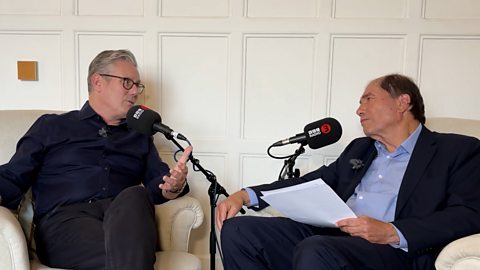
Keir Starmer: "Music is an escape for me"
The PM opens up about how music helped him grieve the loss of his brother in 2024.
5. When it comes to classical, he really loves slow movements
Nearly half of Sir Keir’s music choices for Private Passions are second movements of symphonies, concertos and sonatas. The second, “slow” movement in classical music traditionally has a more downbeat tempo and an expressive, lyrical mood. Is that a reflection of his character, asks Michael Berkeley?
"I think it must be, because there's too strong a pattern there for me to give you any other answer,” Sir Keir concedes. “But it's a yes. It's beautiful. It brings people in.”
Of the second movement of Mozart's Piano Sonata No 16, he says: “This is one of those beautiful pieces of music that is either late night or sort of evening music. Every day in my job, you wake up to the known challenges and then you get added to that the additional challenges of the day. Almost every decision is between really difficult and really, really difficult.
“And sometimes, therefore, when I get home, breaking out of that with a bit of Mozart is really fantastic.”