
Home > Opinion > By order of The Management
Seaneen Molloy

Seaneen is the three-quarter sized Irish writer behind The Secret Life of a Manic Depressive blog. In her spare time she enjoys tea, hurling insults at the television and tutting at those who tut at others on public transport. She lives in London with two cats and eight million other people.
By order of The Management
16th October 2009
My first psychiatrist was a man with the tweed elbows of a geography teacher and the manner of a particularly fervent football manager. I, as a newly diagnosed hopeful-yet-horrified mentalist, was prepared to swallow everything he gave me - from the medications he prescribed to advice on how to manage my illness. It was straightforward enough.

"No alcohol," he barked. "No caffeine. Avoid recreational drugs. Give up smoking. Exercise for at least thirty minutes a day. Eat a healthy, balanced diet full of fresh fruits and vegetables. Sleep for at least eight hours a night, join a support group, keep a mood journal, keep in touch, employ a routine..."
Basically, everything apart from breathing was out. If I wanted to be well, I'd have to live a life of simple monastic purity. On lithium.
His message was quite clear. Although I probably needed the medication and the therapies, they were, essentially, stabilizers. I couldn’t rely solely on them to make me better. I’m the one living with bipolar disorder, so it was up to me to be proactive in my recovery. Bitter was my disappointment. I am not a patient person.
Basically, everything apart from breathing was out. If I wanted to be well, I'd have to live a life of simple monastic purity. On lithium.
His message was quite clear. Although I probably needed the medication and the therapies, they were, essentially, stabilizers. I couldn’t rely solely on them to make me better. I’m the one living with bipolar disorder, so it was up to me to be proactive in my recovery. Bitter was my disappointment. I am not a patient person.

So, I took his words on board and then spent the next three or so years periodically ignoring them. Now I’m finding things that work for me, but it hasn’t been easy. The tips I’ve been given on managing my illness have ranged from common sense to the downright bizarre.
Take maintaining a healthy diet and exercising, for instance. This guidance applies to everybody everywhere. It is touted from the television daily. And yes, exercise is beneficial for people suffering from depression. However, when I am seriously depressed, I can’t summon the energy to cry, let alone to go for a jog. A lack of energy is a symptom of depression, and it’s a terribly hard one to battle unless you have a cattle prod handy.
Likewise, I could get my five a day and more and I’d still be bouncing off the walls babbling about whatever topic has caught my attention within that five seconds. Probably more so, owing to the sugar rush.
But there is the sound advice, too. The doctor was essentially right. Apart from some, “Into the Thames with you!” hissy fits, I do take my medication. And because I take my medication, I sleep roughly the same amount each night. As a result, my moods are more even. When I sleep a lot less, or a lot more, it’s usually an indication that something might be wrong, either in terms of my mood or my medication. Managing my sleep has arguably been the most important thing that I’ve learned to do.
But there is the sound advice, too. The doctor was essentially right. Apart from some, “Into the Thames with you!” hissy fits, I do take my medication. And because I take my medication, I sleep roughly the same amount each night. As a result, my moods are more even. When I sleep a lot less, or a lot more, it’s usually an indication that something might be wrong, either in terms of my mood or my medication. Managing my sleep has arguably been the most important thing that I’ve learned to do.
I keep a blog. I started it in 2007, shortly after my diagnosis. I scoffed at the idea initially but it has been absolutely invaluable in helping me keep track of my moods. I know personally that without some sort of record, I’d forget, minimise, lose insight into or otherwise ignore a lot of my symptoms. Over time, reading it back, I began to recognise patterns and warning signs. It enables me to take action before things worsen. And it also serves as a record of my progress, a progress that can often feel scant.
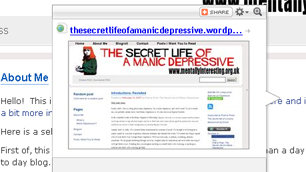
I write publicly, because, although I wanted support, I didn’t feel up to attending a support group. The support, and insight, that I’ve received from my blog readers - many of who experience mental health problems - has been massively helpful. I was quite afraid of reaching out, but I’m glad I did. And in opening up somewhere, it’s helped me to be a bit more vocal with those close to me. It also gives me a place to vent, which saves on furniture.
Alas, I don’t drink anymore. As much as I found it hard to admit, it did have a horrible impact on my mood. It fuelled raging manias and darkened depressions. I do partake of a snifter on special occasions but I generally avoid it. When I find I can’t avoid it, then it’s a red flag to me.
I have a routine, as much as somebody like me can do. No matter how I feel, I get out of bed everyday. I force myself to do something daily, no matter how small. Even if it’s simply going to the shop to replace the greening milk. I would feel useless otherwise.
I have a routine, as much as somebody like me can do. No matter how I feel, I get out of bed everyday. I force myself to do something daily, no matter how small. Even if it’s simply going to the shop to replace the greening milk. I would feel useless otherwise.
These are my basic ways of managing my illness, and they help me with the bigger things such as the fruit-eating and the taking-a-walking. And my walks are sometimes baby-steps. I still experience the symptoms of bipolar disorder and I am not super-capable all or even most of the time. I cut myself a bit of slack when I need to. But I feel a lot more in control now than I did after my diagnosis.
More articles about
Bookmark with...
Live community panel
Our blog is the main place to go for all things Ouch! Find info, comment, articles and great disability content on the web via us.
Listen to our regular razor sharp talk show online, or subscribe to it as a podcast. Spread the word: it's where disability and reality almost collide.
More from the BBC

All the latest news from the paralympics.

News and views for people who are blind or partially sighted.

Weekdays 12.40pm. Radio 4's consumer affairs programme.

~RS~q~RS~_bbc_=0&__ip__=54.77.26.26&dnainitialtitle=By%20order%20of%20The%20Management&dnahostpageurl=http://www.bbc.co.uk/ouch/opinion/the_management.shtml&dnauid=ouch:article:2126&s_baseHeadingLevel=1&dnashow=10&dnafrom=0&dnato=9&dna_encoding=utf-8&s_sssicomponent=1&s_sssiCommentCount=&dnacommentforumlistprefix=%5B_%5D&dnarecentcommentsprefix=%5B_%5D&s_commentprofileurl=/dna/mbouch/CommentProfile?&s_contact=0~RS~z~RS~26~RS~)

Comments
Dear,Seaneen I do believe it is good to reflect,especially if the mind plays tricks on one even if we are unsure to be self critical,shared information is even greater it gives us the chance to visually check our thoughts, Always praise oneself as a diagnosed Depressive,I am hard on myself but reading your blog is very informative .Thanks for Insight
Complain about this comment
View these comments in RSS