
Home > Opinion > Disabled at 35,000 feet
Liz Carr
Liz is a crip activist and actor, now trying to gain experience as a stand-up comedian. Originally from the North West, she recently moved to London, lured by the bright lights and the promise of fame and fortune. She's still waiting.
Disabled at 35,000 feet
4th May 2009
The more I fly, the more terrified I become of flying. Like many other people with this fear, I worry that the metal tube I'm trapped in will just randomly fall out of the sky. I play out what I'll do if there's a terrorist attack, an in-air collision or a crash landing. Before we've even taken off, I'll look around at the other passengers in the cabin and imagine the voiceover of a true life disaster documentary: "Little did they realise what was about to happen to flight 403 ..."
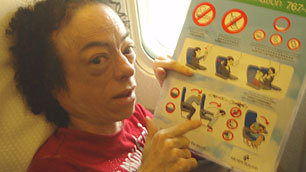
Okay, I'll admit that I am a little dramatic, but unlike most people who are scared of flying, I have the added fear that, as a disabled person, in the event of an emergency I would stand absolutely no chance of survival. None at all.
So how have I come to such a pessimistic conclusion? Well, in the last 8 weeks, I've spent over 50 hours in an aeroplane. During that time, I've watched 21 films, eaten 16 pre-packaged meals and endured 12 safety demonstrations. Whilst I can now confidently recite the safety briefing word for word, what I can't do is actually carry out any of its instructions. I can't fasten my seatbelt, put an oxygen mask over my nose and mouth or pull the toggle on my lifejacket. If things went wrong, I'd be stuffed.
As soon as I'm on the plane, the flight attendant approaches, crouches down to my level and smiles in that way that tells me they're about to say something I'm not going to like. "Miss Carr? If there's a need to evacuate the plane for any reason, we ask you to please stay behind until last, when a member of the cabin crew will come and assist you."
I want to laugh at her and reply sarcastically that of course being left until last is absolutely fine with me, thanks. I wish I could tell her to cut the polite crap and just say that walkers take priority while cripples get in the way. I'd like to rant at her about how this feels like a Darwinian 'survival of the fittest' approach to airline safety. Instead, I opt for a quiet life and just nod, smile and agree. She cheerily continues: "... but please do feel free to enjoy the complimentary in-flight entertainment while waiting to be evacuated".
So how have I come to such a pessimistic conclusion? Well, in the last 8 weeks, I've spent over 50 hours in an aeroplane. During that time, I've watched 21 films, eaten 16 pre-packaged meals and endured 12 safety demonstrations. Whilst I can now confidently recite the safety briefing word for word, what I can't do is actually carry out any of its instructions. I can't fasten my seatbelt, put an oxygen mask over my nose and mouth or pull the toggle on my lifejacket. If things went wrong, I'd be stuffed.
As soon as I'm on the plane, the flight attendant approaches, crouches down to my level and smiles in that way that tells me they're about to say something I'm not going to like. "Miss Carr? If there's a need to evacuate the plane for any reason, we ask you to please stay behind until last, when a member of the cabin crew will come and assist you."
I want to laugh at her and reply sarcastically that of course being left until last is absolutely fine with me, thanks. I wish I could tell her to cut the polite crap and just say that walkers take priority while cripples get in the way. I'd like to rant at her about how this feels like a Darwinian 'survival of the fittest' approach to airline safety. Instead, I opt for a quiet life and just nod, smile and agree. She cheerily continues: "... but please do feel free to enjoy the complimentary in-flight entertainment while waiting to be evacuated".
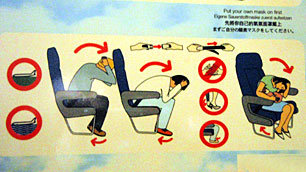
I'm flicking through the airline's listings magazine and planning what to watch if the plane should suddenly start plunging towards the ground, when the safety demonstration begins. On the TV screen, a colourful cartoon character with a celebrity voice asks us if we've fastened our seat belts. I haven't, because having arms like wishbones means that I can't reach my waist or my belt. I nudge my personal assistant to buckle me up. So far so good.
But then my heart sinks as I hear those dreaded words: "brace position". The on-screen cartoon passenger adopts the correct pose by putting their hands behind their head, resting their elbows around their thighs and leaning forward. I watch with a mixture of amusement and awe. I can only dream of bracing. With me, there's no leaning forwards, backwards or any which way. My emergency brace position is exactly the same as my sitting position. The cartoon helpfully advises us that if you can't put your head on your knees then you should press it against the back of the seat in front instead. I try to lean forward, but the only discernible part of my body moving anywhere is my eyebrows.
But then my heart sinks as I hear those dreaded words: "brace position". The on-screen cartoon passenger adopts the correct pose by putting their hands behind their head, resting their elbows around their thighs and leaning forward. I watch with a mixture of amusement and awe. I can only dream of bracing. With me, there's no leaning forwards, backwards or any which way. My emergency brace position is exactly the same as my sitting position. The cartoon helpfully advises us that if you can't put your head on your knees then you should press it against the back of the seat in front instead. I try to lean forward, but the only discernible part of my body moving anywhere is my eyebrows.
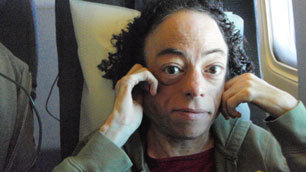
So there's no bracing. To make matters still worse, there's no oxygen mask either. The cartoon announcement reminds us that: "If you have to assist a child or someone else with their mask, make sure you affix yours first, as loss of oxygen will result in loss of consciousness". Oh great, yet again I have to wait until last. As everyone else is putting on their masks and breathing easily, I'll presumably be waiting patiently, gasping for air and watching the complimentary in-flight entertainment. Lucky me.
By the time the chirpy character is detailing the location of the lifejackets and how you should fit them, I'm a nervous wreck. If I could reach my hair, I'd be pulling it out. In the event of an emergency landing in the sea, the only saving grace would be that at least the safety slides would act like giant ramps.
I'm still 6,000 miles away from home, which means that I have 4 more films, 2 more pre-packaged meals and another 12 hour flight to go. So instead of sitting through yet another normal safety demonstration, I've decided to create an alternative disability version:
By the time the chirpy character is detailing the location of the lifejackets and how you should fit them, I'm a nervous wreck. If I could reach my hair, I'd be pulling it out. In the event of an emergency landing in the sea, the only saving grace would be that at least the safety slides would act like giant ramps.
I'm still 6,000 miles away from home, which means that I have 4 more films, 2 more pre-packaged meals and another 12 hour flight to go. So instead of sitting through yet another normal safety demonstration, I've decided to create an alternative disability version:
"Cripples and carers, your cabin crew will be around shortly to fasten your seatbelts. In the event of an emergency, you will be assisted out of the plane before everyone else. Your oxygen masks must, by law, be fitted first. If the brace position needs to be adopted, just sit back and relax in the most comfortable and stress-free position for you. If necessary, you will be fitted with adjustable, heated and fashionably coloured flotation devices, and given a portable MP3 player with which you can entertain yourself until your rescue. Thank you very much, and enjoy your flight."
Bookmark with...
Live community panel
Our blog is the main place to go for all things Ouch! Find info, comment, articles and great disability content on the web via us.
Listen to our regular razor sharp talk show online, or subscribe to it as a podcast. Spread the word: it's where disability and reality almost collide.
More from the BBC

All the latest news from the paralympics.

News and views for people who are blind or partially sighted.

Weekdays 12.40pm. Radio 4's consumer affairs programme.

~RS~q~RS~_bbc_=0&__ip__=54.77.33.255&dnainitialtitle=Disabled%20at%2035%2C000%20feet&dnahostpageurl=http://www.bbc.co.uk/ouch/opinion/disabled_at_35_000_feet.shtml&dnauid=ouch:article:2007&s_baseHeadingLevel=1&dnashow=10&dnafrom=0&dnato=9&dna_encoding=utf-8&s_sssicomponent=1&s_sssiCommentCount=&dnacommentforumlistprefix=%5B_%5D&dnarecentcommentsprefix=%5B_%5D&s_commentprofileurl=/dna/mbouch/CommentProfile?&s_contact=0~RS~z~RS~19~RS~)

Comments
"If there's a need to evacuate the plane for any reason, we ask you to please stay behind until last, when a member of the cabin crew will come and assist you."
Wow...I can't believe they can do that!
Complain about this comment
I have highlighted a similar problem on trains. "Your attention is drawn to the safety cards..." - I've written in and asked why they don't show how the wheelchair user evacuates, they don't even say "we know you are there and someone will come and get you" - at least on the card in the wheelchair bay!
Complain about this comment
Great article!
Complain about this comment
Great article!
Complain about this comment
I love it!!
I like your writing and I totally relate to your experience!
Complain about this comment
View these comments in RSS