
Home > Features > I Moscow Again
I Moscow Again
5th May 2004
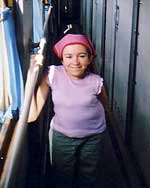
As a person not noted of my high regard for the morning rail commute in the UK, my choice of a train holiday was something of a departure for me (get it?)
In short, I hate the UK train experience with such a seething passion that I'd rather listen to Gareth Gates records over and over again in preference to waiting on a station platform for a delayed train, and ending up missing it anyway due to the pre-booked disability assistance person not bothering to turn up.
What sets apart the Trans-Mongolian Express journey from the GNER east coast route, however, is its inclusion as one of the best adventures on the planet by travel editors everywhere. Plus, you may have noticed that the 08:00 to King's Cross doesn't snake through Siberia, edge into Outer Mongolia or glide past the Great Wall of China.
Not only is the journey a great adventure, it's also a great challenge for anyone other than a hardy backpacker. Going on this journey requires forward planning and help from your travelling companions, plus some physical stamina. Get it right, and your effort will pay off in droves.
In short, I hate the UK train experience with such a seething passion that I'd rather listen to Gareth Gates records over and over again in preference to waiting on a station platform for a delayed train, and ending up missing it anyway due to the pre-booked disability assistance person not bothering to turn up.
What sets apart the Trans-Mongolian Express journey from the GNER east coast route, however, is its inclusion as one of the best adventures on the planet by travel editors everywhere. Plus, you may have noticed that the 08:00 to King's Cross doesn't snake through Siberia, edge into Outer Mongolia or glide past the Great Wall of China.
Not only is the journey a great adventure, it's also a great challenge for anyone other than a hardy backpacker. Going on this journey requires forward planning and help from your travelling companions, plus some physical stamina. Get it right, and your effort will pay off in droves.

Be prepared - disability access in the three countries en route is largely a pipe dream. In Moscow, their idea of subway access is a couple of breathtakingly steep metal tracks down the stone steps. Comprehensive travel insurance is definitely recommended for anyone attempting this one, along with a swift shot of vodka for Dutch courage.
Mongolian pavements, where they exist, are rollercoaster-style and riddled with open manholes just to check that you're paying attention. I came across some tactile paving in Beijing, which led to a pedestrian crossing. Pretty handy, you would have thought - except Beijing drivers are of the kamikaze variety and don't actually stop at red lights. Only Olympic sprinters have much of a chance of making it to the other side in one piece. Finally, there's no disability provision on the train itself.
The Trans-Mongolian Express is actually two train journeys. From Moscow to Mongolia the train is Russian-run, and from Mongolia to Beijing it's a Chinese service. It's possible, if you've got oodles of time, to stop off for a few nights at various towns in Siberia. Sights such as Lake Baikal and Ekaterinburg, where the Russian royal family was murdered, await you.
We chose to take only one stop on the 7865km journey. Our route was Moscow to Mongolia, a five-day train journey. Next, after a break of three nights, was a two-day ride from Mongolia to Beijing.
Mongolian pavements, where they exist, are rollercoaster-style and riddled with open manholes just to check that you're paying attention. I came across some tactile paving in Beijing, which led to a pedestrian crossing. Pretty handy, you would have thought - except Beijing drivers are of the kamikaze variety and don't actually stop at red lights. Only Olympic sprinters have much of a chance of making it to the other side in one piece. Finally, there's no disability provision on the train itself.
The Trans-Mongolian Express is actually two train journeys. From Moscow to Mongolia the train is Russian-run, and from Mongolia to Beijing it's a Chinese service. It's possible, if you've got oodles of time, to stop off for a few nights at various towns in Siberia. Sights such as Lake Baikal and Ekaterinburg, where the Russian royal family was murdered, await you.
We chose to take only one stop on the 7865km journey. Our route was Moscow to Mongolia, a five-day train journey. Next, after a break of three nights, was a two-day ride from Mongolia to Beijing.
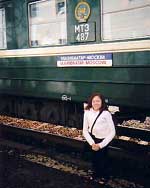
It was a crisp and clear night in Moscow when, excitedly, we waited to board the train, surrounded by Mongolians with bags and bags of luggage. Unlike British trains, the Russian variety actually turn up on time and leave you with half an hour to get on and get settled before the start of the journey. The train is high up from the platform, and in the absence of a pole vault I jumped up with the help of the carriage attendant. It's this attendant's job to keep the carriage clean, top up the samovar of boiling water (free for the passengers to use), and generally bustle about looking official.
The Trans-Mongolian Express is popular with tourists. In our carriage were Swedes, Brits and Australians; the only natives were Mongolians who appeared to have tardis-style compartments housing their bags of luggage.
A second class carriage consists of two lower beds that double up as seats, and two upper bunks that fold up in the daytime. Under the seats and above the compartment door is storage space for rucksacks. At the end of the carriage is a prison-like stainless steel toilet and washbasin, with an aroma not dissimilar to a back alley on a Saturday night. This offputting feature provides good training in crossing your legs - not an easy skill with the continuous jigging motion of the train and the provision of constant hot water on tap.
First class compartments are the same as second class but without the top two bunks. Though they are a bit more expensive, they're a better disability option - though still no room for something the size of a wheelchair. Still no shower in first class, but you're nearer the buffet car.
Plastic cloths and flowers adorn the restaurant tables and the air is thick with the pungent smell of Russian cigarettes. The food on offer is meat and rice, plus meat and rice, followed by meat and rice. Go early in the journey if you want vegetables, because by the end of the trip the caterers resort to sauerkraut.
The other option for in-train dining is buying food from locals during the short stops at stations. Each ten-minute stop was our cue to go foraging for food. I thought that all of the Russian locals gathered on the platform were just there to sell passengers pastries, boiled eggs, crisps and drinks. At the first daylight stop in Siberia I was put straight though - it seems it's more of a two-way trading opportunity. Some of the Mongolian passengers dashed along the train corridor to the platform carrying coats, jumpers, jeans, and a disturbing line in fluted light fittings. The locals on the platform pushed each other in the throng to pick up a new outfit from them, holding out on the price until it was time for the hawkers to dash back on the train. Siberia is obviously lacking a local branch of Top Shop.
At one stop on a Saturday night, young couples turned up on the platform for a romantic evening shopping, flicking through the goods on offer with a determined expression and a steely glint. Winter coats seemed to sell well - handy in an area that gets down to minus 30 degrees centigrade.
People-watching is one of the main pleasures of the train ride. Away from the constant communication of western life, the journey allows time to observe a different way of living and see the change in the landscape as Europe turns into Asia. The trees shrouding the line near Moscow turn into the almost Alpine appearance of Siberia in late summer, before metamorphosing into the starker, bolder steppes of Mongolia.
The journey is not boring. Life takes on a rhythmic routine - stopping for food, taking in the scenery, playing cards and having time to think. The trip is physically demanding, and without the friends I travelled with I would have found the city stops virtually impossible, but time back on the train was the chance to recharge my batteries. The motion of the train is almost soporific, except for the regular rattle of the compartment door handle. Roughing it is part of the holiday's attraction, as is waking up and peeping out of the window to look for a distance marker to see how far you've come. And whilst the trip may not be disability-friendly, most of the people I met were far more helpful than their counterparts in England.
Going through border crossings takes a lot of time, involving smiling at stern-faced officials wearing scary, oversized hats. Crossing the border from China into Mongolia, we filled out lots of customs forms and waved our passports and visas.
The Trans-Mongolian Express is popular with tourists. In our carriage were Swedes, Brits and Australians; the only natives were Mongolians who appeared to have tardis-style compartments housing their bags of luggage.
A second class carriage consists of two lower beds that double up as seats, and two upper bunks that fold up in the daytime. Under the seats and above the compartment door is storage space for rucksacks. At the end of the carriage is a prison-like stainless steel toilet and washbasin, with an aroma not dissimilar to a back alley on a Saturday night. This offputting feature provides good training in crossing your legs - not an easy skill with the continuous jigging motion of the train and the provision of constant hot water on tap.
First class compartments are the same as second class but without the top two bunks. Though they are a bit more expensive, they're a better disability option - though still no room for something the size of a wheelchair. Still no shower in first class, but you're nearer the buffet car.
Plastic cloths and flowers adorn the restaurant tables and the air is thick with the pungent smell of Russian cigarettes. The food on offer is meat and rice, plus meat and rice, followed by meat and rice. Go early in the journey if you want vegetables, because by the end of the trip the caterers resort to sauerkraut.
The other option for in-train dining is buying food from locals during the short stops at stations. Each ten-minute stop was our cue to go foraging for food. I thought that all of the Russian locals gathered on the platform were just there to sell passengers pastries, boiled eggs, crisps and drinks. At the first daylight stop in Siberia I was put straight though - it seems it's more of a two-way trading opportunity. Some of the Mongolian passengers dashed along the train corridor to the platform carrying coats, jumpers, jeans, and a disturbing line in fluted light fittings. The locals on the platform pushed each other in the throng to pick up a new outfit from them, holding out on the price until it was time for the hawkers to dash back on the train. Siberia is obviously lacking a local branch of Top Shop.
At one stop on a Saturday night, young couples turned up on the platform for a romantic evening shopping, flicking through the goods on offer with a determined expression and a steely glint. Winter coats seemed to sell well - handy in an area that gets down to minus 30 degrees centigrade.
People-watching is one of the main pleasures of the train ride. Away from the constant communication of western life, the journey allows time to observe a different way of living and see the change in the landscape as Europe turns into Asia. The trees shrouding the line near Moscow turn into the almost Alpine appearance of Siberia in late summer, before metamorphosing into the starker, bolder steppes of Mongolia.
The journey is not boring. Life takes on a rhythmic routine - stopping for food, taking in the scenery, playing cards and having time to think. The trip is physically demanding, and without the friends I travelled with I would have found the city stops virtually impossible, but time back on the train was the chance to recharge my batteries. The motion of the train is almost soporific, except for the regular rattle of the compartment door handle. Roughing it is part of the holiday's attraction, as is waking up and peeping out of the window to look for a distance marker to see how far you've come. And whilst the trip may not be disability-friendly, most of the people I met were far more helpful than their counterparts in England.
Going through border crossings takes a lot of time, involving smiling at stern-faced officials wearing scary, oversized hats. Crossing the border from China into Mongolia, we filled out lots of customs forms and waved our passports and visas.
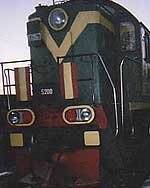
Just as all the pen-pushing began to get tedious, the Chinese put on a show. There was lots of banging and shunting of carriages, then we found ourselves levitating in a large shed. No, it was nothing to do with David Blaine - underneath the carriage was a large jack lifting us up to enable numerous workers to scrabble underneath. Handily, Chinese railway tracks are a different width from those in Russia and Mongolia, so the wheels on the train have to be changed. That gave us a great opportunity to wave at the passengers in the carriage shunted next to us. Finally, it was down to earth with another bang, and when the carriages were fixed back together we gathered pace and sped into China.
The best visual part of the journey was playing 'spot the Great Wall'. The first glimpse of it was hard to define. Through the mist a thin grey line snaked across the top of the faraway hills. When the train stopped at Badaling, however, there was no missing it.
Seemingly defying gravity, the stone draped itself at steep angles down the hills, connected by small castle-like structures. As I'd discover a few days later when I visited, its numerous crumbling steps and steep inclines make it much harder to walk on than look at. It was an exciting sight, one that disappeared all too quickly as the countryside scenery turned into industrial estates and apartment blocks. In fact, at that point of our adventure, the journey through the suburbs of Beijing wasn't dissimilar to the 08:00 to King's Cross after all.
Soon enough it was the end of the line. Our Chinese carriage attendant couldn't be more helpful, insisting on carrying our bags and helping me off the train. I got the feeling he hadn't seen many people with a physical disability on the train before.
At Beijing it was time to leave our temporary moving home and head to the hotel for a much longed for hot shower. Backpackers buckling under the weight of their rucksacks pushed past us. Those of the Mongolians who didn't leave the train in their mother country headed off with what looked like the same amount of goods they had brought onto the train to begin with.
The best visual part of the journey was playing 'spot the Great Wall'. The first glimpse of it was hard to define. Through the mist a thin grey line snaked across the top of the faraway hills. When the train stopped at Badaling, however, there was no missing it.
Seemingly defying gravity, the stone draped itself at steep angles down the hills, connected by small castle-like structures. As I'd discover a few days later when I visited, its numerous crumbling steps and steep inclines make it much harder to walk on than look at. It was an exciting sight, one that disappeared all too quickly as the countryside scenery turned into industrial estates and apartment blocks. In fact, at that point of our adventure, the journey through the suburbs of Beijing wasn't dissimilar to the 08:00 to King's Cross after all.
Soon enough it was the end of the line. Our Chinese carriage attendant couldn't be more helpful, insisting on carrying our bags and helping me off the train. I got the feeling he hadn't seen many people with a physical disability on the train before.
At Beijing it was time to leave our temporary moving home and head to the hotel for a much longed for hot shower. Backpackers buckling under the weight of their rucksacks pushed past us. Those of the Mongolians who didn't leave the train in their mother country headed off with what looked like the same amount of goods they had brought onto the train to begin with.

Yes, we could have gone from Moscow to Beijing much quicker on a plane, but whilst we had travelled a long way in distance, the journey in life experience and memories had been far greater. I could not have attempted this journey without my helpful friends, but my message is this ... even if something doesn't look as if it's going to be fantastically accessible, do some planning and give it a go wherever possible. For me it was well worth it.
Essential items for the Trans-Mongolian Express:
- Toilet roll - take it with you everywhere.
- A plastic mug to make use of the free hot water.
- Tea, coffee, hot chocolate or instant soup.
- Snacks such as cereal bars, for when you can't face chicken and rice in the buffet car again
- Russian and Chinese phrasebooks.
- Deodorant (there is no shower on the train).
- Money-belt to hide your valuables.
- Books and travel games to while away the hours.
- Something - anything! - to stop the compartment door handle squeaking.
- Bottled water.
- Cheap Russian vodka and champagne - hey, it’s not necessary, but it sure adds to the enjoyment of the trip!
Bookmark with...
Live community panel
Our blog is the main place to go for all things Ouch! Find info, comment, articles and great disability content on the web via us.
Listen to our regular razor sharp talk show online, or subscribe to it as a podcast. Spread the word: it's where disability and reality almost collide.
More from the BBC

All the latest news from the paralympics.

News and views for people who are blind or partially sighted.

Weekdays 12.40pm. Radio 4's consumer affairs programme.

~RS~q~RS~_bbc_=0&__ip__=54.77.26.26&dnainitialtitle=I%20Moscow%20Again&dnahostpageurl=http://www.bbc.co.uk/ouch/features/i_moscow_again.shtml&dnauid=ouch:article:984&s_baseHeadingLevel=1&dnashow=10&dnafrom=0&dnato=9&dna_encoding=utf-8&s_sssicomponent=1&s_sssiCommentCount=&dnacommentforumlistprefix=%5B_%5D&dnarecentcommentsprefix=%5B_%5D&s_commentprofileurl=/dna/mbouch/CommentProfile?&s_contact=0~RS~z~RS~45~RS~)

Comments
Sounds like you had brilliant time! Did you fly to Moscow or take train? Also did you travel independently or using one of the packages available? I have mobiliy problems (altough not wheelchair bound) Planning to take tain fomLondonto Beijing alone and not with a package....Am I likely to find this really difficult? (did this in India 15 years ago BUT before I became disabled)...I'm not expecting it to be easy! CONGRATULATION ON YOUR SUCCESSFUL JOURNEY!
Complain about this comment
View these comments in RSS