 Home Home | Explore the BBC |
 | ||
 | 11 November |  |
| ||
| | | | | | | |
| |||||||
| Search ON THIS DAY by date | | |   | |||
| |||||||
| |||||||
|
|
| | | | | | | | ||||||||||||||||
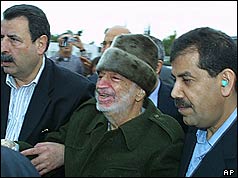
| 2004: Veteran leader Yasser Arafat is dead The veteran Palestinian leader Yasser Arafat has died in hospital in Paris, France, aged 75. The man who led his people's struggle for more than 40 years suffered multiple organ failure at 0330 local time (0230 GMT). He had been in a coma since 3 November and two days ago suffered a brain haemorrhage. He was brought to a military hospital near Paris from Ramallah on the West Bank at the end of last month as his condition deteriorated. The exact nature of his illness remains a mystery, although doctors ruled out cancer and rejected the allegation by Palestinian militant groups that he had been poisoned. Funeral His body was flown this evening to Cairo, Egypt, where his funeral will be held tomorrow, attended by Arab and other leaders. He will be buried in Ramallah on Saturday. In the Palestinian territories news of his death was greeted with open displays of grief. The authorities have declared 40 days of mourning. Tributes came in from around the world. The French President, Jacques Chirac, said the Palestinian leader was "a man of courage and conviction who for 40 years incarnated the Palestinians' fight for recognition of their national rights". The White House simply described the death as a "significant moment in Palestinian history" and offered condolences. The Israeli government, which has long labelled Mr Arafat a terrorist, said his death could be a turning point for peace in the Middle East. Virtual prisoner Mr Arafat spent his last three years held a virtual prisoner by the Israeli authorities in his partially-destroyed compound in Ramallah. Relations between the Palestinian Authority and the Israeli government deteriorated since 2000, when he was blamed by Israel and the United States for the failure of peace talks at Camp David. Mr Arafat always insisted the deal he was offered was less generous than it has since been portrayed. Under the Bush administration, he has been shunned by the United States as complicit in terrorism. Since the 1950s Mr Arafat has been the public face of Palestinian opposition to Israel, first as the leader of Fatah, the Movement for the Liberation of Palestine, and then at the head of the PLO. There is a long-standing question mark over his involvement in attacks by Palestinian guerrillas from various factions. Mr Arafat refused to discuss such attacks, though he always denounced terrorism as a tactic. Then in 1993, he began negotiating with Israel's Prime Minister, Yitzhak Rabin, in secret talks in Oslo. He was awarded the Nobel Peace Prize, along with Mr Rabin and Shimon Perez, after signing the Oslo Accords, seen as a breakthrough towards an independent Palestinian state and a permanent peace with Israel.
| |
| | | Stories From 11 Nov | | ||||||||||||||||
| | ||||||||||||||||||||||
| | | | | | | |
| |||||||
| Search ON THIS DAY by date | | | | |||
| |||||||
| |||||||
 | ^^ back to top |
| Front Page | Years | Themes | Witness | |
| ©MMVIII | News Sources | Privacy & Cookies Policy |




 In Depth: The Death of Arafat