1967: First all-British satellite 'Ariel 3' launched
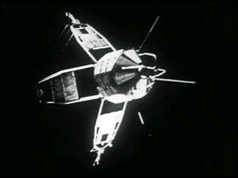
The first ever all-British satellite has been successfully launched into orbit from the United States.
Ariel 3 was propelled into space from Vandenberg Air Force Base in California watched by a team of 40 British scientists and technicians and US Minister of State for the Department of Education Goronwy Roberts.
The satellite's orbit is expected to shift over the next three months to allow it to survey the ionospheric conditions about 60kms (37 miles) above the Earth's surface.
The small satellite has been designed to continue and expand on the previous UK satellite investigations - Ariels 1 and 2 which were built in America.
Ariel 3 was designed, built and tested over four years at the space department of the Royal Aircraft Establishment, Farnborough. British Aircraft Corporation was the main contractor and GEC provided the bulk of the electronics.
It carries five experiments:
- A study of very low frequency radiation from space for Sheffield University;
- Measurement of electron density and temperature in the upper ionosphere for Birmingham University;
- Information on medium-frequency waves from space for Jodrell Bank;
- Measurement of the oxygen found at high altitude for the Meteorological Office;
- Analysis of atmospheric noise over Earth for the Radio and Space Research Station.
The project was the result of close co-operation between the Science Research Council and Nasa which provided the launch facilities and four-stage Scout rocket.
Ariel 3 orbits the Earth every 95 minutes and is expected to relay information back to a computer at Slough's Radio and Space Research Station for at least a year.
 Home
Home





 Space
Space