1956: Gold Coast to get independence
The Gold Coast is to become the first black African nation to be granted independence from Britain.
In a statement to the House of Commons, Colonial Secretary Alan Lennox-Boyd said the Gold Coast will be allowed to govern itself within the Commonwealth provided a general election is held in the country.
|
 |
The new West African state will incorporate the Gold Coast, Ashanti, the Northern Territories and Togoland, which recently voted to integrate with the Gold Coast. He set the target date for independence at 6 March, 1957.
The fledgling state will be named Ghana after an ancient West African kingdom which flourished from 300AD to 1100AD.
Ghana will be the first black African nation to become independent from Britain, but there are fears of internal fighting between various tribes in the region over a new constitution. For this reason, the minister is insisting on elections for a new legislature that will then be asked to approve self-governance.
The finance minister of the Gold Coast, Mr Gbedemah, welcomed Mr Lennox-Boyd's announcement today and in an interview with the BBC made assurances that elections would be held soon.
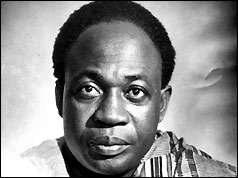
"I know enough to be able to say that the prime minister [Kwame Nkrumah] has been planning that if an election will be the only solution to the present situation then he will go to the country as soon as possible," he said.
The Gold Coast has been a British colony since 1901. After World War I part of the German colony of Togoland was mandated to the British, who linked it administratively with the Gold Coast colony.
In the Gold Coast, nationalist activity intensified after World War II. Kwame Nkrumah of the Convention People's Party (CPP) emerged as the leading nationalist figure.
In 1951, Britain granted a new constitution, which had been drawn up by Africans, and general elections were held. The CPP won and Mr Nkrumah became prime minister.
 Home
Home




 6 March 1957
 Country profile