 Home Home | Explore the BBC |
 | ||
 | 25 January |  |
| ||
| | | | | | | |
| |||||||
| Search ON THIS DAY by date | | |   | |||
| |||||||
| |||||||
|
|
| | | | | | | | ||||||||||||||||||||||||
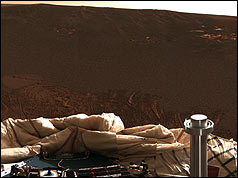
| 2004: Nasa rover looks for water on Mars The second of two Nasa rovers sent to explore Mars has landed on the surface of the planet, where it will look for signs of water. The Opportunity rover touched down at 0505 GMT, on the opposite side of Mars from where its sister rover, Spirit, landed three weeks ago. After a promising start sending back striking colour photographs of the Martian surface, the Spirit rover has run into difficulties and stopped working altogether last week. Space scientists say they are making progress on fixing the probe, but that it could take days or weeks to put right. 'Alien place' After a six-month journey from Earth, the Opportunity landed on a smooth, flat plain in the highest altitude landing ever attempted by Nasa. It sent images back of its landing site showing an unfamiliar, largely featureless landscape except for a conspicuous outcrop of bedrock nearby. "This is a beautiful, alien place, a world unlike any we've seen before," said Professor Steve Squyres, principal payload investigator. He added that Opportunity could have landed in a crater and that the bedrock could be the rim of that crater. The rock has a slab-like form which scientists say could have been created either by volcanic activity or by the action of water. Gentle landing The rover's airbags have made distinctive imprints in the Martian soil, suggesting it may be fine-grained and multi-layered. It is also much darker in colour than the soil at Spirit's Gusev Crater landing site, 10,600 km (6,600 miles) away. Scientists believe the soil is rich in a mineral called grey haematite, usually formed on Earth in the presence of water. Opportunity approached the Martian surface at a speed of 19,000 km/h (12,000 mph). It deployed a parachute to slow its descent and airbags to cushion its landing. Rockets on the lander counteracted light gusts of wind during the descent. Because of this, it touched down with a force of between two and three Gs - an exceptionally gentle landing. The rover was designed to withstand a landing of up to 40 Gs. Nasa will now spend a week unpacking and testing the six-wheeled vehicle.
| |
| | | Stories From 25 Jan
| | ||||||||||||||||||||||||
| | ||||||||||||||||||||||||||||||
| | | | | | | |
| |||||||
| Search ON THIS DAY by date | | | | |||
| |||||||
| |||||||
 | ^^ back to top |
| Front Page | Years | Themes | Witness | |
| ©MMVIII | News Sources | Privacy & Cookies Policy |



 In Depth:
 Space
Space