 Home Home | Explore the BBC |
 | ||
 | 3 February |  |
| ||
| | | | | | | |
| |||||||
| Search ON THIS DAY by date | | |   | |||
| |||||||
| |||||||
|
|
| | | | | | | | ||||||||||||||||||||||||||||
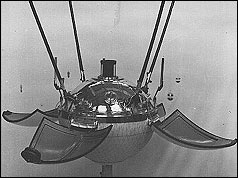
| 1966: Soviets land probe on Moon The Russians have made the first controlled landing of a spacecraft on the Moon.
Luna 9 made its "soft" landing at 2145 Moscow time (1845 GMT). The probe immediately began taking pictures of its surroundings. It is the first time the Moon has been observed at surface level. The area viewed was to the west of the craters of Reiner and Marius in the Ocean of Storms. The Soviet Union has not so far released any of the photographs to the wider world. Firm surface The landing also confirms suggestions from photographs sent back by the American Ranger probes that the Moon's surface is firm, and not covered with a soft layer of dust as some astronomers had thought. The proof that astronauts visiting the Moon will not sink into a dusty quicksand will give added impetus to the race to land the first man on the Moon. The possibility of a Russian man on the moon by 1970 was mentioned by several commentators. In a televised news conference, a Soviet scientist said the surface of the moon appeared to be stony where Luna 9 came down. He said the ground was made of dark, chocolate-coloured porous rock like volcanic rock or lava. 'Historic moment' Sir Bernard Lovell, director of Jodrell Bank, the British radio telescope in Cheshire which has been tracking the Russian rocket, paid tribute to the achievement. "It is an historic moment," he said. "It is the final achievement ... necessary for a manned landing on the Moon." The exact nature of the instruments on board Luna 9 remains secret, although it is thought they would have been able to record temperature, pressure and the nature of the lunar surface. There would also have been radio equipment to send information back to Earth. One of the things it will be measuring is the ability of the Moon's surface to support objects of heavy weight, such as manned spaceships. The methods used to achieve the landing are also the subject of some speculation. It is believed to have used an intricate coordination of retro-rockets to slow down the 3,000lb (1,360 kg) spacecraft from 6,000 mph (9,600 km/h) to six mph (9.65 km/h).
| |
| | | Stories From 3 Feb
| | ||||||||||||||||||||||||||||
| | ||||||||||||||||||||||||||||||||||
| | | | | | | |
| |||||||
| Search ON THIS DAY by date | | | | |||
| |||||||
| |||||||
 | ^^ back to top |
| Front Page | Years | Themes | Witness | |
| ©MMVIII | News Sources | Privacy & Cookies Policy |



 Special report
 Space
Space